
Online Database of Chemicals from Around the World
| Hangzhou Verychem Science And Technology Co., Ltd. | China | |||
|---|---|---|---|---|
 | www.verychem.com | |||
 | +86 (571) 8816-2785 +86 13606544505 | |||
 | +86 (571) 8816-2787 | |||
 | lucy@verychem.com | |||
| Chemical manufacturer since 2004 | ||||
| chemBlink Massive supplier since 2021 | ||||
| Sinocompound Catalysts Co., Ltd. | China | |||
|---|---|---|---|---|
| www.sinocompound.com | |||
| +86 (512) 6721-6630 | |||
| +86 (512) 5631-6689 | |||
| sales@sinocompound.com | |||
| Chemical manufacturer since 2008 | ||||
| chemBlink Standard supplier since 2010 | ||||
| BOC Sciences | USA | |||
|---|---|---|---|---|
| www.bocsci.com | |||
| +1 (631) 485-4226 | |||
| +1 (631) 614-7828 | |||
| info@bocsci.com | |||
| Chemical manufacturer | ||||
| chemBlink Standard supplier since 2010 | ||||
| Intatrade Chemicals GmbH | Germany | |||
|---|---|---|---|---|
| www.intatrade.de | |||
| +49 (3493) 605-465 | |||
| +49 (3493) 605-470 | |||
| sales@intatrade.de | |||
| Chemical distributor | ||||
| chemBlink Standard supplier since 2011 | ||||
| Hangzhou Leap Chem Co., Ltd. | China | |||
|---|---|---|---|---|
| www.leapchem.com | |||
| +86 (571) 8771-1850 | |||
| market19@leapchem.com | |||
 | QQ Chat | |||
| Chemical manufacturer since 2006 | ||||
| chemBlink Standard supplier since 2015 | ||||
| Chempharmsou (Beijing) Technology Co., Ltd. | China | |||
|---|---|---|---|---|
| www.chempharmsou.com | |||
| +86 (10) 5296-7079 | |||
| +86 (10) 5296-7079 | |||
| info@chempharmsou.com | |||
| QQ Chat | |||
| Chemical manufacturer since 2013 | ||||
| chemBlink Standard supplier since 2015 | ||||
| Zhengzhou Kingorgchem Chemical Technology Co., Ltd. | China | |||
|---|---|---|---|---|
| www.kingorgchem.com | |||
| +86 (371) 6551-1006 | |||
| +86 (371) 6575-6965 | |||
| sales@kingorgchem.com | |||
| QQ Chat | |||
 | WeChat: 18625597674 | |||
| Chemical manufacturer since 2015 | ||||
| chemBlink Standard supplier since 2016 | ||||
| Zhengzhou Changkuan Technology Co., Ltd. | China | |||
|---|---|---|---|---|
| www.changkuantech.com | |||
| +86 (371) 6376-9919 +86 18530983798 | |||
| +86 (371) 6360-3986 | |||
| sales5@changkuantech.com | |||
| QQ Chat | |||
| Chemical manufacturer since 2012 | ||||
| chemBlink Standard supplier since 2016 | ||||
| Shanghai Fuxin Pharmaceutical Co., Ltd. | China | |||
|---|---|---|---|---|
| www.fuxinpharm.com | |||
| +86 (21) 3130-0828 +86 18645121291 | |||
| +86 (21) 3130-0828 | |||
| contact@fuxinpharm.com | |||
| Chemical manufacturer since 2016 | ||||
| chemBlink Standard supplier since 2018 | ||||
| Dalchem | Russia | |||
|---|---|---|---|---|
| www.dalchem.com | |||
| +7 (8312) 753-772 | |||
| +7 (8312) 750-799 | |||
| dregichy@dalchem.com | |||
| Chemical manufacturer since 1997 | ||||
| Classification | Organic raw materials >> Hydrocarbon compounds and their derivatives >> Aromatic hydrocarbon |
|---|---|
| Name | BrettPhos |
| Synonyms | Dicyclohexyl[3,6-dimethoxy-2',4',6'-tris(1-methylethyl)[1,1'-biphenyl]-2-yl]phosphine |
| Molecular Structure | 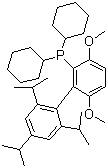 |
| Molecular Formula | C35H53O2P |
| Molecular Weight | 536.77 |
| CAS Registry Number | 1070663-78-3 |
| EC Number | 812-485-3 |
| SMILES | CC(C)C1=CC(=C(C(=C1)C(C)C)C2=C(C=CC(=C2P(C3CCCCC3)C4CCCCC4)OC)OC)C(C)C |
| Melting point | 191-193 °C |
|---|---|
| Hazard Symbols |  GHS07 Warning Details GHS07 Warning Details | ||||||||||||||||||||||||||||
|---|---|---|---|---|---|---|---|---|---|---|---|---|---|---|---|---|---|---|---|---|---|---|---|---|---|---|---|---|---|
| Risk Statements | H302-H315-H319-H335-H412 Details | ||||||||||||||||||||||||||||
| Safety Statements | P261-P264-P270-P271-P273-P280-P301+P312-P302+P352-P304+P340-P305+P351+P338-P312-P330-P332+P313-P337+P313-P362-P403+P233-P405-P501 Details | ||||||||||||||||||||||||||||
| Hazard Classification | |||||||||||||||||||||||||||||
| |||||||||||||||||||||||||||||
| SDS | Available | ||||||||||||||||||||||||||||
 chemBlink Chemical Story
|
BrettPhos, a specialized ligand in coordination chemistry, is notable for its unique role in various catalytic processes. This ligand, whose full chemical name is [2,2'-bis(diphenylphosphino)-1,1'-binaphthyl] (commonly abbreviated as BrettPhos), combines two diphenylphosphino groups with a binaphthyl backbone. This structure provides a chiral environment that is valuable in asymmetric synthesis and catalysis. The discovery of BrettPhos stems from the need for efficient and selective ligands in asymmetric catalysis. Developed as part of a broader effort to enhance catalytic performance in enantioselective reactions, BrettPhos has gained recognition for its effectiveness in promoting a range of chemical transformations. The ligand's design incorporates a binaphthyl framework, which imparts rigidity and chirality, crucial for achieving high levels of stereoselectivity. BrettPhos is particularly valuable in palladium-catalyzed reactions. Palladium, being a versatile metal in catalysis, pairs well with BrettPhos to facilitate various transformations. The ligand's ability to stabilize palladium centers and influence their reactivity makes it suitable for applications in cross-coupling reactions, such as the Suzuki-Miyaura and Buchwald-Hartwig couplings. These reactions are essential for the formation of carbon-carbon bonds, which are fundamental in the synthesis of complex organic molecules. In addition to its role in cross-coupling reactions, BrettPhos is used in asymmetric hydrogenation and other chiral transformations. The ligand's design allows for precise control over the stereochemistry of the products, which is critical in the synthesis of chiral pharmaceuticals and fine chemicals. By providing a chiral environment around the metal center, BrettPhos ensures that reactions proceed with high enantioselectivity, thereby enhancing the efficiency and selectivity of the synthesis. The application of BrettPhos extends beyond organic synthesis to materials science and drug discovery. Its ability to enable selective reactions is leveraged in the development of new materials with specific properties, as well as in the creation of novel pharmaceutical compounds. The ligand's performance in these areas underscores its significance in both academic research and industrial applications. Overall, BrettPhos represents a significant advancement in the field of coordination chemistry. Its development has provided chemists with a powerful tool for asymmetric synthesis and catalysis, offering improved selectivity and efficiency in a variety of chemical processes. As research continues, BrettPhos and similar ligands will likely play an increasingly important role in advancing chemical synthesis and material science. References 2008. Pd/BrettPhos: A Highly Active Catalyst for C-N Cross-Coupling Reactions. Synfacts. DOI: 10.1055/s-0028-1087458 2009. A Versatile Ligand for Suzuki-Miyaura Coupling of Tosylates and Mesylates. Synfacts. DOI: 10.1055/s-0029-1218165 2013. Recent Advances in Transition-Metal-Catalyzed Trifluoromethylation and Related Transformations. Synthesis. DOI: 10.1055/s-0033-1339677 |
| Market Analysis Reports |