
Online Database of Chemicals from Around the World
| Taizhou Crene Biotechnology Co., Ltd. | China | |||
|---|---|---|---|---|
 | www.pharm-intermediates.com | |||
 | +86 (576) 8881-3233 8820-5808 +86 13396860566 | |||
 | +86 (576) 8822-9589 | |||
 | sales@pharm-intermediates.com | |||
 | QQ Chat | |||
| Chemical manufacturer since 2011 | ||||
| chemBlink Standard supplier since 2009 | ||||
| BOC Sciences | USA | |||
|---|---|---|---|---|
| www.bocsci.com | |||
| +1 (631) 485-4226 | |||
| +1 (631) 614-7828 | |||
| info@bocsci.com | |||
| Chemical manufacturer | ||||
| chemBlink Standard supplier since 2010 | ||||
| Shanghai Forever Synthesis Co.,Ltd. | China | |||
|---|---|---|---|---|
| www.foreversyn.com | |||
| +86 (551) 6288-8437 +86 18096409024 | |||
| sales@foreversyn.com sales02@foreversyn.com | |||
| QQ Chat | |||
 | Skype Chat | |||
| Chemical distributor since 2013 | ||||
| chemBlink Standard supplier since 2018 | ||||
| Shanghai Finetech pharm Co., Ltd. | China | |||
|---|---|---|---|---|
| www.finetechpharm.cn | |||
| +86 18221039705 | |||
| ad@finetechpharm.cn | |||
| Chemical manufacturer since 2016 | ||||
| chemBlink Standard supplier since 2026 | ||||
| Cayman Chemical Company | USA | |||
|---|---|---|---|---|
| www.caymanchem.com | |||
| +1 (734) 971-3335 | |||
| +1 (734) 971-3640 | |||
| sales@caymanchem.com | |||
| Chemical manufacturer | ||||
| Dalton Pharma Services | Canada | |||
|---|---|---|---|---|
| www.dalton.com | |||
| +1 (416) 661-2102 | |||
| +1 (416) 661-2108 | |||
| chemist@dalton.com | |||
| Chemical manufacturer | ||||
| Classification | API >> Inhibitor drug |
|---|---|
| Name | (15R)-Bimatoprost |
| Synonyms | (5Z)-7-[(1R,2R,3R,5S)-3,5-Dihydroxy-2-[(1E,3R)-3-hydroxy-5-phenyl-1-penten-1-yl]cyclopentyl]-N-ethyl-5-heptenamide |
| Molecular Structure | 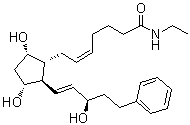 |
| Molecular Formula | C25H37NO4 |
| Molecular Weight | 415.57 |
| CAS Registry Number | 1163135-92-9 |
| EC Number | 810-192-5 |
| SMILES | CCNC(=O)CCC/C=CC[C@H]1[C@H](C[C@H]([C@@H]1/C=C/[C@@H](CCC2=CC=CC=C2)O)O)O |
| Solubility | Practically insoluble (0.04 g/L) (25 °C), Calc.* |
|---|---|
| Density | 1.145±0.06 g/cm3 (20 °C 760 Torr), Calc.* |
| Boiling point | 629.8±55.0 °C 760 mmHg (Calc.)* |
| Flash point | 334.7±31.5 °C (Calc.)* |
| Index of refraction | 1.591 (Calc.)* |
| * | Calculated using Advanced Chemistry Development (ACD/Labs) Software. |
| Hazard Symbols |   GHS07;GHS08 Danger Details GHS07;GHS08 Danger Details |
|---|---|
| Risk Statements | H302-H319-H340-H360 Details |
| Safety Statements | P203-P264-P264+P265-P270-P280-P301+P317-P305+P351+P338-P318-P330-P337+P317-P405-P501 Details |
| SDS | Available |
 chemBlink Chemical Story
|
(15R)-Bimatoprost is a synthetic prostamide analogue structurally related to prostaglandin F2α (PGF2α). It belongs to the class of lipid-derived eicosanoid mimetics designed to interact with prostaglandin receptors and related signaling pathways. Bimatoprost is widely recognized in pharmacological contexts for its use in ophthalmology, where prostaglandin analogues play an important role in regulating intraocular pressure. The development of prostaglandin analogues, including bimatoprost, emerged from research on arachidonic acid metabolism and eicosanoid signaling in the late twentieth century. Prostaglandins are naturally occurring lipid mediators derived from polyunsaturated fatty acids and are involved in numerous physiological processes, including inflammation, smooth muscle tone regulation, and ocular fluid dynamics. Synthetic analogues were developed to improve metabolic stability and receptor selectivity compared with endogenous prostaglandins. Bimatoprost is structurally distinct from classical prostaglandin analogues in that it is classified as a prostamide, meaning it is an amide derivative of a prostaglandin-like structure rather than a simple ester or free acid. The presence of an amide linkage increases metabolic stability and alters receptor interaction profiles. The compound retains a 20-carbon prostanoid backbone, which is characteristic of eicosanoid-derived molecules. The stereochemical designation (15R) indicates the configuration at the 15-position of the prostanoid skeleton. Stereochemistry is critical in prostaglandin biology, as receptor binding and biological activity are highly dependent on the three-dimensional arrangement of hydroxyl and side-chain substituents. Small changes in stereochemistry can significantly alter pharmacological activity and receptor affinity. Bimatoprost and related prostamides act primarily by reducing intraocular pressure, which is a key therapeutic strategy in the management of conditions such as glaucoma and ocular hypertension. These compounds enhance aqueous humor outflow through the uveoscleral pathway, thereby lowering intraocular pressure. This mechanism differs from that of some other anti-glaucoma agents, which may act by reducing aqueous humor production. The discovery of bimatoprost is associated with efforts to develop more stable and effective analogues of prostaglandin F2α. Natural prostaglandins are rapidly metabolized in vivo, limiting their therapeutic utility. Synthetic modification of the prostanoid scaffold, including substitution at key functional groups and stabilization of labile bonds, led to the development of compounds with improved pharmacokinetic properties. From a chemical perspective, bimatoprost contains multiple functional groups, including hydroxyl groups, an amide linkage, and unsaturated carbon–carbon bonds within its long aliphatic chain. This combination of polar and nonpolar regions contributes to its amphiphilic character, which is important for membrane permeability and receptor interaction in biological systems. The prostanoid framework of bimatoprost is derived conceptually from arachidonic acid metabolism via cyclooxygenase-mediated pathways, although synthetic analogues are constructed through chemical synthesis rather than enzymatic biosynthesis. The structural mimicry of endogenous prostaglandins allows these compounds to interact with prostamide and prostaglandin receptors in ocular tissues. In medicinal chemistry, prostaglandin analogues represent a well-established class of small-molecule therapeutics with a strong emphasis on stereochemical control. The biological activity of these compounds depends heavily on maintaining correct stereochemistry at multiple chiral centers along the prostanoid backbone. The (15R) configuration is one of the defining stereochemical features of bimatoprost and is important for its pharmacological profile. Overall, (15R)-bimatoprost is a synthetic prostamide analogue of prostaglandin F2α used in ophthalmic pharmacology. Its significance lies in its role as a metabolically stable prostaglandin-related compound designed to modulate intraocular pressure through effects on aqueous humor outflow, as well as in its contribution to the broader field of prostanoid-based drug development. References 2013. A Novel Convergent Synthesis of the Antiglaucoma PGF2α Analogue Bimatoprost. Chirality. DOI: 10.1002/chir.22123 |
| Market Analysis Reports |