
Online Database of Chemicals from Around the World
| Minakem S.A.S. | France | |||
|---|---|---|---|---|
 | www.minakem.com | |||
 | +33 (3) 2064-6830 | |||
 | +33 (3) 2064-3198 | |||
 | contact@minakem.com | |||
| Chemical manufacturer | ||||
| chemBlink Standard supplier since 2009 | ||||
| BOC Sciences | USA | |||
|---|---|---|---|---|
| www.bocsci.com | |||
| +1 (631) 485-4226 | |||
| +1 (631) 614-7828 | |||
| info@bocsci.com | |||
| Chemical manufacturer | ||||
| chemBlink Standard supplier since 2010 | ||||
| wuhan chemi Pharmacy Chemical Technology Co., Ltd. | China | |||
|---|---|---|---|---|
| www.chemipharm.com.cn | |||
| +86 13971619949 | |||
| gmn424@chemipharm.com.cn | |||
 | QQ Chat | |||
 | WeChat: 13971619949 | |||
| Chemical manufacturer since 2014 | ||||
| chemBlink Standard supplier since 2026 | ||||
| J & W PharmLab LLC | USA | |||
|---|---|---|---|---|
| www.jwpharmlab.com | |||
| +1 (215) 945-6595 | |||
| +1 (215) 945-6597 | |||
| services@jwpharmlab.com | |||
| Chemical manufacturer | ||||
| Anisyn, Inc. | USA | |||
|---|---|---|---|---|
| www.anisyn.com | |||
| +1 (269) 372-8736 | |||
| +1 (269) 372-3397 | |||
| sales@anisyn.com | |||
| Chemical manufacturer | ||||
| Novasep Synthesis | Germany | |||
|---|---|---|---|---|
| www.novasep.com | |||
| +49 (214) 357-491 | |||
| +49 (214) 357-435 | |||
| novasep-synthesis@novasep.com | |||
| Chemical manufacturer | ||||
| Classification | Chemical reagent >> Organic reagent >> Imide |
|---|---|
| Name | 2-(4-Aminophenyl)ethylamine dihydrochloride |
| Synonyms | 4-(2-aminoethyl)aniline;dihydrochloride |
| Molecular Structure | 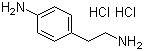 |
| Molecular Formula | C8H12N2.2(HCl) |
| Molecular Weight | 209.12 |
| CAS Registry Number | 13078-82-5 |
| SMILES | C1=CC(=CC=C1CCN)N.Cl.Cl |
| Hazard Symbols |  GHS07 Warning Details GHS07 Warning Details |
|---|---|
| Risk Statements | H302-H315-H319-H350 Details |
| Safety Statements | P280-P305+P351+P338 Details |
| SDS | Available |
 chemBlink Chemical Story
|
2-(4-Aminophenyl)ethylamine dihydrochloride is an organic ammonium salt derived from a substituted phenethylamine framework. The compound consists of a benzene ring bearing a para-positioned amino group and a two-carbon ethylamine side chain terminating in a primary amine. In its dihydrochloride form, both amine functionalities are protonated and associated with chloride counterions, resulting in a stable, highly water-soluble ionic solid. Phenethylamine derivatives have been known since the early development of aromatic organic chemistry in the nineteenth century, when systematic studies of coal-tar-derived compounds and amines led to the identification of many benzene-substituted alkylamines. The phenethylamine scaffold became an important structural motif in both synthetic and applied chemistry due to its accessibility from aromatic precursors and its versatility as a building block for further functionalization. Compounds bearing additional substitution on the aromatic ring, such as para-substituted amino groups, were subsequently explored as intermediates in dye chemistry and later in pharmaceutical and materials-related research. The structure of 2-(4-aminophenyl)ethylamine dihydrochloride reflects a bifunctional amine system. The aromatic amine (para-amino group on the phenyl ring) and the aliphatic primary amine on the ethyl side chain provide two reactive sites with distinct electronic environments. The aromatic amine is influenced by resonance with the benzene ring, which can reduce its basicity relative to aliphatic amines, while the terminal aliphatic amine retains higher nucleophilicity and basicity. This dual amine functionality makes the compound useful as an intermediate in stepwise chemical transformations. The formation of dihydrochloride salts is a common strategy in amine chemistry to improve handling, stability, and solubility in aqueous media. Protonation of both nitrogen atoms leads to a doubly charged cationic species balanced by two chloride ions. This salt form reduces volatility and enhances crystallinity, which is advantageous for purification and storage in laboratory and industrial contexts. Salt formation is also widely used in pharmaceutical and fine chemical development to standardize physical properties of amine-containing compounds. Compounds based on para-aminophenethylamine structures are frequently used as intermediates in organic synthesis. The presence of two amine groups allows for a range of chemical transformations, including acylation, alkylation, diazotization (for the aromatic amine under appropriate conditions), and condensation reactions with carbonyl-containing compounds. These reactions enable incorporation of the scaffold into more complex molecular architectures. Historically, aromatic amines and ethylamine-substituted benzenes have played a significant role in the development of industrial chemistry, particularly in the synthesis of azo dyes and other colorant systems. Para-substituted anilines are especially important in this context because the electronic properties of the amino group strongly activate the aromatic ring toward electrophilic substitution and coupling reactions. While 2-(4-aminophenyl)ethylamine dihydrochloride itself is not primarily known as a dye precursor, it belongs to the same broader chemical family of functionalized aromatic amines used in synthetic chemistry. From a physicochemical perspective, the dihydrochloride salt is expected to exhibit high polarity and strong water solubility due to its ionic nature. The presence of two protonated amine groups leads to strong interactions with polar solvents and hydrogen bonding networks in the solid state. In contrast, the corresponding free base would be significantly less polar and more volatile. The salt form is therefore preferred for practical handling and reaction control. The compound’s reactivity is governed by its two amine functionalities. The aliphatic amine can act as a nucleophile in substitution and condensation reactions, while the aromatic amine can participate in electrophilic aromatic substitution or serve as a precursor to diazonium intermediates under appropriate synthetic conditions. This dual reactivity makes the molecule a flexible intermediate in multi-step synthetic sequences. In modern organic synthesis, substituted phenethylamines are used as structural building blocks for the preparation of more complex nitrogen-containing molecules. Their utility arises from the ease of functional group modification and the presence of a flexible carbon chain connecting the aromatic system to reactive amine sites. Such features are valuable in the construction of ligands, functional materials, and heterocyclic compounds. Overall, 2-(4-aminophenyl)ethylamine dihydrochloride is a bifunctional aromatic–aliphatic diamine salt with significant utility as a synthetic intermediate. Its importance lies in the combination of two chemically distinct amine groups within a single molecule, as well as its enhanced stability and solubility in dihydrochloride form, which facilitate its use in organic synthesis and chemical research. |
| Market Analysis Reports |