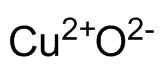
The black oxide on copper and the red oxide associated with the same metal are different compounds. Copper(II) oxide, CuO, contains copper in the +2 oxidation state, whereas copper(I) oxide, Cu2O, contains copper in the +1 state. Their contrasting colors are visible signs of different electronic and crystal structures. CuO, registered as CAS 1317-38-0, is a useful example of how changing oxidation state changes a material even when the constituent elements remain the same.
In nature, CuO occurs as the mineral tenorite. Its ordinary crystal structure is monoclinic, unlike the cubic structure of cuprite, the mineral form of copper(I) oxide. Synthetic CuO can be obtained through oxidation of copper or thermal conversion of suitable copper-containing precursors. Precipitation of a precursor followed by heating offers another route. These methods need not produce identical powders: crystallite size, porosity and exposed surfaces can change with the starting material and thermal history.
A familiar laboratory reaction involves heating a copper(II) hydroxide precipitate to form black CuO and water. The visible change connects a chemical transformation with a change in solid structure. Conversely, CuO can react with acids to form copper(II) salts, or participate in reduction reactions that produce lower oxidation states. The black solid is thus useful for explaining both acid-base behavior of metal oxides and oxidation-reduction chemistry. Neither lesson requires treating every copper oxide as the same substance.
Its semiconductor behavior has made CuO a substantial subject in materials research. It is generally described as a p-type semiconductor, with positive charge carriers associated with its defect chemistry. Light absorption and charge transport depend on the solid's electronic structure, but measured device performance also depends on contacts, interfaces and preparation. Consequently, a reported response from a thin film or a nanowire is a property of that fabricated specimen and measurement arrangement, not a universal specification for any CuO powder.
A comprehensive 2014 review by Qiaobao Zhang and coauthors surveyed CuO nanostructures, their synthesis and their proposed applications. The field includes gas sensing, catalysis, energy storage and optical devices. Nanoscale preparation increases the importance of surfaces and transport distances. A small particle can expose more surface per unit mass, while a porous or wire-like architecture can alter access of gases or electrolytes. Those structural effects help explain why researchers investigate shapes as well as composition.
Gas sensing gives a concrete example. Adsorption at the surface of a semiconducting oxide can modify its electrical behavior, and a device can use that change as a signal. Yet humidity, operating temperature and competing gases can also influence the response. Sensitivity to a target gas is therefore only one requirement; selectivity, recovery and stability are separate questions. Describing CuO as a sensor material identifies a research platform, rather than guaranteeing a ready-made detector.
The distinction between composition and architecture is especially visible here. Two electrodes may contain the same oxide yet differ in electrical connection between particles, access to electrolyte and available space for structural changes during operation.
Energy-storage studies introduce a different challenge. Copper oxide can undergo substantial chemical changes during electrochemical cycling, so electrode architecture and mechanical integrity matter alongside charge storage. A high result for one engineered composite cannot be assigned to unmodified bulk CuO. Across these applications, the compound's appeal is the combination of accessible copper chemistry, a distinctive electronic structure and a surface that can be deliberately engineered. Its simple formula is the beginning of the materials description, rather than the complete account.
References:
1. PubChem. Copper oxide (CuO), CID 164827; CAS 1317-38-0. https://pubchem.ncbi.nlm.nih.gov/compound/164827
2. Handbook of Mineralogy. Tenorite, CuO. Mineral Data Publishing. https://handbookofmineralogy.org/pdfs/tenorite.pdf
3. Zhang Q et al. CuO nanostructures: Synthesis, characterization, growth mechanisms, fundamental properties, and applications. Prog Mater Sci. 2014;60:208-337. DOI: 10.1016/j.pmatsci.2013.09.003. https://doi.org/10.1016/j.pmatsci.2013.09.003
|





 GHS09 Warning Details
 chemBlink Chemical Story