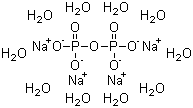
Sodium pyrophosphate decahydrate shows what happens when two phosphate units are joined by a P-O-P bond and then packed into a crystal containing a remarkable amount of water. The common decahydrate is Na4P2O7·10H2O. Its chemistry is not simply that of two independent orthophosphate ions: condensation creates the pyrophosphate anion P2O74-, with different acid-base behavior, metal binding, and reactivity.
The solid structure has been known in detail for decades. In 1957, MacArthur and Beevers reported the crystal structure of sodium pyrophosphate decahydrate. Ten waters per formula unit may sound excessive, but they form part of an extended network around sodium and pyrophosphate ions. The crystal is therefore a useful reminder that water can be a structural building block of an inorganic solid rather than merely liquid trapped between particles.
Pyrophosphate is a condensed phosphate. In chemical terms, it can be imagined as arising when two orthophosphate units lose water and form a P-O-P bridge. That bridge changes the anion's ability to coordinate metal ions. Pyrophosphates can sequester calcium, magnesium, iron, and other cations, which explains their importance in water treatment, detergency, dispersion, and industrial formulations. Binding a metal ion can prevent unwanted precipitation or alter the way particles interact with each other.
The same P-O-P bond has a completely different significance in biology. In many biosynthetic reactions, ATP or another nucleotide triphosphate transfers a group and releases inorganic pyrophosphate, PPi. Cells often hydrolyze PPi to orthophosphate using inorganic pyrophosphatase. Removing PPi pulls the preceding biosynthetic equilibrium forward, making reactions such as nucleic-acid polymerization effectively more favorable. A humble industrial phosphate therefore shares its central anion with one of the mechanisms biology uses to make synthesis directional.
Hydration state again matters quantitatively. The decahydrate contains a large fraction of its mass as water, so it cannot be substituted gram-for-gram for anhydrous tetrasodium pyrophosphate. Heating drives dehydration and can produce other solid forms. Storage, assay, and calculation must therefore refer to the specific hydrate being used.
Sodium pyrophosphate decahydrate is memorable because one oxygen bridge changes the story. Join two phosphates and a new anion appears with stronger metal-binding behavior and a role in biological energy coupling; surround it with ten waters and the solid-state chemistry changes again. It is a compact example of how condensation and hydration can create properties that are not obvious from the starting ions.
References:
1. MacArthur D.M., Beevers C.A. The crystal structure of sodium pyrophosphate decahydrate, Na4P2O7.10H2O. Acta Crystallographica. 1957, 10, 428-432. DOI: 10.1107/S0365110X57001383.
2. ACS Reagent Chemicals. Sodium Pyrophosphate, Decahydrate specifications. DOI: 10.1021/acsreagents.4367.20241202.
3. Standard biochemistry references on inorganic pyrophosphate and pyrophosphatase coupling in biosynthesis.
4. General condensed-phosphate literature on metal sequestration and dispersion.
|







 GHS07 Warning Details
 chemBlink Chemical Story