
Online Database of Chemicals from Around the World
| Nanjing Search Biotech Co., Ltd. | China | |||
|---|---|---|---|---|
 | www.searchbio.com.cn | |||
 | +86 (25) 8168-2922 8586-0978 +86 18913919581 | |||
 | +86 (25) 8586-0962 | |||
 | trade@searchbio.com.cn sales@searchbio.com.cn Linda@searchbio.com.cn | |||
 | QQ Chat | |||
| Chemical manufacturer since 2007 | ||||
| chemBlink Standard supplier since 2007 | ||||
| Hangzhou TJM Chemical Co., Ltd. | China | |||
|---|---|---|---|---|
| www.tjmchem.com | |||
| +86 13388471767 | |||
| +86 (571) 8822-3279 | |||
| sales@tjmchem.com | |||
| Chemical manufacturer | ||||
| chemBlink Standard supplier since 2011 | ||||
| Yuan Shi (SuQian) Biotechnology Co., Ltd. | China | |||
|---|---|---|---|---|
| www.yuanshibio.com | |||
| +86 (527) 8422-6679 | |||
| +86 (527) 8458-0458 | |||
| lee@yuanshibio.com | |||
| Chemical manufacturer | ||||
| chemBlink Standard supplier since 2012 | ||||
| LOBA Feinchemie AG | Austria | |||
|---|---|---|---|---|
| www.loba.co.at | |||
| +43 (223) 277-391 | |||
| +43 (223) 276-677 | |||
| sales@loba.co.at | |||
| Chemical distributor | ||||
| chemBlink Standard supplier since 2012 | ||||
| Hangzhou Leap Chem Co., Ltd. | China | |||
|---|---|---|---|---|
| www.leapchem.com | |||
| +86 (571) 8771-1850 | |||
| market19@leapchem.com | |||
| QQ Chat | |||
| Chemical manufacturer since 2006 | ||||
| chemBlink Standard supplier since 2015 | ||||
| Changchun BC&HC Pharmaceutical Technology Co., Ltd. | China | |||
|---|---|---|---|---|
| www.bchc-china.com | |||
| +86 (431) 8087-1788 8087-1588 +86 15804318207 | |||
| +86 (431) 8841-7879 | |||
| 3468242165@qq.com | |||
| QQ Chat | |||
| Chemical manufacturer since 2014 | ||||
| chemBlink Standard supplier since 2016 | ||||
| Carbosynth China Ltd. | China | |||
|---|---|---|---|---|
| www.carbosynth.cn | |||
| +86 (512) 6260-5585 | |||
| +86 (512) 6260-5576 | |||
| sales@carbosynth.com | |||
| QQ Chat | |||
| Chemical manufacturer since 2006 | ||||
| chemBlink Standard supplier since 2016 | ||||
| HuNan Huibaiyi New Materials Co; Ltd. | China | |||
|---|---|---|---|---|
| www.hbsjxcl.com | |||
| +86 13319523173 | |||
| ivy@hnhbsj.com | |||
| QQ Chat | |||
 | WeChat: 13319523173 | |||
| Chemical manufacturer since 2014 | ||||
| chemBlink Standard supplier since 2026 | ||||
| Luoyang Tiancheng Chemical Reagent Co., Ltd. | China | |||
|---|---|---|---|---|
| www.tcchemical.com | |||
| +86 13851387644 +86 13951399608 | |||
| tc66cn@126.com | |||
| Chemical manufacturer | ||||
| Anisyn, Inc. | USA | |||
|---|---|---|---|---|
| www.anisyn.com | |||
| +1 (269) 372-8736 | |||
| +1 (269) 372-3397 | |||
| sales@anisyn.com | |||
| Chemical manufacturer | ||||
| Classification | Chemical reagent >> Organic reagent >> Aromatic hydrocarbon reagent |
|---|---|
| Name | 3-Hydroxy-2,4,6-tribromobenzoic acid |
| Synonyms | 2,4,6-Tribromo-3-hydroxybenzoic Acid |
| Molecular Structure | 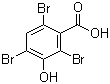 |
| Molecular Formula | C7H3Br3O3 |
| Molecular Weight | 374.81 |
| CAS Registry Number | 14348-40-4 |
| EC Number | 619-514-7 |
| SMILES | C1=C(C(=C(C(=C1Br)O)Br)C(=O)O)Br |
| Density | 2.5±0.1 g/cm3 Calc.* |
|---|---|
| Melting point | 145 - 148 °C (Expl.) |
| Boiling point | 355.3±42.0 °C 760 mmHg (Calc.)* |
| Flash point | 168.7±27.9 °C (Calc.)* |
| Solubility | DMSO: 39mg/mL (Expl.) |
| Index of refraction | 1.709 (Calc.)* |
| * | Calculated using Advanced Chemistry Development (ACD/Labs) Software. |
| Hazard Symbols |  GHS07 Warning Details GHS07 Warning Details | ||||||||||||||||||||||||||||
|---|---|---|---|---|---|---|---|---|---|---|---|---|---|---|---|---|---|---|---|---|---|---|---|---|---|---|---|---|---|
| Risk Statements | H302-H312-H315-H319-H332-H335 Details | ||||||||||||||||||||||||||||
| Safety Statements | P261-P264-P264+P265-P270-P271-P280-P301+P317-P302+P352-P304+P340-P305+P351+P338-P317-P319-P321-P330-P332+P317-P337+P317-P362+P364-P403+P233-P405-P501 Details | ||||||||||||||||||||||||||||
| Hazard Classification | |||||||||||||||||||||||||||||
| |||||||||||||||||||||||||||||
| SDS | Available | ||||||||||||||||||||||||||||
 chemBlink Chemical Story
|
3-Hydroxy-2,4,6-tribromobenzoic acid is a halogenated aromatic carboxylic acid derived from benzoic acid, in which three hydrogen atoms on the benzene ring are substituted by bromine atoms and one hydrogen is substituted by a hydroxyl group. The molecule combines strong electron-withdrawing halogen substitution with a phenolic hydroxyl group and a carboxylic acid functionality, producing a highly substituted and electronically distinctive aromatic system. The core of the molecule is a benzoic acid framework, consisting of a benzene ring bearing a carboxylic acid group (–COOH). The carboxylic acid group is a strongly polar functional group that can donate and accept hydrogen bonds and can also ionize to form carboxylate salts depending on pH. This group is the primary acidic site of the molecule and plays a major role in its chemical reactivity and intermolecular interactions. At the 3-position of the aromatic ring is a hydroxyl group (–OH), making this compound a hydroxybenzoic acid derivative. The hydroxyl group is phenolic in nature and can act as both a hydrogen-bond donor and acceptor. It also contributes to intramolecular and intermolecular hydrogen bonding, depending on the molecular conformation and environment. At the 2-, 4-, and 6-positions, the benzene ring is substituted with bromine atoms, giving a tribrominated aromatic system. Bromine is a large, highly polarizable halogen substituent that exerts a strong inductive electron-withdrawing effect on the aromatic ring. The presence of three bromine atoms significantly increases molecular weight and polarizability while reducing overall electron density on the ring. These substituents also increase hydrophobic character despite the presence of polar functional groups. The substitution pattern places bulky bromine atoms adjacent to both the hydroxyl and carboxylic acid groups. This can influence steric hindrance around the functional groups and affect their orientation relative to the aromatic plane. In some cases, such substitution patterns can promote intramolecular hydrogen bonding between the hydroxyl group and the carboxylic acid group, depending on spatial arrangement. From a structural perspective, the molecule is planar in its aromatic core, as benzene derivatives typically maintain planarity to preserve aromatic conjugation. However, steric interactions from the three bromine substituents may slightly distort bond angles or influence torsional preferences of substituent groups. Physicochemically, 3-hydroxy-2,4,6-tribromobenzoic acid is expected to exhibit mixed polarity characteristics. The carboxylic acid and hydroxyl groups contribute hydrophilicity and hydrogen-bonding capacity, while the heavy bromine substitution contributes strong hydrophobic and lipophilic character. The overall molecule therefore contains both polar functional sites and a highly halogenated aromatic surface. The carboxylic acid group is the most chemically reactive site under typical conditions. It can undergo deprotonation to form carboxylate salts or participate in esterification and amide formation reactions. The phenolic hydroxyl group can undergo etherification or oxidation under appropriate conditions. The aromatic ring, although deactivated by strong electron-withdrawing substituents such as bromine and the carboxyl group, may still participate in substitution reactions under sufficiently strong conditions. The bromine substituents are generally stable under standard conditions but can serve as potential synthetic handles in cross-coupling chemistry, where carbon–bromine bonds are used in metal-catalyzed bond-forming reactions. However, such reactivity depends on specific reaction conditions and catalytic systems. Overall, 3-hydroxy-2,4,6-tribromobenzoic acid is a highly substituted aromatic carboxylic acid featuring a phenolic hydroxyl group and three bromine atoms on a benzoic acid scaffold. Its structure is dominated by strong halogen substitution and polar functional groups, resulting in a chemically stable but electronically highly modified aromatic system with distinct steric and electronic characteristics. References 2025. Activity assays for flavoprotein oxidases: an overview. Applied Microbiology and Biotechnology. DOI: 10.1007/s00253-025-13494-2 2025. Investigating the photolytic degradation of novel monomeric and polymeric brominated flame retardants: analytical characterization, acute ecotoxicological effects and influence of sample storage. Environmental Sciences Europe. DOI: 10.1186/s12302-025-01083-z 2024. Development of hepatocellular carcinoma organoid model recapitulating HIF-1A metabolic signature. Clinical and Experimental Medicine. DOI: 10.1007/s10238-024-01521-x |
| Market Analysis Reports |