
Online Database of Chemicals from Around the World
| Changzhou Ditong Chemical Co., Ltd. | China | |||
|---|---|---|---|---|
 | www.edengenechem.com | |||
 | +86 (519) 8829-8848 +86 18118010980 | |||
 | info@edengenechem.com sale@edengenechem.com | |||
 | QQ Chat | |||
 | WeChat: 18118010980 | |||
| Chemical manufacturer since 2006 | ||||
| chemBlink Premium supplier since 2026 | ||||

| Hangzhou Verychem Science And Technology Co., Ltd. | China | |||
|---|---|---|---|---|
| www.verychem.com | |||
| +86 (571) 8816-2785 +86 13606544505 | |||
 | +86 (571) 8816-2787 | |||
| lucy@verychem.com | |||
| Chemical manufacturer since 2004 | ||||
| chemBlink Massive supplier since 2021 | ||||
| Classification | Biochemical >> Nucleoside drugs >> Deoxynucleotides and their analogues |
|---|---|
| Name | Ac-dC Phosphoramidite |
| Synonyms | N-Acetyl-5'-O-[bis(4-methoxyphenyl)phenylmethyl]-2'-deoxy-3'-[2-cyanoethyl-N,N-bis(1-methylethyl)phosphoramidite]cytidine |
| Molecular Structure | 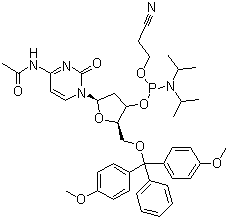 |
| Molecular Formula | C41H50N5O8P |
| Molecular Weight | 771.84 |
| CAS Registry Number | 154110-40-4 |
| SMILES | CC(C)N(C(C)C)P(OCCC#N)O[C@@H]1C[C@H](O[C@H]1COC(C2=CC=CC=C2)(C3=CC=C(C=C3)OC)C4=CC=C(C=C4)OC)N5C=CC(=NC5=O)NC(=O)C |
| Hazard Symbols |  GHS07 Warning Details GHS07 Warning Details |
|---|---|
| Risk Statements | H315-H319 Details |
| Safety Statements | P264-P280-P302+P352-P337+P313-P305+P351+P338-P362+P364-P332+P313 Details |
| SDS | Available |
 chemBlink Chemical Story
|
Ac-dC phosphoramidite is a protected nucleoside phosphoramidite building block used in the chemical synthesis of DNA oligonucleotides. It is a derivative of 2'-deoxycytidine (dC) in which the reactive functional groups of the nucleoside are selectively protected and the 3'-hydroxyl group is converted into a phosphoramidite functionality suitable for automated solid-phase DNA synthesis. The molecular framework of Ac-dC phosphoramidite is based on 2'-deoxycytidine, one of the four naturally occurring deoxyribonucleosides found in DNA. The molecule consists of a cytosine nucleobase linked through a β-N-glycosidic bond to a 2-deoxyribose sugar. The sugar component contains a five-membered furanose ring, while the cytosine base contains a six-membered pyrimidine ring with nitrogen atoms incorporated into the heterocyclic system. The cytosine nucleobase contains an exocyclic amino group at the 4-position that is chemically reactive during oligonucleotide synthesis. In Ac-dC phosphoramidite, this amino group is protected by an acetyl (Ac) group, forming an N4-acetylcytosine derivative. The acetyl protecting group converts the amino functionality into an amide, reducing its nucleophilicity and preventing unwanted side reactions during phosphoramidite coupling cycles. The acetyl group consists of a carbonyl carbon attached to a methyl group. The carbonyl carbon is sp2-hybridized and participates in resonance with the nitrogen atom of the protected amino group. This resonance stabilization reduces the reactivity of the nitrogen while allowing the protecting group to be removed under appropriate deprotection conditions after oligonucleotide assembly. The 5'-hydroxyl group of the deoxyribose sugar is typically protected with a 4,4'-dimethoxytrityl (DMTr) group in standard Ac-dC phosphoramidite reagents. The bulky DMTr group prevents undesired reactions at the 5'-position during chain elongation and can be selectively removed under mild acidic conditions at each synthesis cycle to expose the hydroxyl group for the next nucleotide addition. The 3'-hydroxyl group is transformed into a phosphoramidite functional group. This phosphorus(III)-containing moiety is the key reactive component in automated DNA synthesis. The phosphorus atom is bonded to the nucleoside oxygen, a 2-cyanoethyl group, and a diisopropylamino group. The trivalent phosphorus center is highly reactive toward nucleophilic attack after activation by acidic activators such as tetrazole derivatives. During DNA synthesis, the activated phosphoramidite reacts with the free 5'-hydroxyl group of the growing oligonucleotide chain. This coupling reaction forms a phosphite triester linkage between adjacent nucleosides. The phosphorus center is subsequently oxidized from phosphorus(III) to phosphorus(V), producing the stable phosphate backbone characteristic of DNA. The 2-cyanoethyl substituent attached to phosphorus functions as a phosphate protecting group. It prevents unwanted reactions involving the phosphate during synthesis and is removed during the final basic deprotection step by β-elimination. From a physicochemical perspective, Ac-dC phosphoramidite contains both polar and hydrophobic structural elements. The nucleoside portion contains multiple heteroatoms capable of hydrogen bonding, while the DMTr protecting group and acetyl group introduce aromatic and carbonyl-containing regions that influence solubility in organic solvents used during synthesis. Chemically, the phosphoramidite group is the most moisture-sensitive part of the molecule. Exposure to water leads to hydrolysis of the phosphorus(III) center, producing inactive phosphate derivatives. Therefore, these reagents are handled and stored under anhydrous conditions. The protected cytidine derivative demonstrates the principle of orthogonal protecting group chemistry, in which different functional groups are temporarily masked and selectively removed at specific stages. This allows precise sequential assembly of DNA strands with controlled nucleotide order. Overall, Ac-dC phosphoramidite is a protected 2'-deoxycytidine derivative designed for automated oligonucleotide synthesis. Its acetyl-protected nucleobase, protected 5'-hydroxyl group, and reactive 3'-phosphoramidite functionality enable efficient and controlled incorporation of cytosine residues into synthetic DNA molecules. |
| Market Analysis Reports |