
Online Database of Chemicals from Around the World
| Neostar United (Changzhou) Industrial Co., Ltd. | China | |||
|---|---|---|---|---|
 | www.neostarunited.com | |||
 | +86 (519) 8555-7386 +86 18015025600 | |||
 | +86 (519) 8555-7389 | |||
 | marketing1@neostarunited.com | |||
| Chemical distributor since 2014 | ||||
| chemBlink Standard supplier since 2020 | ||||
| wuhan chemi Pharmacy Chemical Technology Co., Ltd. | China | |||
|---|---|---|---|---|
| www.chemipharm.com.cn | |||
| +86 13971619949 | |||
| gmn424@chemipharm.com.cn | |||
 | QQ Chat | |||
 | WeChat: 13971619949 | |||
| Chemical manufacturer since 2014 | ||||
| chemBlink Standard supplier since 2026 | ||||
| Rintech, Inc. | USA | |||
|---|---|---|---|---|
| www.rintechinc.com | |||
| +1 (301) 987-1980 | |||
| +1 (301) 987-1981 | |||
| info@rintechinc.com | |||
| Chemical manufacturer since 1997 | ||||
| Classification | Pharmaceutical intermediate >> Heterocyclic compound intermediate >> Pyrimidine compound >> Chloropyrimidine |
|---|---|
| Name | 2-Chloro-4-methyl-5-pyrimidinecarboxylic acid ethyl ester |
| Synonyms | ethyl 2-chloro-4-methylpyrimidine-5-carboxylate |
| Molecular Structure | 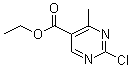 |
| Molecular Formula | C8H9ClN2O2 |
| Molecular Weight | 200.62 |
| CAS Registry Number | 188781-08-0 |
| EC Number | 692-873-5 |
| SMILES | CCOC(=O)C1=CN=C(N=C1C)Cl |
| Density | 1.3±0.1 g/cm3 Calc.* |
|---|---|
| Boiling point | 302.7±22.0 °C 760 mmHg (Calc.)* |
| Flash point | 136.9±22.3 °C (Calc.)* |
| Index of refraction | 1.525 (Calc.)* |
| * | Calculated using Advanced Chemistry Development (ACD/Labs) Software. |
| Hazard Symbols |  GHS07 Warning Details GHS07 Warning Details | ||||||||||||||||||||||||||||||||
|---|---|---|---|---|---|---|---|---|---|---|---|---|---|---|---|---|---|---|---|---|---|---|---|---|---|---|---|---|---|---|---|---|---|
| Risk Statements | H302-H312-H315-H319-H332-H335 Details | ||||||||||||||||||||||||||||||||
| Safety Statements | P261-P264-P264+P265-P270-P271-P280-P301+P317-P302+P352-P304+P340-P305+P351+P338-P317-P319-P321-P330-P332+P317-P337+P317-P362+P364-P403+P233-P405-P501 Details | ||||||||||||||||||||||||||||||||
| Hazard Classification | |||||||||||||||||||||||||||||||||
| |||||||||||||||||||||||||||||||||
| SDS | Available | ||||||||||||||||||||||||||||||||
 chemBlink Chemical Story
|
2-Chloro-4-methyl-5-pyrimidinecarboxylic acid ethyl ester is a substituted pyrimidine derivative bearing a chloro substituent at the 2-position, a methyl group at the 4-position, and an ethyl ester of a carboxylic acid at the 5-position of the pyrimidine ring. Pyrimidine is a six-membered aromatic heterocycle containing two nitrogen atoms at the 1 and 3 positions, and it represents a fundamental scaffold in many biologically relevant molecules, including nucleic acid bases and a wide range of synthetic pharmaceuticals and agrochemicals. The chemistry of functionalized pyrimidines has been extensively developed in heterocyclic chemistry due to the strong influence of ring nitrogen atoms on electronic structure and reactivity. Pyrimidines are electron-deficient aromatic systems, which makes them particularly susceptible to nucleophilic aromatic substitution when activated by electron-withdrawing substituents or leaving groups such as halogens. In this compound, the chlorine atom at the 2-position serves as a key leaving group, enabling substitution reactions that are widely used in synthetic organic chemistry. The presence of a methyl group at the 4-position introduces a mild electron-donating effect through hyperconjugation and inductive influence. This substituent slightly modifies the electronic distribution of the pyrimidine ring but does not significantly disrupt its overall electron-deficient character. The balance between electron-withdrawing and electron-donating substituents plays an important role in tuning the reactivity of the heterocycle in subsequent transformations. The ethyl carboxylate group at the 5-position is an ester functionality derived from a carboxylic acid. Ester groups are commonly used in synthetic chemistry both as functional intermediates and as protecting groups for carboxylic acids. In heterocyclic systems, ester substituents can be hydrolyzed under acidic or basic conditions to yield the corresponding carboxylic acid, which can then undergo further derivatization such as amide formation or coupling reactions. Pyrimidine derivatives bearing halogen and ester substituents are widely used as versatile intermediates in organic synthesis. The combination of a reactive chloro substituent and an ester group allows for stepwise functionalization, enabling the construction of more complex heterocyclic frameworks. Such compounds are often used in the synthesis of biologically active molecules, where controlled substitution patterns on the pyrimidine ring are required to achieve desired activity profiles. The reactivity of the 2-chloro substituent is enhanced by the presence of adjacent nitrogen atoms in the pyrimidine ring, which stabilize the intermediate anionic species formed during nucleophilic aromatic substitution reactions. This facilitates displacement of chloride by nucleophiles such as amines, alkoxides, or thiols, leading to a wide range of substituted pyrimidine derivatives. From a physicochemical standpoint, 2-chloro-4-methyl-5-pyrimidinecarboxylic acid ethyl ester is expected to be a moderately polar organic compound. The pyrimidine ring contributes polarity due to its nitrogen atoms, while the ester group adds additional dipolar character. The chloro and methyl substituents modulate hydrophobicity, resulting in a balance of lipophilic and polar properties that influence solubility in organic solvents. The compound is typically handled as a synthetic intermediate rather than a final end-use product. In medicinal chemistry and agrochemical research, such multifunctional heterocycles serve as key building blocks for library synthesis, where systematic substitution of functional groups is used to explore structure–activity relationships. The synthesis of substituted pyrimidine esters generally involves cyclization strategies or stepwise functionalization of preformed heterocycles. Common approaches include condensation reactions of amidine or guanidine derivatives with β-dicarbonyl compounds, followed by selective halogenation or esterification to introduce desired substituents. Alternatively, halopyrimidine intermediates can be further elaborated through nucleophilic substitution and carboxylation strategies. Overall, 2-chloro-4-methyl-5-pyrimidinecarboxylic acid ethyl ester is a multifunctional pyrimidine derivative characterized by a reactive chloro substituent, a methyl group, and an ester functionality on an electron-deficient heteroaromatic ring. Its significance lies in its role as a versatile intermediate in heterocyclic chemistry, enabling the synthesis of more complex pyrimidine-based compounds through controlled nucleophilic substitution and functional group transformation strategies. References 2011. Facile transformation of Biginelli pyrimidin-2(1H)-ones to pyrimidines. In vitro evaluation as inhibitors of Mycobacterium tuberculosis and modulators of cytostatic activity. European Journal of Medicinal Chemistry. DOI: 10.1016/j.ejmech.2011.03.010 |
| Market Analysis Reports |