
Online Database of Chemicals from Around the World
| Alway Chem, China | China | |||
|---|---|---|---|---|
 | www.alwaychem.net | |||
 | +86 (532) 8586-4000 | |||
 | +86 (532) 8589-3133 | |||
 | alwaychem@gmail.com alwaychem@hotmail.com | |||
| Chemical manufacturer | ||||
| chemBlink Standard supplier since 2006 | ||||
| Zhejiang Esun Chemical Co., Ltd. | China | |||
|---|---|---|---|---|
| www.esunchem.com | |||
| +86 (571) 5628-6531 | |||
| +86 (571) 5628-7608 | |||
| esunchem@gmail.com | |||
| Chemical manufacturer | ||||
| chemBlink Standard supplier since 2007 | ||||
| Hefei TNJ Chemical Industry Co., Ltd. | China | |||
|---|---|---|---|---|
| www.tnjchem.com | |||
| +86 (551) 6541-8684 | |||
| +86 (551) 6541-8697 | |||
| sales@tnjchem.com | |||
| Chemical manufacturer since 2001 | ||||
| chemBlink Standard supplier since 2010 | ||||
| BOC Sciences | USA | |||
|---|---|---|---|---|
| www.bocsci.com | |||
| +1 (631) 485-4226 | |||
| +1 (631) 614-7828 | |||
| info@bocsci.com | |||
| Chemical manufacturer | ||||
| chemBlink Standard supplier since 2010 | ||||
| Yancheng Jiangzhong Chemicals Co., Ltd. | China | |||
|---|---|---|---|---|
| www.chinajzchemicals.com | |||
| +86 (515) 8898-1987 +86 13365196093 +8613918567443 | |||
| +86 (515) 8839-6093 | |||
| richard.li_jzchem@263.net | |||
 | QQ Chat | |||
| Chemical manufacturer since 1989 | ||||
| chemBlink Standard supplier since 2011 | ||||
| Chengdu Laurelsci Technology Co., Ltd. | China | |||
|---|---|---|---|---|
| www.laurelsci.com | |||
| +86 (28) 8798-3001 +86 18380459909 | |||
| +86 (28) 8610-2331 | |||
| sales@laurelsci.com | |||
| QQ Chat | |||
| Chemical manufacturer since 2012 | ||||
| chemBlink Standard supplier since 2014 | ||||
| Labseeker Inc | USA | |||
|---|---|---|---|---|
| www.labseeker.com | |||
| +1 (858) 750-1632 | |||
| +1 (858) 412-1220 | |||
| marketing@labseeker.com | |||
| Chemical manufacturer since 2002 | ||||
| chemBlink Standard supplier since 2015 | ||||
| Hangzhou Leap Chem Co., Ltd. | China | |||
|---|---|---|---|---|
| www.leapchem.com | |||
| +86 (571) 8771-1850 | |||
| market19@leapchem.com | |||
| QQ Chat | |||
| Chemical manufacturer since 2006 | ||||
| chemBlink Standard supplier since 2015 | ||||
| Koffee Pharm Co., Ltd. | China | |||
|---|---|---|---|---|
| www.koffeepharm.com | |||
| +86 (21) 6172-9394 | |||
| +86 (21) 6172-9329 | |||
| sales01@koffeepharm.com | |||
| Chemical manufacturer since 1999 | ||||
| chemBlink Standard supplier since 2015 | ||||
| Vedi Care Health | India | |||
|---|---|---|---|---|
| vedicarehealth.com | |||
| 8664220509 | |||
| vedicarehealth1@gmail.com | |||
| Chemical distributor since 2023 | ||||
| chemBlink Standard supplier since 2024 | ||||
| Sun Bed Booster Tapentadol Store | USA | |||
|---|---|---|---|---|
| www.sunbedbooster.com | |||
| +1 (811) 020-0001 | |||
| sunbooster1@gmail.com | |||
| Chemical distributor since 2018 | ||||
| chemBlink Standard supplier since 2024 | ||||
| Iyrin Health Care | India | |||
|---|---|---|---|---|
| iyrinhealth.com | |||
| +1 (480) 770-0630 | |||
| iyrinhealthcare@gmail.com | |||
| Chemical distributor since 2024 | ||||
| chemBlink Standard supplier since 2024 | ||||
| Secure HEalth Mart | USA | |||
|---|---|---|---|---|
| www.securehealthmart.com | |||
| +1 8110200001 | |||
| sunbedbooster@proton.me | |||
| Chemical distributor since 2019 | ||||
| chemBlink Standard supplier since 2026 | ||||
| Shineme Chemfar Co., Ltd. | China | |||
|---|---|---|---|---|
| www.chemfar.com | |||
| +86 (731) 8471-8061 | |||
| +86 (731) 8471-6269 | |||
| sales@chemfar.com | |||
| Chemical manufacturer since 1996 | ||||
| Santa Cruz Biotechnology, Inc. | USA | |||
|---|---|---|---|---|
| www.scbt.com | |||
| +1 (831) 457-3800 | |||
| +1 (831) 457-3801 | |||
| scbt@scbt.com | |||
| Chemical manufacturer | ||||
| Classification | Biochemical >> Inhibitor >> Metabolism >> PDE inhibitor |
|---|---|
| Name | Vardenafil |
| Synonyms | 2-[2-Ethoxy-5-(4-ethylpiperazin-1-yl-1-sulfonyl)phenyl]-5-methyl-7-propyl-3H-imidazo[5,1-f][1,2,4]triazin-4-one; Nuviva |
| Molecular Structure | 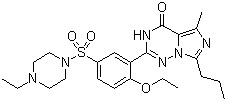 |
| Molecular Formula | C23H32N6O4S |
| Molecular Weight | 488.60 |
| CAS Registry Number | 224785-90-4 |
| EC Number | 607-088-5 |
| SMILES | CCCC1=NC(=C2N1N=C(NC2=O)C3=C(C=CC(=C3)S(=O)(=O)N4CCN(CC4)CC)OCC)C |
| Solubility | 10 mM (DMSO) |
|---|---|
| Density | 1.37 |
| Hazard Symbols |    GHS05;GHS08;GHS09 Danger Details GHS05;GHS08;GHS09 Danger Details | ||||||||||||||||
|---|---|---|---|---|---|---|---|---|---|---|---|---|---|---|---|---|---|
| Risk Statements | H301-H373-H410 Details | ||||||||||||||||
| Safety Statements | P273-P301+P310 Details | ||||||||||||||||
| Hazard Classification | |||||||||||||||||
| |||||||||||||||||
| SDS | Available | ||||||||||||||||
 chemBlink Chemical Story
|
Discovered by pharmaceutical researchers in the late 20th century, vardenafil belongs to a class of drugs known as phosphodiesterase type 5 (PDE5) inhibitors. Its mechanism of action involves inhibition of PDE5, an enzyme that regulates penile blood flow. By blocking PDE5, vardenafil promotes relaxation of the smooth muscle tissue of the penile arteries, thereby increasing blood flow and achieving and maintaining an erection. Vardenafil is notable for its rapid onset of action and long duration of effect. Compared to other PDE5 inhibitors, vardenafil has a faster onset of action, with effects typically felt within 30 to 60 minutes of ingestion. In addition, vardenafil has a longer duration of action, up to 5 hours, making sexual activity more flexible and spontaneous. The efficacy of vardenafil in treating ED has been demonstrated in many clinical studies and real-world applications. Whether used on an as-needed basis or as a daily regimen, vardenafil significantly improves erectile function, intercourse satisfaction, and overall satisfaction in men with ED of various etiologies, including organic, psychogenic, and mixed. Vardenafil has several advantages over other PDE5 inhibitors, including a favorable safety and tolerability profile. Clinical trials have shown that vardenafil is well tolerated, with a low incidence of adverse reactions, including headache, hot flashes, and gastrointestinal discomfort. In addition, vardenafil has been shown to be effective in men with comorbidities, such as diabetes, hypertension, and cardiovascular disease, making it a suitable treatment option for a wide range of patients. In addition to its primary indication of ED, vardenafil is also used for other conditions. Preliminary studies suggest that vardenafil may be effective in treating premature ejaculation (PE), a common sexual dysfunction characterized by uncontrollable ejaculation before or shortly after intercourse. By delaying ejaculation and prolonging sexual activity, vardenafil may provide relief for patients and their partners. Vardenafil has been studied for the treatment of other urological and non-urological conditions. Studies have shown that vardenafil may improve urinary symptoms in patients with benign prostatic hyperplasia (BPH), a common age-related condition characterized by an enlarged prostate. Additionally, vardenafil's vasodilatory effects may treat conditions such as pulmonary arterial hypertension (PAH) and Raynaud's phenomenon, although further studies are needed to confirm its efficacy in these areas. References 2021. Vardenafil in the Treatment of Male Erectile Dysfunction: A Systematic Review and Meta-Analysis. *Advances in Therapy*, 38(2). DOI: 10.1007/s12325-020-01559-9 2018. Development and single dose clinical pharmacokinetics investigation of novel zein assisted-alpha lipoic acid nanoencapsulation of vardenafil. *Scientific Reports*, 8(1). DOI: 10.1038/s41598-018-34235-8 2005. Vardenafil for the Treatment of Erectile Dysfunction: A Critical Review of the Literature Based on Personal Clinical Experience. *European Urology*, 47(5). DOI: 10.1016/j.eururo.2005.01.007 |
| Market Analysis Reports |