
Online Database of Chemicals from Around the World
| Synasia Inc | USA | |||
|---|---|---|---|---|
 | www.synasia.com | |||
 | +1 (732) 205-9880 | |||
 | +1 (732) 205-1788 | |||
 | info@synasia.com | |||
| Chemical manufacturer | ||||
| chemBlink Standard supplier since 2011 | ||||
| Jiangsu Fuyuan New Material Co., Ltd. | China | |||
|---|---|---|---|---|
| www.js-fuyuan.com | |||
| +86 (25) 8436-4996 | |||
| info@jsfuyuanchem.com | |||
| Chemical distributor since 2016 | ||||
| chemBlink Standard supplier since 2026 | ||||
| Classification | Catalysts and additives >> Polymer |
|---|---|
| Name | Perfluoroethylene propylene copolymer |
| Synonyms | Hexafluoropropene tetrafluoroethylene polymer |
| Molecular Structure | 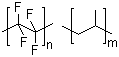 |
| Molecular Formula | (C2F4)n.(C3H6)m |
| CAS Registry Number | 25067-11-2 |
| EC Number | 607-524-4 |
| Density | 2.2g/mL (Expl.) |
|---|---|
 chemBlink Chemical Story
|
Perfluoroethylene propylene copolymer, CAS 25067-11-2, is better known as fluorinated ethylene propylene, or FEP. Despite the older name suggesting “ethylene” and “propylene,” FEP is a fully fluorinated random copolymer made principally from tetrafluoroethylene (TFE) and hexafluoropropylene (HFP). The HFP comonomer introduces CF3-bearing units into the otherwise PTFE-like chain, disrupting crystallinity enough to make the polymer melt-processable. That distinction is historically important. Polytetrafluoroethylene has exceptional chemical resistance and a very low-friction surface, but its extraordinarily high melt viscosity prevents conventional melt extrusion. FEP was developed to retain much of the fluorocarbon character of PTFE while allowing processing from the melt. Commercial FEP is produced by free-radical addition polymerization of TFE and HFP, commonly in aqueous systems, followed by recovery, drying and melt fabrication. The carbon-fluorine-rich backbone gives FEP its characteristic combination of chemical inertness, weather resistance, electrical insulation and low surface energy. The HFP units lower crystallinity and melting behavior relative to PTFE, enabling extrusion into wire insulation, tubing, films and other shapes. This combination is especially valuable where a component must tolerate aggressive chemicals or elevated temperatures while also being fabricated by conventional thermoplastic methods. FEP is also optically useful in thin films and is available commercially as clear film, sheet, tubing and molded stock. Its dielectric properties and chemical resistance support electrical and laboratory applications, while its non-stick surface is useful where adhesion or contamination must be minimized. The polymer illustrates a classic strategy in materials chemistry: modify an outstanding but difficult-to-process polymer just enough to make manufacturing practical. HFP units interrupt the regular TFE sequence, sacrificing some crystallinity but gaining melt processability. FEP therefore occupies the space between molecular design and manufacturing design: the comonomer changes not merely a laboratory property, but the way the material can be turned into useful objects. References: 1. SEMI, PFAS Explainer: FEP, CAS 25067-11-2. 2. Ebnesajjad S. Fluorinated Ethylene Propylene. Applied Plastics Engineering Handbook. 2nd ed. 2017. 3. Sigma-Aldrich, Fluorinated Ethylene Propylene Copolymer, CAS 25067-11-2. |
| Market Analysis Reports |