
Online Database of Chemicals from Around the World
| Chengdu Herbpurify Co., Ltd. | China | |||
|---|---|---|---|---|
 | www.scstandards.com | |||
 | +86 028 8265-1368 | |||
 | 2851037747@qq.com | |||
 | QQ Chat | |||
 | WeChat: 18981950076 | |||
| Chemical manufacturer since 2019 | ||||
| chemBlink Standard supplier since 2026 | ||||
| Classification | Natural product >> Terpenes |
|---|---|
| Name | 3,26-Dihydroxylanosta-8,24-dien-7-one |
| Synonyms | Ganoderon B; Lucidadiol |
| Molecular Structure | 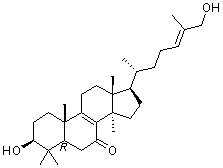 |
| Molecular Formula | C30H48O3 |
| Molecular Weight | 456.70 |
| CAS Registry Number | 252351-95-4 |
| SMILES | C[C@H](CC/C=C(C)/CO)[C@H]1CC[C@@]2([C@@]1(CCC3=C2C(=O)C[C@@H]4[C@@]3(CC[C@@H](C4(C)C)O)C)C)C |
| Solubility | Insoluble (2.3E-4 g/L) (25 °C), Calc.* |
|---|---|
| Density | 1.07±0.1 g/cm3 (20 °C 760 Torr), Calc.* |
| Melting point | 163-165 °C** |
| Boiling point | 569.8±50.0 °C 760 mmHg (Calc.)* |
| Flash point | 312.4±26.6 °C (Calc.)* |
| Index of refraction | 1.547 (Calc.)* |
| * | Calculated using Advanced Chemistry Development (ACD/Labs) Software V11.02 (©1994-2014 ACD/Labs) |
| ** | Gonzalez, Antonio G. |
| Hazard Symbols |  GHS07 Warning Details GHS07 Warning Details |
|---|---|
| Risk Statements | H302-H315-H319-H350 Details |
| Safety Statements | P280-P305+P351+P338 Details |
| SDS | Available |
 chemBlink Chemical Story
|
3,26-Dihydroxylanosta-8,24-dien-7-one is a highly oxygenated lanostane-type triterpenoid derivative characterized by a tetracyclic sterol-like core structure bearing multiple functional groups, including two hydroxyl groups at the 3 and 26 positions, a ketone group at the 7 position, and conjugated double bonds at the 8 and 24 positions. Compounds of the lanostane class are widely distributed in fungi and are recognized as key intermediates in the biosynthesis of more complex triterpenoid natural products. The lanostane skeleton originates from the cyclization of squalene via enzymatic processes in biological systems. In fungi, this cyclization is catalyzed by oxidosqualene cyclase enzymes, leading to lanosterol and related tetracyclic intermediates. Lanosterol and its derivatives serve as precursors for a broad range of structurally diverse triterpenoids, many of which undergo extensive post-cyclization modifications such as oxidation, reduction, and rearrangement. The presence of multiple oxygen-containing substituents in 3,26-dihydroxylanosta-8,24-dien-7-one reflects such oxidative tailoring processes. The lanostane core consists of four fused rings forming a rigid, polycyclic hydrocarbon framework. This structural rigidity is a defining feature of triterpenoids and contributes to their distinctive three-dimensional shapes and biological recognition properties. Substituents at specific carbon positions introduce polarity and reactivity, allowing further biochemical transformation or interaction with enzymes and biological targets. The hydroxyl group at the 3-position is a common functional feature in sterol and triterpenoid chemistry. It is typically involved in hydrogen bonding and can serve as a site for further derivatization, such as esterification or glycosylation in natural product biosynthesis. The hydroxyl group at the 26-position, located on a side chain extending from the tetracyclic core, increases the polarity of the molecule and provides an additional functional handle for enzymatic modification. The ketone group at the 7-position introduces a carbonyl functionality into the otherwise hydrocarbon-rich lanostane framework. This oxidation alters the electronic properties of the molecule and can influence both its conformational behavior and its reactivity. Carbonyl groups in triterpenoids are often introduced through enzymatic oxidation steps and can participate in further biochemical transformations or serve as intermediates in biosynthetic pathways. The presence of double bonds at the 8 and 24 positions indicates unsaturation within both the core ring system and the side chain. These unsaturations influence the geometry and rigidity of the molecule and are common features in lanostane derivatives. The 24-position double bond, located in the side chain, is particularly relevant in distinguishing different triterpenoid subclasses and can affect both biological activity and further oxidative transformations. Lanostane-type triterpenoids are widely studied in natural product chemistry due to their structural diversity and biological relevance. They are commonly found in fungi, particularly in species used in traditional medicinal contexts, where they are associated with a variety of biochemical activities. Although the specific biological role of 3,26-dihydroxylanosta-8,24-dien-7-one depends on its natural source and context, lanostane derivatives as a group are often investigated for their interactions with enzymes, membranes, and signaling pathways. From a physicochemical perspective, 3,26-dihydroxylanosta-8,24-dien-7-one is expected to be a largely hydrophobic molecule due to its extensive hydrocarbon framework, with localized polarity introduced by hydroxyl and carbonyl groups. This amphiphilic character influences its solubility, aggregation behavior, and interaction with biological membranes. The biosynthesis of lanostane derivatives involves multiple enzymatic oxidation steps following the initial cyclization of squalene. These transformations are catalyzed by oxidases and hydroxylases that introduce functional groups at specific carbon positions, generating the structural diversity observed in natural triterpenoids. The resulting compounds often serve as intermediates in the production of more complex metabolites. Overall, 3,26-dihydroxylanosta-8,24-dien-7-one is a structurally complex lanostane-type triterpenoid featuring multiple oxygenated functional groups and unsaturation within its tetracyclic framework. Its significance lies in its role as part of the broader family of fungal triterpenoids derived from lanosterol biosynthesis, which are important in natural product chemistry and biochemical research. References 2026. The LOTUS Initiative for Open Natural Products Research: frozen dataset union wikidata (with metadata). . DOI: 10.5281/zenodo.5794106 2012. Lanostanoids from Fungi: A Group of Potential Anticancer Compounds. Journal of Natural Products. DOI: 10.1021/np300412h 2011. Selective cholinesterase inhibition by lanostane triterpenes from fruiting bodies of Ganoderma lucidum. Bioorganic & Medicinal Chemistry Letters. DOI: 10.1016/j.bmcl.2011.04.042 |
| Market Analysis Reports |