
Online Database of Chemicals from Around the World
| Pharmaccare | UK | |||
|---|---|---|---|---|
 | www.pharmaccare.com | |||
 | +44 7362050789 | |||
 | duranjohnson16@gmail.com | |||
| Chemical distributor since 2020 | ||||
| chemBlink Standard supplier since 2026 | ||||
| Classification | Organic raw materials >> Heterocyclic compound >> Imidazoles |
|---|---|
| Name | N-Desethyletonitazene |
| Synonyms | 2-[2-[(4-ethoxyphenyl)methyl]-5-nitrobenzimidazol-1-yl]-N-ethylethanamine |
| Molecular Structure | 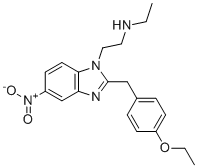 |
| Molecular Formula | C20H24N4O3 |
| Molecular Weight | 368.43 |
| CAS Registry Number | 2732926-26-8 |
| SMILES | CCNCCN1C2=C(C=C(C=C2)[N+](=O)[O-])N=C1CC3=CC=C(C=C3)OCC |
| Density | 1.2±0.1 g/cm3 Calc.* |
|---|---|
| Boiling point | 583.2±45.0 °C 760 mmHg (Calc.)* |
| Flash point | 306.5±28.7 °C (Calc.)* |
| Solubility | 25 mg/mL (DMF) (Expl.) |
| Index of refraction | 1.611 (Calc.)* |
| * | Calculated using Advanced Chemistry Development (ACD/Labs) Software. |
| SDS | Available |
|---|---|
 chemBlink Chemical Story
|
A small change in a chemical name can conceal an important change in biological behavior. N-Desethyletonitazene, CAS 2732926-26-8, belongs to the nitazene family of synthetic opioids. The United Nations Office on Drugs and Crime identifies its structure as a substituted 2-benzylbenzimidazole with an ethoxy group and an N-ethylaminoethyl side chain. Exact identification matters because closely related nitazenes are distinct substances, not interchangeable spellings of the same compound. The prefix N-desethyl describes the removal of an ethyl group from nitrogen relative to etonitazene. It does not mean removal of the ethoxy substituent on the aromatic ring. More importantly, such a structural change is not evidence that the resulting compound is inactive. Biological activity depends on the complete molecular structure and its interaction with receptors, rather than on whether a name sounds like that of a shortened parent molecule. Monti and colleagues reported N-desethyl etonitazene in a sample submitted to a Swiss drug-checking service in 2023, publishing their chemical and pharmacological characterization in 2024. Their work combined substance identification with functional receptor assays. The study established that this particular compound could occur in a submitted drug sample and showed potent activity at the mu-opioid receptor under the experimental conditions used. Chemical analysis and receptor testing answer complementary questions. Analytical evidence addresses what substance is present. A functional assay addresses what that substance does in a specified biological test system. Neither a product label nor a receptor result alone establishes the composition or clinical consequences of every mixture encountered outside the laboratory. In particular, an in vitro potency comparison is not a human dose conversion or a prediction of a safe exposure. The World Health Organization's 2025 critical review placed the compound in the context of emerging synthetic-opioid monitoring and public-health risk. Such monitoring is important because unrecognized active substances can complicate interpretation of intoxications and analytical findings. Specific identification helps laboratories distinguish this nitazene from related compounds and communicate evidence consistently. The scientific relevance of N-desethyletonitazene is therefore primarily analytical, pharmacological, and toxicological. It illustrates why small structural changes must be investigated rather than judged by name alone. A defensible account connects an exact molecular identity with measured biological activity, while keeping laboratory findings distinct from unsupported claims of medical usefulness or predictable effects in humans. References: 1. UNODC Early Warning Advisory. N-Desethyl etonitazene: substance identity, CAS 2732926-26-8. https://www.unodc.org/LSS/Substance/Details/62425b00-285d-40d5-8e38-d4b1ab7fe0a5 2. Monti MC et al. Detection of N-desethyl etonitazene in a drug checking sample: Chemical analysis and pharmacological characterization of a recent member of the 2-benzylbenzimidazole nitazene class. J Pharm Biomed Anal. 2024;251:116453. https://doi.org/10.1016/j.jpba.2024.116453 3. WHO Expert Committee on Drug Dependence. Critical Review Report: N-desethyl etonitazene. 48th meeting, 2025. https://cdn.who.int/media/docs/default-source/controlled-substances/48th-ecdd/3.3.2_n-desethyl-etonitazene-crit-rev.pdf |
| Market Analysis Reports |