
Online Database of Chemicals from Around the World
| Wuhan Kemi-works Chemical Co., Ltd. | China | |||
|---|---|---|---|---|
 | www.kemiworks.net | |||
 | +86 (27) 8573-6489 | |||
 | +86 (27) 8573-6485 | |||
 | info@kemiworks.net sales@kemiworks.com | |||
| Chemical manufacturer | ||||
| chemBlink Premium supplier since 2011 | ||||
| Classification | Catalysts and additives >> Antioxidant |
|---|---|
| Name | Antioxidant 3114 |
| Synonyms | Tris(3,5-di-tert-butyl-4-hydroxybenzyl) isocyanurate |
| Molecular Structure | 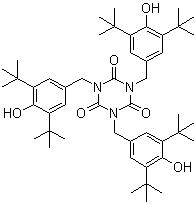 |
| Molecular Formula | C48H69N3O6 |
| Molecular Weight | 784.08 |
| CAS Registry Number | 27676-62-6 |
| EC Number | 248-597-9 |
| SMILES | CC(C)(C)C1=CC(=CC(=C1O)C(C)(C)C)CN2C(=O)N(C(=O)N(C2=O)CC3=CC(=C(C(=C3)C(C)(C)C)O)C(C)(C)C)CC4=CC(=C(C(=C4)C(C)(C)C)O)C(C)(C)C |
| Density | 1.1±0.1 g/cm3 Calc.* |
|---|---|
| Melting point | 218 - 220 °C (Expl.) |
| Boiling point | 757.9±60.0 °C 760 mmHg (Calc.)* |
| Flash point | 412.2±32.9 °C (Calc.)* |
| Index of refraction | 1.567 (Calc.)* |
| * | Calculated using Advanced Chemistry Development (ACD/Labs) Software. |
| Hazard Symbols |  GHS07 Warning Details GHS07 Warning Details |
|---|---|
| Risk Statements | H302-H315-H319-H332-H335 Details |
| Safety Statements | P261-P280-P305+P351+P338 Details |
| SDS | Available |
 chemBlink Chemical Story
|
Antioxidant 3114, chemically known as tris(3,5-di-tert-butyl-4-hydroxybenzyl)isocyanurate, is a high-molecular-weight hindered phenolic antioxidant developed to provide long-term thermal stability for modern polymers. Unlike many conventional antioxidants that are gradually lost during processing or service, Antioxidant 3114 was designed to remain within polymer matrices for extended periods, providing durable protection against oxidative degradation. Its development represents an important milestone in polymer additive engineering, illustrating how molecular design can dramatically improve the lifetime of bulk materials. As plastics became indispensable engineering materials during the second half of the twentieth century, manufacturers faced an increasingly complex challenge. Polymer chains were continuously exposed to heat, oxygen, mechanical stress, and ultraviolet radiation during processing and service. These conditions generated free radicals capable of initiating self-propagating oxidation reactions that gradually reduced molecular weight, discolored materials, and caused embrittlement. Preventing this degradation became as important as developing new polymers themselves. Hindered phenolic antioxidants emerged as one of the most successful solutions. By donating hydrogen atoms to highly reactive free radicals, these compounds interrupt oxidation chain reactions before extensive polymer damage can occur. However, early generations of phenolic antioxidants often exhibited limited permanence because smaller molecules could volatilize, migrate to the polymer surface, or be extracted during long-term use. This limitation encouraged chemists to redesign antioxidant molecules with greater molecular weight and improved compatibility with polymer matrices. Antioxidant 3114 exemplifies this strategy. Its molecular architecture consists of three sterically hindered phenolic groups attached to a rigid isocyanurate core, producing a highly symmetrical molecule with exceptional thermal stability and very low volatility. The large molecular size significantly reduces migration while preserving efficient radical-scavenging activity. As a result, the antioxidant remains effective throughout prolonged processing and service under demanding conditions. These characteristics have made Antioxidant 3114 valuable in polypropylene, polyethylene, engineering plastics, elastomers, adhesives, synthetic fibers, and numerous industrial materials requiring long-term durability. It is particularly effective where repeated thermal exposure or extended service life demands antioxidants that remain within the polymer rather than gradually disappearing over time. In many applications it is combined with phosphite secondary antioxidants, ultraviolet stabilizers, and light stabilizers, creating integrated stabilization systems capable of protecting polymers against multiple degradation pathways simultaneously. The development of antioxidants such as Antioxidant 3114 also reflects an important shift in materials science. Rather than relying solely on new polymer chemistry, researchers increasingly recognized that carefully engineered additive packages could significantly extend product lifetime while reducing waste and improving sustainability. Modern polymers are therefore designed not only as macromolecules but as complete material systems in which stabilizers, processing aids, flame retardants, and other additives work together to maintain performance throughout the product lifecycle. The scientific significance of Antioxidant 3114 extends beyond its chemistry as a hindered phenol. It demonstrates how molecular engineering at concentrations of less than one percent can determine the reliability of products used in transportation, construction, electronics, healthcare, and everyday consumer goods. Although almost invisible to end users, antioxidants such as Antioxidant 3114 quietly protect countless polymer products from degradation, making them among the most important unsung contributors to modern materials technology. References 1. Zweifel, H. (ed.) Plastics Additives Handbook. 6th ed. Hanser Publishers, 2009. 2. Gugumus, F. "Processing and Long-Term Thermal Stabilization of Polyolefins." Polymer Degradation and Stability. 3. Wypych, G. Handbook of Antioxidants. ChemTec Publishing, 2015. |
| Market Analysis Reports |