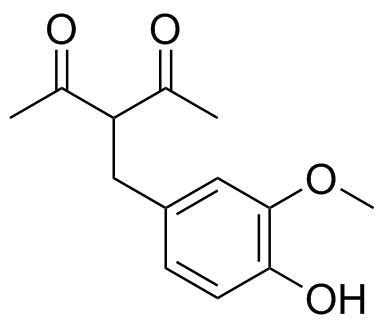
3-((4-Hydroxy-3-methoxyphenyl)methyl)pentane-2,4-dione is an aromatic diketone derivative containing a substituted guaiacol-type aromatic ring linked through a methylene bridge to a pentane-2,4-dione framework. The structure combines three chemically important motifs: a phenolic hydroxyl group, a methoxy substituent, and a β-dicarbonyl (1,3-diketone) system.
The aromatic portion of the molecule is a 4-hydroxy-3-methoxyphenyl group. This substitution pattern is characteristic of guaiacol-derived structures and is found in numerous naturally occurring phenolic compounds. The hydroxyl group (–OH) can act as both a hydrogen-bond donor and acceptor, while the methoxy group (–OCH₃) donates electron density to the aromatic ring through resonance. Together, these substituents make the aromatic system relatively electron-rich.
The pentane-2,4-dione portion represents a β-dicarbonyl system. Compounds containing two carbonyl groups separated by a methylene carbon frequently exist in equilibrium between keto and enol forms (keto–enol tautomerism). In many β-diketones, the enol form can be stabilized by conjugation and intramolecular hydrogen bonding. This tautomeric behavior strongly affects the chemical reactivity and physicochemical properties of the molecule.
The central methylene linkage connecting the aromatic ring to the diketone chain interrupts direct conjugation between the aromatic system and the carbonyl functionality. Consequently, the electronic influence of the aromatic ring on the diketone unit is less extensive than in compounds possessing a directly conjugated aryl–enone structure.
From a chemical perspective, the most reactive portions of the molecule are likely to be the β-dicarbonyl system and the phenolic hydroxyl group. The diketone region can participate in condensation reactions, metal chelation, and nucleophilic addition reactions, while the phenolic hydroxyl group may undergo esterification, etherification, or oxidation reactions under suitable conditions.
The molecule contains both hydrophilic and hydrophobic regions. The aromatic ring and hydrocarbon chain contribute hydrophobic character, whereas the hydroxyl and carbonyl groups increase polarity and hydrogen-bonding capability. This mixed character influences solubility and intermolecular interactions.
Without verified literature specific to this compound, additional statements regarding biological activity, pharmacological properties, or specific applications should not be made. Based on established structural information, it can be reliably described as a substituted phenolic β-diketone with potential reactivity arising from its diketone tautomerism and phenolic functionality.
|





 GHS09 Details
 chemBlink Chemical Story