
Online Database of Chemicals from Around the World
| Changzhou Ditong Chemical Co., Ltd. | China | |||
|---|---|---|---|---|
 | www.edengenechem.com | |||
 | +86 (519) 8829-8848 +86 18118010980 | |||
 | info@edengenechem.com sale@edengenechem.com | |||
 | QQ Chat | |||
 | WeChat: 18118010980 | |||
| Chemical manufacturer since 2006 | ||||
| chemBlink Premium supplier since 2026 | ||||
| Classification | Pharmaceutical intermediate >> Heterocyclic compound intermediate >> Pyrimidine compound >> Amine |
|---|---|
| Name | 2,3,5,6-Tetramethyl-1,4-phenylenediamine |
| Molecular Structure | 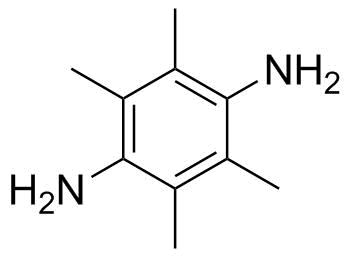 |
| Molecular Formula | C10H16N2 |
| Molecular Weight | 164.25 |
| CAS Registry Number | 3102-87-2 |
| EC Number | 221-457-4 |
| SMILES | CC1=C(C(=C(C(=C1N)C)C)N)C |
| Density | 1.0±0.1 g/cm3 Calc.* |
|---|---|
| Melting point | 150 - 155 °C (Expl.) |
| Boiling point | 310.6±37.0 °C 760 mmHg (Calc.)* |
| Flash point | 167.8±26.0 °C (Calc.)* |
| Index of refraction | 1.595 (Calc.)* |
| * | Calculated using Advanced Chemistry Development (ACD/Labs) Software. |
| Hazard Symbols |  GHS07 Warning Details GHS07 Warning Details | ||||||||||||||||
|---|---|---|---|---|---|---|---|---|---|---|---|---|---|---|---|---|---|
| Risk Statements | H315-H319-H335 Details | ||||||||||||||||
| Safety Statements | P261-P264-P264+P265-P271-P280-P302+P352-P304+P340-P305+P351+P338-P319-P321-P332+P317-P337+P317-P362+P364-P403+P233-P405-P501 Details | ||||||||||||||||
| Hazard Classification | |||||||||||||||||
| |||||||||||||||||
| SDS | Available | ||||||||||||||||
 chemBlink Chemical Story
|
2,3,5,6-Tetramethyl-1,4-phenylenediamine is an aromatic diamine consisting of a benzene ring substituted with two amino groups at the para positions and four methyl groups occupying the remaining carbon atoms of the ring. It belongs to the class of substituted phenylenediamines and is an electron-rich aromatic compound with significant redox activity. Structurally, the molecule is based on a benzene ring, a planar six-membered aromatic system containing six delocalized π-electrons. The aromatic framework provides considerable thermodynamic stability and serves as the rigid backbone of the molecule. The amino groups are located at the 1 and 4 positions of the benzene ring, giving the compound a para-substituted arrangement. Each amino group (–NH2) contains a lone pair of electrons that can delocalize into the aromatic π-system through resonance. This electron donation substantially increases the electron density of the ring, making the molecule considerably more electron-rich than unsubstituted benzene. The remaining ring positions (2, 3, 5, and 6) are occupied by methyl groups. These methyl substituents are weak electron-donating groups through inductive effects and further increase the electron density of the aromatic system. In addition, the four methyl groups introduce significant steric bulk around the amino substituents, influencing molecular geometry and intermolecular interactions. The extensive substitution pattern creates a highly symmetrical molecule. The para arrangement of the amino groups and the symmetrical placement of the methyl substituents produce an approximately balanced distribution of electron density across the aromatic ring. From an electronic perspective, the combined effects of the amino and methyl groups make the aromatic nucleus highly activated. The amino groups contribute strongly through resonance, while the methyl groups provide additional electron donation through hyperconjugation and inductive effects. This combination lowers the oxidation potential of the molecule compared with less substituted phenylenediamines. The amino groups can participate in hydrogen bonding. In the neutral form, each amino group can function as both a hydrogen bond donor and a hydrogen bond acceptor. Under acidic conditions, the amino nitrogens are readily protonated to form ammonium groups, producing water-soluble salts. The aromatic ring remains planar due to its conjugated π-system, although the amino groups may deviate slightly from coplanarity depending on their hydrogen-bonding environment and crystal packing. The methyl substituents project outward from the plane of the ring and reduce the ability of neighboring molecules to pack closely together. Physicochemically, the molecule exhibits both polar and nonpolar characteristics. The aromatic ring and methyl substituents contribute hydrophobicity, whereas the amino groups provide localized polarity and hydrogen-bonding capability. As a result, the compound has limited water solubility in its neutral form but forms more water-soluble salts upon protonation. Chemically, the most important property of 2,3,5,6-tetramethyl-1,4-phenylenediamine is its ease of oxidation. The electron-rich aromatic system readily undergoes one-electron and two-electron oxidation to generate radical cations and quinonediimine-type oxidation products. These oxidized species are stabilized by resonance over the aromatic framework and are responsible for the compound's use in redox and analytical chemistry. The amino groups are also reactive toward common transformations of aromatic amines, including acylation, alkylation, and diazotization under appropriate conditions. The aromatic ring itself is highly activated toward electrophilic substitution, although the four methyl substituents occupy all available carbon positions, greatly limiting further substitution on the ring. Overall, 2,3,5,6-tetramethyl-1,4-phenylenediamine is a highly substituted aromatic diamine composed of a benzene core bearing two para amino groups and four methyl substituents. Its strongly electron-rich aromatic system, hydrogen-bonding capability, and reversible oxidation chemistry make it a representative member of the substituted phenylenediamine family with important applications in redox and analytical chemistry. References 2025. Hymenobacter cheonanensis sp. nov., and Hymenobacter convexus sp. nov. isolated from the construction site. Antonie van Leeuwenhoek. DOI: 10.1007/s10482-025-02164-y 2025. Breaking the Trade-off: Cross-Linked Polymeric Membranes for Superior Olefin/Paraffin Separation. Korean Journal of Chemical Engineering. DOI: 10.1007/s11814-025-00549-3 2025. Halomonas sp. NEC-1, an ectoine-rich and wide pH tolerant halophilic bacterium isolated from a salt lake of Xizang, China. Journal of Oceanology and Limnology. DOI: 10.1007/s00343-024-4168-8 |
| Market Analysis Reports |