
Online Database of Chemicals from Around the World
| wuhan chemi Pharmacy Chemical Technology Co., Ltd. | China | |||
|---|---|---|---|---|
 | www.chemipharm.com.cn | |||
 | +86 13971619949 | |||
 | gmn424@chemipharm.com.cn | |||
 | QQ Chat | |||
 | WeChat: 13971619949 | |||
| Chemical manufacturer since 2014 | ||||
| chemBlink Standard supplier since 2026 | ||||
| Classification | Chemical reagent >> Organic reagent >> Alkane |
|---|---|
| Name | 1-Iodo-2-(2-iodoethoxy)ethane |
| Synonyms | 2-Iodoethyl ether |
| Molecular Structure | 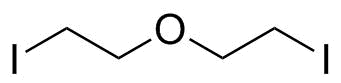 |
| Molecular Formula | C4H8I2O |
| Molecular Weight | 325.91 |
| CAS Registry Number | 34270-90-1 |
| EC Number | 626-001-1 |
| SMILES | C(CI)OCCI |
| Density | 2.4±0.1 g/cm3 Calc.*, 2.3 g/mL (Expl.) |
|---|---|
| Boiling point | 258.7±25.0 °C 760 mmHg (Calc.)*, 140 - 141 °C (Decomposes) (Expl.) |
| Flash point | 110.3±23.2 °C (Calc.)*, 86 °C (Expl.) |
| Index of refraction | 1.613 (Calc.)*, 1.601 (Expl.) |
| * | Calculated using Advanced Chemistry Development (ACD/Labs) Software. |
| Hazard Symbols |   GHS05;GHS07 Danger Details GHS05;GHS07 Danger Details | ||||||||||||||||||||||||||||
|---|---|---|---|---|---|---|---|---|---|---|---|---|---|---|---|---|---|---|---|---|---|---|---|---|---|---|---|---|---|
| Risk Statements | H317-H318 Details | ||||||||||||||||||||||||||||
| Safety Statements | P261-P264+P265-P272-P280-P302+P352-P305+P354+P338-P317-P321-P333+P317-P362+P364-P501 Details | ||||||||||||||||||||||||||||
| Hazard Classification | |||||||||||||||||||||||||||||
| |||||||||||||||||||||||||||||
| SDS | Available | ||||||||||||||||||||||||||||
 chemBlink Chemical Story
|
1-Iodo-2-(2-iodoethoxy)ethane is a diiodinated ether derivative belonging to the class of halogenated ethylene glycol analogs. The molecule contains an ether backbone derived from ethylene glycol in which both terminal positions are substituted with iodine atoms through iodoalkyl groups. Compounds of this type are part of a broader group of bifunctional alkylating agents and halogenated ether intermediates used in synthetic organic chemistry. The development of halogenated ether compounds is closely linked to the historical expansion of organohalogen chemistry, particularly during the twentieth century when systematic studies of alkyl halides and polyfunctional halogenated molecules were carried out. Alkyl iodides, in particular, were of interest due to the relatively weak carbon–iodine bond, which makes them highly reactive toward nucleophilic substitution reactions. This reactivity led to their widespread use as intermediates in organic synthesis and as building blocks for more complex molecular architectures. 1-Iodo-2-(2-iodoethoxy)ethane can be understood structurally as a symmetrical dihaloether in which an ethylene glycol-derived oxygen atom links two iodoethyl groups. The presence of two terminal iodide substituents confers bifunctional reactivity, allowing the molecule to undergo two successive substitution reactions. Such bifunctional alkylating agents are important in the synthesis of crosslinked structures, oligomers, and functionalized organic frameworks. The compound is typically prepared through halogenation of ethylene glycol derivatives or by substitution reactions involving activated diols or glycol ethers. In these processes, hydroxyl groups are converted into good leaving groups and subsequently replaced by iodide ions. Because iodine is a large and polarizable leaving group, carbon–iodine bonds are relatively labile, which contributes to the high reactivity of the resulting molecule. One of the primary applications of diiodinated ethers such as 1-iodo-2-(2-iodoethoxy)ethane is in organic synthesis as a bifunctional alkylating reagent. The two reactive iodine termini allow the compound to participate in nucleophilic substitution reactions with a variety of nucleophiles, including amines, thiols, and oxygen-based nucleophiles. This enables the construction of larger molecular frameworks through stepwise or one-pot coupling reactions. Such compounds are also relevant in polymer and materials chemistry. Bifunctional alkyl halides can act as crosslinking agents by connecting two nucleophilic polymer chains. In this context, diiodoethers can be used to introduce ether-linked bridges between functionalized polymers, contributing to network formation and modification of mechanical or thermal properties. The ether oxygen in the backbone may also influence flexibility and polarity in the resulting structures. In addition, halogenated ethers are sometimes used as intermediates in the synthesis of more complex functional molecules, including surfactants and specialty chemicals. The ability to introduce two reactive sites within a single molecule makes compounds like 1-iodo-2-(2-iodoethoxy)ethane useful for stepwise functionalization strategies, where each iodine atom can be selectively substituted under controlled conditions. From a physicochemical standpoint, the compound is expected to exhibit high density and significant polarizability due to the presence of two iodine atoms. Alkyl iodides generally show higher reactivity than corresponding bromides or chlorides, and this trend is reflected in their use as leaving groups in nucleophilic substitution chemistry. The ether linkage introduces some polarity and conformational flexibility compared with simple alkyl diiodides. Overall, 1-iodo-2-(2-iodoethoxy)ethane is a bifunctional halogenated ether that serves as a reactive intermediate in organic synthesis. Its importance lies in the combination of two alkyl iodide functional groups within a single molecular framework, enabling its use in nucleophilic substitution reactions, crosslinking processes, and the construction of more complex ether-linked organic structures in synthetic and materials chemistry contexts. References 2014. Fluorescence and crystal structures of new mercury(II) macrocyclic N-heterocyclic carbene complexes with ether chains. Journal of Structural Chemistry. DOI: 10.1134/s0022476614040167 2001. Towards synthetic vaccines built on carbohydrate cores. International Journal of Peptide Research and Therapeutics. DOI: 10.1007/bf02446528 1987. High pressure approach to the synthesis of cryptands and related compounds. Journal of Inclusion Phenomena and Macrocyclic Chemistry. DOI: 10.1007/bf00662994 |
| Market Analysis Reports |