
Online Database of Chemicals from Around the World
| Changzhou Ditong Chemical Co., Ltd. | China | |||
|---|---|---|---|---|
 | www.edengenechem.com | |||
 | +86 (519) 8829-8848 +86 18118010980 | |||
 | info@edengenechem.com sale@edengenechem.com | |||
 | QQ Chat | |||
 | WeChat: 18118010980 | |||
| Chemical manufacturer since 2006 | ||||
| chemBlink Premium supplier since 2026 | ||||
| Classification | Organic raw materials >> Heterocyclic compound |
|---|---|
| Name | 5-Amino-1-(4-methoxybenzyl)-1H-pyrazole |
| Synonyms | 5-Amino-1-(4-methoxybenzyl)pyrazole |
| Molecular Structure | 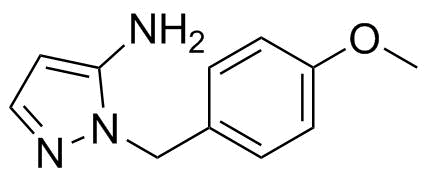 |
| Molecular Formula | C11H13N3O |
| Molecular Weight | 203.24 |
| CAS Registry Number | 3528-45-8 |
| EC Number | 845-273-4 |
| SMILES | COC1=CC=C(C=C1)CN2C(=CC=N2)N |
| Solubility | Slightly soluble (1.9 g/L) (25 °C), Calc.* |
|---|---|
| Density | 1.19±0.1 g/cm3 (20 °C 760 Torr), Calc.* |
| Boiling point | 407.4±30.0 °C 760 mmHg (Calc.)* |
| Flash point | 200.2±24.6 °C (Calc.)* |
| Index of refraction | 1.599 (Calc.)* |
| * | Calculated using Advanced Chemistry Development (ACD/Labs) Software. |
| Hazard Symbols |  GHS07 Warning Details GHS07 Warning Details | ||||||||||||||||||||
|---|---|---|---|---|---|---|---|---|---|---|---|---|---|---|---|---|---|---|---|---|---|
| Risk Statements | H302-H315-H319-H335 Details | ||||||||||||||||||||
| Safety Statements | P261-P264-P264+P265-P270-P271-P280-P301+P317-P302+P352-P304+P340-P305+P351+P338-P319-P321-P330-P332+P317-P337+P317-P362+P364-P403+P233-P405-P501 Details | ||||||||||||||||||||
| Hazard Classification | |||||||||||||||||||||
| |||||||||||||||||||||
 chemBlink Chemical Story
|
5-Amino-1-(4-methoxybenzyl)-1H-pyrazole is a substituted pyrazole compound belonging to the class of nitrogen-containing heterocyclic aromatic compounds. It consists of a pyrazole ring containing two adjacent nitrogen atoms, an amino group attached at the 5-position, and a 4-methoxybenzyl substituent attached to the ring nitrogen. The compound is of interest as a heterocyclic building block in organic synthesis and medicinal chemistry research. Pyrazole derivatives have been studied extensively since the development of heterocyclic chemistry because of their broad range of chemical properties and their presence in many biologically active molecules. The pyrazole ring is a five-membered aromatic heterocycle containing two nitrogen atoms at adjacent positions. Synthetic methods for preparing substituted pyrazoles have been developed to introduce different functional groups and substituents, allowing researchers to modify electronic properties, solubility, and biological activity. The structure of 5-amino-1-(4-methoxybenzyl)-1H-pyrazole contains a pyrazole ring as the central framework. The ring consists of three carbon atoms and two nitrogen atoms arranged in a conjugated aromatic system. Aromaticity in pyrazole arises from the delocalization of pi electrons across the ring, giving the structure stability and allowing participation in characteristic heteroaromatic reactions. The amino group at the 5-position provides additional chemical functionality. The amino nitrogen contains a lone pair of electrons and can participate in hydrogen bonding. It can also undergo common reactions of aromatic amines, including acylation, alkylation, and condensation reactions. The presence of the amino group makes the compound useful as an intermediate for the preparation of more complex heterocyclic molecules. The 1-position of the pyrazole ring is substituted with a 4-methoxybenzyl group. This substituent consists of a benzene ring containing a methoxy group at the para position and a methylene bridge connecting it to the pyrazole nitrogen. The benzene ring contributes aromatic character and hydrophobicity, while the methoxy group introduces an oxygen-containing functional group that can participate in hydrogen bonding as an acceptor. The benzyl linkage provides conformational flexibility between the pyrazole ring and the aromatic substituent. Rotation around the carbon-nitrogen and carbon-carbon single bonds allows different spatial arrangements of the two aromatic systems. This flexibility can influence intermolecular interactions and the behavior of derivatives prepared from the compound. The compound has been used mainly as an intermediate in synthetic chemistry. Substituted pyrazoles are important structural components in pharmaceutical research, agrochemical development, and materials chemistry. The pyrazole ring provides a stable heteroaromatic framework, while functional groups such as amino and benzyl substituents allow further chemical modification. In medicinal chemistry, amino-substituted pyrazoles are valuable because the pyrazole ring can participate in interactions with biological targets through hydrogen bonding and aromatic interactions. Researchers have prepared numerous pyrazole derivatives by modifying amino groups and aromatic substituents to investigate their chemical and biological properties. The methoxybenzyl substituent also represents a common structural feature used in organic synthesis. Aromatic ether groups can influence molecular polarity and provide additional sites for chemical transformation. The combination of a heteroaromatic pyrazole core with an aromatic ether-containing substituent makes this compound suitable as a versatile synthetic intermediate. The chemical behavior of 5-amino-1-(4-methoxybenzyl)-1H-pyrazole is determined mainly by its amino group and heteroaromatic ring. The amino functionality provides a reactive site for derivatization, while the pyrazole ring maintains aromatic stability and contributes to the electronic properties of the molecule. Overall, 5-amino-1-(4-methoxybenzyl)-1H-pyrazole is a functionalized pyrazole derivative developed as a useful heterocyclic intermediate. Its combination of an aromatic pyrazole framework, reactive amino group, and methoxybenzyl substituent provides a versatile structure for the synthesis of more complex organic compounds in chemical research and related applications. |
| Market Analysis Reports |