
Online Database of Chemicals from Around the World
| Laizhou Laiyu Chemical Co., Ltd. | China | |||
|---|---|---|---|---|
 | www.laiyu.com | |||
 | +86 (535) 271-9337 | |||
 | liyunxia0707@163.com | |||
 | QQ Chat | |||
 | WeChat: 15864067774 | |||
 | WhatsApp:8615864067774 | |||
| Chemical manufacturer since 1998 | ||||
| chemBlink Standard supplier since 2008 | ||||
| Simagchem Corporation | China | |||
|---|---|---|---|---|
| www.simagchem.com | |||
| +86 13806087780 | |||
 | +86 (592) 268-0237 | |||
| sale@simagchem.com | |||
| Chemical manufacturer since 2002 | ||||
| chemBlink Standard supplier since 2008 | ||||
| Tyger Scientific Inc. | USA | |||
|---|---|---|---|---|
| www.tygersci.com | |||
| +1 (609) 434-0144 | |||
| +1 (609) 434-0143 | |||
| sales@tygersci.com | |||
| Chemical manufacturer since 1992 | ||||
| chemBlink Standard supplier since 2008 | ||||
| Wilshire Technologies, Inc. | USA | |||
|---|---|---|---|---|
| www.wilshiretechnologies.com | |||
| +1 (609) 683-1117 | |||
| +1 (732) 274-0049 | |||
| Wilshire-info@evonik.com | |||
| Chemical manufacturer since 1997 | ||||
| chemBlink Standard supplier since 2010 | ||||
| BOC Sciences | USA | |||
|---|---|---|---|---|
| www.bocsci.com | |||
| +1 (631) 485-4226 | |||
| +1 (631) 614-7828 | |||
| info@bocsci.com | |||
| Chemical manufacturer | ||||
| chemBlink Standard supplier since 2010 | ||||
| Chembridge International Corp. Taipei / Dongguan / Nanjing | China | |||
|---|---|---|---|---|
| www.chembridge.com.tw | |||
| +886 (2) 2649-6320 +86 (769) 2250-4087 +86 (25) 8471-2192 | |||
| +886 (2) 2704-3915 / +86 (769) 2246-8225 / +86 (25) 8471-2052 | |||
| cnservice@chembridge.net | |||
| Chemical manufacturer | ||||
| chemBlink Standard supplier since 2011 | ||||
| Alfa Chemistry | USA | |||
|---|---|---|---|---|
| www.alfa-chemistry.com | |||
| +1 (516) 734-6573 | |||
| +1 (516) 927-0118 | |||
| support@alfa-chemistry.com | |||
| Chemical manufacturer since 2005 | ||||
| chemBlink Standard supplier since 2012 | ||||
| Suqian Xiken Pharmaceutical Technology Co., Ltd. | China | |||
|---|---|---|---|---|
| www.xiken.com | |||
| +86 (0527) 8651-1777 | |||
| 8621010@qq.com | |||
| QQ Chat | |||
| Chemical manufacturer since 2017 | ||||
| chemBlink Standard supplier since 2013 | ||||
| Hangzhou Leap Chem Co., Ltd. | China | |||
|---|---|---|---|---|
| www.leapchem.com | |||
| +86 (571) 8771-1850 | |||
| market19@leapchem.com | |||
| QQ Chat | |||
| Chemical manufacturer since 2006 | ||||
| chemBlink Standard supplier since 2015 | ||||
| Wuhan Qiaofeng Chemical Technology Co., Ltd. | China | |||
|---|---|---|---|---|
| qfhgchem.com | |||
| +86 18271818137 | |||
| 2814999308@qq.com | |||
| QQ Chat | |||
| Chemical manufacturer since 2019 | ||||
| chemBlink Standard supplier since 2021 | ||||
| Qingdao Highcloud Tech Material Co., Ltd. | China | |||
|---|---|---|---|---|
| www.highcloudtech.com.cn | |||
| +86 86-15864067774 | |||
| info@highcloudtech.com.cn | |||
| QQ Chat | |||
| WeChat: 8615864067774 | |||
| WhatsApp:8615864067774 | |||
| Chemical manufacturer since 2023 | ||||
| chemBlink Standard supplier since 2026 | ||||
| Classification | Chemical reagent >> Organic reagent >> Ether |
|---|---|
| Name | Bisphenol A bisallyl ether |
| Synonyms | Bisphenol A diallyl ether; BBE; 4,4'-Isopropylidenebis[(allyloxy)benzene]; 1,1'-(1-Methylethylidene)bis[4-(2-propenyloxy)benzene] |
| Molecular Structure | 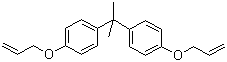 |
| Molecular Formula | C21H24O2 |
| Molecular Weight | 308.41 |
| CAS Registry Number | 3739-67-1 |
| EC Number | 223-123-3 |
| SMILES | CC(C)(C1=CC=C(C=C1)OCC=C)C2=CC=C(C=C2)OCC=C |
| Density | 1.0±0.1 g/cm3 Calc.* |
|---|---|
| Boiling point | 430.5±45.0 °C 760 mmHg (Calc.)* |
| Flash point | 155.3±28.3 °C (Calc.)* |
| Index of refraction | 1.536 (Calc.)* |
| * | Calculated using Advanced Chemistry Development (ACD/Labs) Software. |
| Hazard Symbols |  GHS07 Warning Details GHS07 Warning Details | ||||||||||||||||||||||||||||
|---|---|---|---|---|---|---|---|---|---|---|---|---|---|---|---|---|---|---|---|---|---|---|---|---|---|---|---|---|---|
| Risk Statements | H315-H317-H319 Details | ||||||||||||||||||||||||||||
| Safety Statements | P261-P264-P264+P265-P272-P280-P302+P352-P305+P351+P338-P321-P332+P317-P333+P317-P337+P317-P362+P364-P501 Details | ||||||||||||||||||||||||||||
| Hazard Classification | |||||||||||||||||||||||||||||
| |||||||||||||||||||||||||||||
| SDS | Available | ||||||||||||||||||||||||||||
 chemBlink Chemical Story
|
Bisphenol A bisallyl ether is a diallyl ether derivative of bisphenol A in which both phenolic hydroxyl groups of bisphenol A are converted into allyl ether functionalities. The compound combines a rigid aromatic bisphenol A backbone with two terminal allyl groups, resulting in a structure that contains both aromatic stability and reactive carbon–carbon double bonds. Structurally, the molecule is derived from bisphenol A, which consists of two phenyl rings connected through an isopropylidene bridge. The isopropylidene group contains a central carbon atom bonded to two methyl groups, creating a relatively rigid and sterically hindered linkage between the aromatic rings. This structural motif influences the spatial arrangement of the phenyl rings and contributes to the overall three-dimensional shape of the molecule. In bisphenol A bisallyl ether, each phenolic hydroxyl group is replaced by an allyloxy substituent (–O–CH2–CH=CH2). The ether oxygen atoms connect the aromatic rings to the allyl chains, introducing polar linkages between hydrophobic aromatic and unsaturated hydrocarbon regions. The allyl group contains a carbon–carbon double bond, which is the primary reactive site of the molecule. The aromatic rings retain their delocalized π-electron systems, which contribute to molecular rigidity and hydrophobic character. These rings are relatively electron-rich due to the influence of the ether oxygen substituents, which can donate electron density through resonance effects. The isopropylidene bridge between the aromatic rings reduces direct conjugation between them, maintaining their electronic independence. The allyl groups introduce unsaturation and chemical reactivity. The carbon–carbon double bonds can participate in a variety of reactions, including radical polymerization, electrophilic addition, oxidation, and crosslinking reactions. Because there are two allyl functionalities per molecule, bisphenol A bisallyl ether can act as a difunctional monomer capable of forming network structures in polymerization processes. The ether linkages (Ar–O–CH2–) are generally stable under neutral conditions and serve primarily as structural connectors between the aromatic core and the allyl substituents. These oxygen atoms also contribute to the molecule’s polarity and can participate in weak intermolecular interactions such as hydrogen-bond acceptance. From a conformational perspective, the molecule exhibits a combination of rigid and flexible regions. The bisphenol A core provides a relatively fixed aromatic scaffold, while the allyl ether chains possess rotational freedom around single bonds. This combination influences how the molecule packs in condensed phases and how it reacts in polymer-forming systems. Physicochemically, bisphenol A bisallyl ether is predominantly hydrophobic due to its aromatic rings and hydrocarbon substituents. The ether oxygen atoms introduce limited polarity, but the overall structure remains nonpolar compared with many oxygen-rich organic compounds. The presence of unsaturated allyl groups also contributes to its reactivity rather than significantly increasing polarity. Chemically, the most important feature of the molecule is the allyl double bonds, which can undergo polymerization reactions, particularly under radical initiation. This property makes the compound useful as a reactive intermediate in the preparation of crosslinked polymers and resins. The aromatic rings are relatively stable under typical conditions and mainly contribute structural rigidity and thermal stability. Overall, bisphenol A bisallyl ether is a difunctional allyl ether derivative characterized by a rigid bisphenol A aromatic core and two terminal allyl groups connected through ether linkages. Its structure combines aromatic stability with alkene reactivity, making it a useful monomeric building block in polymer chemistry and materials science. References 2023. Synthesis of a siloxane oligomer containing ether bond for promoting the adhesion between addition-cure silicone rubber and polycarbonate (PC). Silicon. DOI: 10.1007/s12633-023-02361-2 2021. Enhanced the mechanical and dielectric properties of bismaleimide composites modified by graphene oxide grafting with maleic anhydride. Journal of Materials Science: Materials in Electronics. DOI: 10.1007/s10854-021-05475-8 2020. Microstructure and dielectric properties of bismaleimide composite synergistically modified by graphene oxide and polyetheretherketone. Journal of Materials Science: Materials in Electronics. DOI: 10.1007/s10854-020-03097-0 |
| Market Analysis Reports |