
Online Database of Chemicals from Around the World
| BOC Sciences | USA | |||
|---|---|---|---|---|
 | www.bocsci.com | |||
 | +1 (631) 485-4226 | |||
 | +1 (631) 614-7828 | |||
 | info@bocsci.com | |||
| Chemical manufacturer | ||||
| chemBlink Standard supplier since 2010 | ||||
| Suizhou Jiake Pharmaceutical & Chemical Industry Co., Ltd. | China | |||
|---|---|---|---|---|
| www.0722jk.com | |||
| +86 (722) 363-2789 | |||
| +86 (722) 325-5139 | |||
| szjk0722@live.cn | |||
 | QQ Chat | |||
| Chemical manufacturer since 2011 | ||||
| chemBlink Standard supplier since 2013 | ||||
| Hubei Seven Eight Nine Chemical Co., Ltd. | China | |||
|---|---|---|---|---|
| www.hb789.cn | |||
| +86 (27) 8811-1833 +86 15802781837 | |||
| info@hb789.cn niuxiudan@163.com | |||
| Chemical manufacturer since 2012 | ||||
| chemBlink Standard supplier since 2013 | ||||
| Hangzhou Leap Chem Co., Ltd. | China | |||
|---|---|---|---|---|
| www.leapchem.com | |||
| +86 (571) 8771-1850 | |||
| market19@leapchem.com | |||
| QQ Chat | |||
| Chemical manufacturer since 2006 | ||||
| chemBlink Standard supplier since 2015 | ||||
| Weifang Haozhi Polymer Materials Co., Ltd. | China | |||
|---|---|---|---|---|
| www.weifanghaozhi.com | |||
| +86 18853644506 | |||
| 6819834@qq.com | |||
| QQ Chat | |||
 | WeChat: 18853644506 | |||
| Chemical manufacturer since 2026 | ||||
| chemBlink Standard supplier since 2026 | ||||
| Classification | Inorganic chemical industry >> Inorganic salt >> Metal oxide acid salt |
|---|---|
| Name | Iron potassium oxide |
| Synonyms | Potassium iron oxide |
| Molecular Structure | 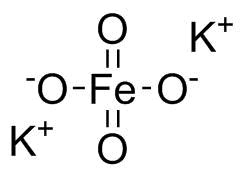 |
| Molecular Formula | K2FeO4 |
| Molecular Weight | 198.04 |
| CAS Registry Number | 39469-86-8 |
| SMILES | O=[Fe](=O)([O-])[O-].[K+].[K+] |
 chemBlink Chemical Story
|
Iron potassium oxide, CAS 39469-86-8, is the database-style name for potassium ferrate(VI), K2FeO4. In this striking dark-purple salt, iron is in the unusually high +6 oxidation state as tetrahedral ferrate, FeO4(2-). NCBI MeSH identifies potassium ferrate as an oxidizing agent, and its unusual redox chemistry has made it a long-studied candidate for water and wastewater treatment. Ferrate(VI) is a strong oxidant. It can attack a wide range of organic and inorganic contaminants, and published studies have examined removal of nitrosamines, sulfamethoxazole, odor compounds, algae and other water contaminants. Reaction rates depend strongly on pH and on the identity of the pollutant because protonated and unprotonated ferrate species have different reactivity. Its most interesting feature for water treatment is what happens after oxidation. Fe(VI) is reduced ultimately to Fe(III), producing iron(III) hydroxide/oxyhydroxide species that can act as coagulants and adsorbents. Thus one reagent can first oxidize contaminants or microorganisms and then generate iron-based solids that help capture particles and reaction products. Studies of algae removal have specifically observed this combined oxidation/coagulation behavior. This dual function has led researchers to describe ferrate as a potentially multifunctional treatment chemical: oxidant, disinfectant and coagulant precursor. It does not mean that potassium ferrate is automatically optimal for every water-treatment system. Stability, production cost, dosing, pH and competing substances all influence performance, and concentrated ferrate is itself a powerful oxidizer requiring careful handling. Potassium ferrate is chemically memorable because iron, more familiar in the +2 and +3 states, is pushed to +6 and temporarily stores strong oxidizing power. During treatment that high-valent state is consumed and iron returns to lower oxidation states that can assist coagulation. The reagent therefore performs two chemically different jobs in sequence: high-valent iron attacks contaminants, then ordinary ferric chemistry helps remove what remains. References: 1. NCBI MeSH, Potassium ferrate, Registry Number 39469-86-8. 2. Jiang JQ, Lloyd B. Water Res. 2002;36:1397-1408. 3. Bartzatt R, Nagel D. Arch Environ Health. 1991;46:313-315. DOI: 10.1080/00039896.1991.9934395. 4. Sharma VK et al. Environ Sci Technol. 2006;40:7222-7227. |
| Market Analysis Reports |