
Online Database of Chemicals from Around the World
| Nanjing Taiye Chemical Industry Co., Ltd. | China | |||
|---|---|---|---|---|
 | www.taiyechem.com | |||
 | +86 (25) 5233-7972 | |||
 | +86 (25) 5233-7971 | |||
 | market@taiyechem.com taiyechem@gmail.com | |||
| Chemical manufacturer since 2001 | ||||
| chemBlink Standard supplier since 2007 | ||||
| Microsin SRL | Romania | |||
|---|---|---|---|---|
| www.microsin.ro | |||
| +40 (21) 345-2066 | |||
| +40 (21) 345-2067 | |||
| office@microsin.ro | |||
| Chemical manufacturer since 1991 | ||||
| chemBlink Standard supplier since 2008 | ||||
| BOC Sciences | USA | |||
|---|---|---|---|---|
| www.bocsci.com | |||
| +1 (631) 485-4226 | |||
| +1 (631) 614-7828 | |||
| info@bocsci.com | |||
| Chemical manufacturer | ||||
| chemBlink Standard supplier since 2010 | ||||
| Ningbo Sialon Chem Co., Ltd. | China | |||
|---|---|---|---|---|
| www.newsialon.com | |||
| +86 (574) 2880-9708 2880-9768 | |||
| +86 (574) 5670-8448 | |||
| sales@newsialon.com roywang0086@hotmail.com | |||
 | QQ Chat | |||
| Chemical manufacturer | ||||
| chemBlink Standard supplier since 2012 | ||||
| Suzhou Myland Pharm & Nutrition Inc. | China | |||
|---|---|---|---|---|
| www.mylandpharm.com | |||
| +86 (512) 6615-0687 | |||
| +86 (512) 6615-7101 | |||
| info@mylandpharm.com | |||
| QQ Chat | |||
| Chemical manufacturer since 2013 | ||||
| chemBlink Standard supplier since 2014 | ||||
| Hangzhou Leap Chem Co., Ltd. | China | |||
|---|---|---|---|---|
| www.leapchem.com | |||
| +86 (571) 8771-1850 | |||
| market19@leapchem.com | |||
| QQ Chat | |||
| Chemical manufacturer since 2006 | ||||
| chemBlink Standard supplier since 2015 | ||||
| Classification | Organic raw materials >> Carboxylic compounds and derivatives >> Salt of carboxylic acid ester and its derivatives |
|---|---|
| Name | Orotic acid lithium salt |
| Synonyms | 1,2,3,6-Tetrahydro-2,6-dioxo-4-pyrimidinecarboxylic acid lithium salt |
| Molecular Structure | 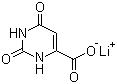 |
| Molecular Formula | C5H3N2O4.Li |
| Molecular Weight | 162.03 |
| CAS Registry Number | 5266-20-6 |
| EC Number | 226-081-4 |
| SMILES | [Li+].C1=C(NC(=O)NC1=O)C(=O)[O-] |
| Hazard Symbols |  GHS07 Warning Details GHS07 Warning Details |
|---|---|
| Risk Statements | H302-H315-H319-H335 Details |
| Safety Statements | P261-P264-P270-P271-P280-P301+P312-P302+P352-P304+P340-P305+P351+P338-P330-P332+P313-P337+P313-P362-P403+P233-P405-P501 Details |
| SDS | Available |
 chemBlink Chemical Story
|
Orotic acid lithium salt is the lithium salt form of orotic acid, a naturally occurring pyrimidine carboxylic acid that serves as an intermediate in the biosynthesis of pyrimidine nucleotides. The salt consists of a lithium cation associated with the deprotonated orotate anion, formed when the acidic proton of orotic acid is replaced by lithium. Orotic acid itself is a heterocyclic compound containing a pyrimidine ring substituted with carbonyl groups at the 2- and 4-positions and a carboxylic acid group at the 6-position. This arrangement places it within the class of uracil derivatives, and its structure is closely related to nucleobase chemistry. The molecule is aromatic in the heterocyclic sense, with electron delocalization across the pyrimidine ring, while the carbonyl and carboxyl groups provide strong polarity and hydrogen-bonding capability. In the lithium salt form, the carboxylic acid group is deprotonated to form a carboxylate anion, which interacts electrostatically with Li⁺. Lithium ions are small, highly polarizing cations that often exhibit strong hydration and coordination with oxygen-containing ligands such as carboxylates and carbonyl oxygens. In solid-state structures, lithium salts frequently show coordination geometries involving multiple oxygen atoms, sometimes including bridging interactions between anions or solvent molecules. The orotate anion contains several sites capable of hydrogen bonding and coordination interactions. The pyrimidine ring nitrogens and carbonyl oxygens can participate as hydrogen bond acceptors, while the deprotonated carboxylate group is a strong coordination site for lithium. This results in a highly polar, strongly interacting ionic structure. From a physicochemical perspective, orotic acid lithium salt is expected to be significantly more water-soluble than neutral orotic acid due to its ionic nature. The presence of lithium enhances dissociation in aqueous environments, while the multiple heteroatoms in the orotate anion promote hydration through hydrogen bonding. Orotic acid is a well-known intermediate in the de novo biosynthesis pathway of pyrimidine nucleotides, where it is converted into orotidine monophosphate (OMP) and subsequently into uridine monophosphate (UMP). This biochemical role has made orotic acid a compound of interest in biochemistry and metabolism studies. However, the lithium salt form primarily represents a chemical modification that improves handling and solubility characteristics rather than altering the fundamental identity of the orotate ion. Chemically, the most reactive sites in orotic acid lithium salt are associated with the carboxylate group and the carbonyl functionalities of the pyrimidine ring. The carboxylate is relatively stable under neutral conditions but can participate in acid–base equilibria, while the heterocyclic ring can undergo protonation under strongly acidic conditions, altering its electronic properties. Overall, orotic acid lithium salt is an ionic pyrimidine derivative consisting of a lithium cation and the orotate anion. Its significance lies in its relationship to pyrimidine metabolism and its physicochemical properties as a highly polar, water-compatible salt of a biologically important heterocycle. References 2026. Lithium and the Brain–Bone Axis: A Bridge between Osteoporosis and Alzheimer’s Disease. Current Osteoporosis Reports. DOI: https://www.ncbi.nlm.nih.gov/pmc/articles/PMC12893336 |
| Market Analysis Reports |