
Online Database of Chemicals from Around the World
| Xi'an Reapsource Biotechnology Co., Ltd. | China | |||
|---|---|---|---|---|
 | www.rpybiotech.com | |||
 | +86 18991103357 | |||
 | buyun.ping@rpybiotech.com | |||
 | QQ Chat | |||
 | WeChat: 18991103357 | |||
| Chemical manufacturer since 2024 | ||||
| chemBlink Standard supplier since 2026 | ||||
| Classification | Chemical reagent >> Deuterated reagent |
|---|---|
| Name | 1,3,5-Tribromobenzene-d3 |
| Molecular Structure | 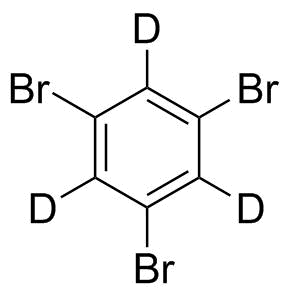 |
| Molecular Formula | C6D3Br3 |
| Molecular Weight | 317.82 |
| CAS Registry Number | 52921-77-4 |
| SMILES | [2H]C1=C(C(=C(C(=C1Br)[2H])Br)[2H])Br |
| Density | 2.3±0.1 g/cm3 Calc.* |
|---|---|
| Boiling point | 269.4±20.0 °C 760 mmHg (Calc.)* |
| Flash point | 115.5±16.5 °C (Calc.)* |
| Index of refraction | 1.634 (Calc.)* |
| * | Calculated using Advanced Chemistry Development (ACD/Labs) Software. |
| Hazard Symbols |  GHS07 Warning Details GHS07 Warning Details |
|---|---|
| Risk Statements | H302-H315-H319-H335 Details |
| Safety Statements | P261-P305+P351+P338 Details |
| SDS | Available |
 chemBlink Chemical Story
|
1,3,5-Tribromobenzene-d3 is a stable isotope-labeled halogenated aromatic compound in which a benzene ring bearing three bromine substituents at the 1-, 3-, and 5-positions is further labeled with three deuterium atoms. It belongs to the class of deuterated polybrominated benzenes, which are primarily used in analytical chemistry as reference standards, tracer compounds, and internal standards in mass spectrometric analysis. The chemistry of polybrominated benzene derivatives has been extensively studied since the development of electrophilic aromatic substitution reactions in classical aromatic chemistry. Bromination of benzene and substituted benzenes is a well-established transformation, typically proceeding through electrophilic substitution mechanisms in the presence of bromine and suitable catalysts. The 1,3,5-substitution pattern reflects the symmetrical directing influence of existing bromine substituents under controlled bromination conditions, leading to a highly symmetrical aromatic framework. Deuterium-labeled aromatic compounds such as 1,3,5-tribromobenzene-d3 became increasingly important with the rise of modern analytical techniques in the twentieth century, particularly gas chromatography–mass spectrometry (GC–MS). The substitution of hydrogen atoms with deuterium introduces a predictable mass shift without significantly altering the compound’s chemical behavior. This allows deuterated analogs to serve as internal standards for quantitative analysis, improving accuracy in complex sample matrices. In 1,3,5-tribromobenzene-d3, the presence of three bromine atoms introduces strong isotopic signatures due to the natural isotopic distribution of bromine (bromine-79 and bromine-81). This results in characteristic mass spectral patterns that are easily distinguishable from non-brominated or differently substituted aromatic compounds. When combined with deuterium labeling, the compound provides a dual isotopic signature, enhancing its utility in analytical workflows that require precise identification and quantification. The deuterium atoms in the benzene ring are chemically similar to hydrogen but exhibit slightly different vibrational and kinetic properties due to the increased mass of deuterium. These differences can lead to small kinetic isotope effects in certain reaction environments, although in most analytical applications the compound is considered chemically equivalent to its non-deuterated counterpart for the purpose of calibration and tracking. Polybrominated benzenes, including tribrominated derivatives, have also been studied in the context of environmental chemistry. Halogenated aromatic compounds can arise in industrial processes and may persist in the environment due to the stability of the carbon–bromine bond. While 1,3,5-tribromobenzene-d3 itself is primarily a synthetic, labeled compound used for analytical purposes, its structural analogs are relevant in studies of halogenated organic pollutants and their behavior in environmental systems. From a physicochemical perspective, 1,3,5-tribromobenzene-d3 is expected to be a dense, nonpolar aromatic compound with low water solubility and relatively high thermal stability. The presence of multiple bromine atoms increases molecular weight and polarizability, while the symmetrical substitution pattern contributes to crystallinity and structural uniformity. Deuterium substitution does not significantly affect bulk physical properties but provides a measurable mass difference for spectrometric detection. In analytical applications, deuterated polybrominated benzenes are used to calibrate instrument response, correct for variability in sample preparation, and serve as reference materials in method validation studies. Their predictable fragmentation patterns in mass spectrometry make them particularly valuable in studies requiring high confidence in compound identification. Overall, 1,3,5-tribromobenzene-d3 is a stable isotope-labeled halogenated aromatic compound used primarily as an analytical reference standard. Its significance lies in the combination of a highly symmetric tribrominated benzene core with deuterium labeling, providing a chemically stable yet isotopically distinguishable molecule for use in mass spectrometric analysis and related analytical chemistry applications. |
| Market Analysis Reports |