
Online Database of Chemicals from Around the World
| Changzhou Ditong Chemical Co., Ltd. | China | |||
|---|---|---|---|---|
 | www.edengenechem.com | |||
 | +86 (519) 8829-8848 +86 18118010980 | |||
 | info@edengenechem.com sale@edengenechem.com | |||
 | QQ Chat | |||
 | WeChat: 18118010980 | |||
| Chemical manufacturer since 2006 | ||||
| chemBlink Premium supplier since 2026 | ||||

| Hangzhou Verychem Science And Technology Co., Ltd. | China | |||
|---|---|---|---|---|
| www.verychem.com | |||
| +86 (571) 8816-2785 +86 13606544505 | |||
 | +86 (571) 8816-2787 | |||
| lucy@verychem.com | |||
| Chemical manufacturer since 2004 | ||||
| chemBlink Massive supplier since 2021 | ||||
| Classification | Chemical reagent >> Organic reagent >> Polycyclic compound |
|---|---|
| Name | 1-Hydroxypyrene |
| Molecular Structure | 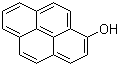 |
| Molecular Formula | C16H10O |
| Molecular Weight | 218.25 |
| CAS Registry Number | 5315-79-7 |
| EC Number | 624-224-9 |
| SMILES | C1=CC2=C3C(=C1)C=CC4=C(C=CC(=C43)C=C2)O |
| Density | 1.4±0.1 g/cm3, Calc.* |
|---|---|
| Melting point | 179-182 °C (Expl.) |
| Index of Refraction | 1.895, Calc.* |
| Boiling Point | 437.4±14.0 °C (760 mmHg), Calc.* |
| Flash Point | 213.0±12.0 °C, Calc.* |
| * | Calculated using Advanced Chemistry Development (ACD/Labs) Software. |
| Hazard Symbols |  GHS07 Warning Details GHS07 Warning Details | ||||||||||||||||
|---|---|---|---|---|---|---|---|---|---|---|---|---|---|---|---|---|---|
| Risk Statements | H315-H319-H335 Details | ||||||||||||||||
| Safety Statements | P261-P305+P351+P338 Details | ||||||||||||||||
| Hazard Classification | |||||||||||||||||
| |||||||||||||||||
| SDS | Available | ||||||||||||||||
 chemBlink Chemical Story
|
1-Hydroxypyrene is a chemical compound that belongs to the class of polycyclic aromatic hydrocarbons (PAHs). It is formed by the hydroxylation of pyrene, a common PAH, and it is considered one of the hydroxylated metabolites of pyrene found in biological systems. 1-Hydroxypyrene is typically used as a biomarker for exposure to pyrene and other PAHs, especially in environmental monitoring and human exposure studies. The discovery of 1-hydroxypyrene dates back to studies focused on the metabolism of polycyclic aromatic hydrocarbons, which are known for their potential carcinogenic effects. Researchers identified 1-hydroxypyrene as one of the primary metabolites formed when pyrene is metabolized in the body, particularly in the liver. This process involves the action of enzymes such as cytochrome P450, which hydroxylate pyrene to produce various hydroxylated metabolites, including 1-hydroxypyrene. 1-Hydroxypyrene is of significant interest due to its role as an indicator of exposure to pyrene and other PAHs, which are prevalent in environmental pollution sources, including cigarette smoke, industrial emissions, vehicle exhaust, and the combustion of fossil fuels. Since pyrene and its metabolites, including 1-hydroxypyrene, are excreted in urine, the presence and concentration of 1-hydroxypyrene in urine samples are commonly used in environmental health studies as a biomarker for PAH exposure. It is often measured to assess exposure in individuals who work in industries such as aluminum production, coke production, or those who are exposed to heavy traffic pollution. The applications of 1-hydroxypyrene extend beyond environmental exposure studies. It is also used in clinical and toxicological research to investigate the effects of PAH exposure on human health, including the potential for carcinogenicity. Since PAHs are associated with an increased risk of various cancers, including lung and skin cancers, the measurement of 1-hydroxypyrene serves as a useful tool in studying the link between environmental PAH exposure and cancer risk. In addition, 1-hydroxypyrene is used in laboratory experiments to investigate the mechanisms of PAH metabolism and detoxification. It aids in the understanding of how the body processes and eliminates harmful substances, providing insights into the potential risks associated with PAH exposure. The presence of 1-hydroxypyrene in urine has also been utilized in epidemiological studies to examine the impact of air pollution on human health. Elevated levels of 1-hydroxypyrene have been correlated with increased exposure to PAH pollutants, helping to establish a link between environmental contamination and adverse health outcomes. Furthermore, its role as a marker for PAH exposure has made it valuable in monitoring the effectiveness of regulatory measures aimed at reducing air pollution and the health risks associated with PAH exposure. The analysis of 1-hydroxypyrene typically involves high-performance liquid chromatography (HPLC) or other sensitive analytical techniques to accurately detect and quantify the compound in urine or other biological samples. Due to its strong association with pyrene exposure, the measurement of 1-hydroxypyrene is widely used in environmental and occupational health studies to assess the degree of exposure to hazardous air pollutants. In conclusion, 1-hydroxypyrene is an important metabolite of pyrene, commonly used as a biomarker for the assessment of exposure to polycyclic aromatic hydrocarbons. It plays a critical role in environmental health studies and occupational safety, aiding in the understanding of the risks associated with PAH exposure. Its presence in urine serves as a valuable indicator of human exposure to environmental pollutants, particularly in individuals working in industries that involve combustion processes or in areas with high levels of air pollution. Through its applications in research and environmental monitoring, 1-hydroxypyrene continues to contribute to the assessment and management of public health risks associated with PAH exposure. References 2003. Simultaneous analysis of naphthols, phenanthrols, and 1-hydroxypyrene in urine as biomarkers of polycyclic aromatic hydrocarbon exposure: intraindividual variance in the urinary metabolite excretion profiles caused by intervention with beta-naphthoflavone induction in the rat. Archives of Toxicology, 77(3). DOI: 10.1007/s00204-003-0436-0 2015. The influence of season and living environment on children's urinary 1-hydroxypyrene levels in Ulaanbaatar, Mongolia. Environmental Research, 137. DOI: 10.1016/j.envres.2014.11.022 2021. Exposure to polycyclic aromatic hydrocarbon mixtures and early kidney damage in Mexican indigenous population. Environmental Science and Pollution Research, 28(26). DOI: 10.1007/s11356-021-12388-w |
| Market Analysis Reports |