
Online Database of Chemicals from Around the World
| Epochem Co., Ltd. | China | |||
|---|---|---|---|---|
 | www.epochem.com | |||
 | +86 (21) 6760-1595 6760-1597 | |||
 | +86 (21) 6760-1605 | |||
 | seth_wang@epochem.com | |||
 | QQ Chat | |||
| Chemical manufacturer since 2006 | ||||
| chemBlink Standard supplier since 2005 | ||||
| Changzhou Yongrui Chemical Research Institute Co., Ltd. | China | |||
|---|---|---|---|---|
| www.czyrchem.com | |||
| +86 (519) 8988-6091 8529-5892 | |||
| +86 (519) 8522-7977 | |||
| info@czyrchem.com | |||
| Chemical manufacturer | ||||
| chemBlink Standard supplier since 2008 | ||||
| Novasyn Organics Pvt. Ltd. | India | |||
|---|---|---|---|---|
| www.novasynorganics.com | |||
| +91 (406) 620-2233 633-9111 | |||
| +91 (402) 781-1997 | |||
| info@novasynorganics.com | |||
| Chemical manufacturer | ||||
| chemBlink Standard supplier since 2010 | ||||
| SL Drugs and Pharmaceuticals Pvt. Ltd. | India | |||
|---|---|---|---|---|
| www.sldrugs.com | |||
| +91 (40) 6661-1133 | |||
| +91 (40) 2375-1130 | |||
| enquiry@sldrugs.com | |||
| Chemical distributor since 1999 | ||||
| chemBlink Standard supplier since 2010 | ||||
| BOC Sciences | USA | |||
|---|---|---|---|---|
| www.bocsci.com | |||
| +1 (631) 485-4226 | |||
| +1 (631) 614-7828 | |||
| info@bocsci.com | |||
| Chemical manufacturer | ||||
| chemBlink Standard supplier since 2010 | ||||
| Hangzhou Leap Chem Co., Ltd. | China | |||
|---|---|---|---|---|
| www.leapchem.com | |||
| +86 (571) 8771-1850 | |||
| market19@leapchem.com | |||
| QQ Chat | |||
| Chemical manufacturer since 2006 | ||||
| chemBlink Standard supplier since 2015 | ||||
| Shanghai Eliv Pharmaceutical Co., Ltd. | China | |||
|---|---|---|---|---|
| www.elivpharma.com | |||
| +86 (21) 5015-8063 | |||
| +86 (21) 5015-8063 | |||
| sales@elivpharma.com | |||
| Chemical manufacturer since 2011 | ||||
| chemBlink Standard supplier since 2015 | ||||
| Amadis Chemical Co., Ltd. | China | |||
|---|---|---|---|---|
| www.amadischem.com | |||
| +86 (571) 8992-5085 | |||
| +86 (571) 8992-5065 | |||
| sales@amadischem.com | |||
| Chemical manufacturer since 2010 | ||||
| chemBlink Standard supplier since 2015 | ||||
| Wonderchem Co., Limited | Hong Kong | |||
|---|---|---|---|---|
| www.wonder-chem.com | |||
| +852 8192-5218 | |||
| sales@wonder-chem.com | |||
| Chemical distributor since 2016 | ||||
| chemBlink Standard supplier since 2017 | ||||
| Finetech Industry Limited | China | |||
|---|---|---|---|---|
| www.finetechchem.com | |||
| +86 (27) 8746-5837 +86 18971612321 | |||
| +86 (27) 8777-2287 | |||
| sales@finetechnology-ind.com | |||
| QQ Chat | |||
| Chemical manufacturer since 2009 | ||||
| chemBlink Standard supplier since 2019 | ||||
| INA Pharmaceuticals Pvt. Ltd. | India | |||
|---|---|---|---|---|
| inapharma.in | |||
| +91 7815933367 | |||
| rd@inapharma.in | |||
| Chemical manufacturer since 2018 | ||||
| chemBlink Standard supplier since 2026 | ||||
| Combi-Blocks, Inc. | USA | |||
|---|---|---|---|---|
| www.combi-blocks.com | |||
| +1 (858) 635-8950 | |||
| +1 (858) 635-8991 | |||
| sales@combi-blocks.com | |||
| Chemical manufacturer | ||||
| Georganics Ltd. | Slovakia | |||
|---|---|---|---|---|
| www.georganics.sk | |||
| +421 (33) 640-3132 | |||
| +421 (33) 640-3133 | |||
| georganics@georganics.sk | |||
| Chemical manufacturer since 1998 | ||||
| Anvia Chemicals, LLC | USA | |||
|---|---|---|---|---|
| www.anviachem.com | |||
| +1 (414) 534-7845 | |||
| +1 (414) 762-5539 | |||
| sales@anviachem.com | |||
| Chemical manufacturer | ||||
| Activate Scientific GmbH | Germany | |||
|---|---|---|---|---|
| www.activate-scientific.com | |||
| +49 (8051) 965-1660 | |||
| +49 (8051) 965-1661 | |||
| rschmitt@activate-scientific.com | |||
| Chemical manufacturer | ||||
| True Pharmachem Inc. | USA | |||
|---|---|---|---|---|
| www.truepharmachem.com | |||
| +1 (217) 766-6932 | |||
| +1 (973) 588-3470 | |||
| sales@truepharmachem.com | |||
| Chemical manufacturer | ||||
| Matrix Scientific Inc. | USA | |||
|---|---|---|---|---|
| www.matrixscientific.com | |||
| +1 (803) 788-9494 | |||
| +1 (803) 788-9419 | |||
| sales@matrixscientific.com | |||
| Chemical manufacturer | ||||
| Classification | Pharmaceutical intermediate >> Heterocyclic compound intermediate >> Pyridine compound >> Cyanopyridine |
|---|---|
| Name | 5-Bromo-3-nitropyridine-2-carbonitrile |
| Synonyms | 5-Bromo-2-cyano-3-nitropyridine |
| Molecular Structure | 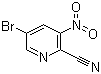 |
| Molecular Formula | C6H2BrN3O2 |
| Molecular Weight | 228.00 |
| CAS Registry Number | 573675-25-9 |
| EC Number | 629-442-8 |
| SMILES | C1=C(C=NC(=C1[N+](=O)[O-])C#N)Br |
| Density | 1.9±0.1 g/cm3 Calc.* |
|---|---|
| Melting point | 101 - 106 °C (Expl.) |
| Boiling point | 348.9±42.0 °C 760 mmHg (Calc.)* |
| Flash point | 164.8±27.9 °C (Calc.)* |
| Index of refraction | 1.646 (Calc.)* |
| * | Calculated using Advanced Chemistry Development (ACD/Labs) Software. |
| Hazard Symbols |    GHS05;GHS06;GHS07 Danger Details GHS05;GHS06;GHS07 Danger Details | ||||||||||||||||||||||||||||||||||||||||
|---|---|---|---|---|---|---|---|---|---|---|---|---|---|---|---|---|---|---|---|---|---|---|---|---|---|---|---|---|---|---|---|---|---|---|---|---|---|---|---|---|---|
| Risk Statements | H301-H312-H315-H318-H332-H335 Details | ||||||||||||||||||||||||||||||||||||||||
| Safety Statements | P261-P264-P264+P265-P270-P271-P280-P301+P316-P302+P352-P304+P340-P305+P354+P338-P317-P319-P321-P330-P332+P317-P362+P364-P403+P233-P405-P501 Details | ||||||||||||||||||||||||||||||||||||||||
| Hazard Classification | |||||||||||||||||||||||||||||||||||||||||
| |||||||||||||||||||||||||||||||||||||||||
| SDS | Available | ||||||||||||||||||||||||||||||||||||||||
 chemBlink Chemical Story
|
5-Bromo-3-nitropyridine-2-carbonitrile, CAS 573675-25-9, is a highly substituted pyridine intermediate used in organic and medicinal chemistry. Its molecular formula is C6H2BrN3O2 and its molecular weight is 228.00. The molecule contains a pyridine nitrogen together with bromo, nitro, and nitrile substituents positioned around the same six-membered aromatic ring. This combination makes the molecule more interesting than its small size might suggest. Each substituent changes the electronic character of the pyridine ring, and some can also serve as handles for subsequent synthetic transformations. The pyridine ring itself is more electron deficient than benzene because one ring carbon has been replaced by nitrogen. The nitrile group, -C≡N, and nitro group, -NO2, are also strongly electron withdrawing. Together they produce an aromatic system whose substitution chemistry can differ considerably from that of a simple bromopyridine. An experimentally documented preparation begins with 2,5-dibromo-3-nitropyridine. Reaction with copper(I) cyanide at 90 °C replaces one of the two bromine atoms with a nitrile group while leaving the other bromine in place. A reported experiment using 25 g of the dibromo starting material gave 17.5 g of 5-bromo-3-nitropyridine-2-carbonitrile, corresponding to a 68% yield. This reaction already illustrates selective molecular editing. The starting material contains two carbon-bromine bonds, but the reaction introduces the nitrile at a particular position while preserving the bromine that can be useful in later chemistry. An even more unusual transformation appears in patent literature involving substituted pyridines. 5-Bromo-3-nitropyridine-2-carbonitrile was treated at room temperature with tetrabutylammonium fluoride in tetrahydrofuran. One might expect fluorine chemistry in a brominated aromatic compound to involve replacement of bromine. That is not what happened. Instead, the nitro group at the 3-position was displaced and fluorine appeared at that position, producing 5-bromo-3-fluoropyridine-2-carbonitrile. The bromine remained attached to the ring. This is an example of nucleophilic aromatic substitution in a highly electron-deficient heteroaromatic system in which a nitro group can function as a leaving group. Nitro groups are usually introduced into aromatic molecules because of their strong electron-withdrawing properties or because they can later be reduced to amino groups. Their ability to leave under suitable nucleophilic substitution conditions is much less familiar to many readers. The reaction demonstrates an important principle: the role of a functional group is determined not only by its name but also by its molecular environment. A group that normally seems permanent can behave very differently when surrounded by ring nitrogen and other electron-withdrawing substituents. Preserving the bromine was especially useful because it left another synthetic handle available. In the next documented step, the resulting 5-bromo-3-fluoropyridine-2-carbonitrile was reacted with 2-hydroxyphenylboronic acid in the presence of a palladium catalyst and sodium carbonate. A Suzuki coupling occurred at the carbon bearing bromine. The C-Br bond was therefore replaced by a new carbon-carbon bond joining the pyridine to an aromatic ring. The sequence is chemically elegant. The original molecule contains two positions that can be edited by different mechanisms. First, fluoride replaces the nitro group while bromine survives. Then palladium-catalyzed coupling uses the surviving bromine to attach another carbon fragment. In simplified form, the sequence can be viewed as: NO2 → F followed by C-Br → C-C while the pyridine nitrile framework remains available throughout the sequence. This kind of orthogonal reactivity is extremely valuable in medicinal chemistry. Researchers often need to prepare many related molecules while changing one structural feature at a time. If different positions of an intermediate can be modified selectively by different reactions, a common starting material can lead to a much larger family of compounds. The nitrile contributes yet another useful structural feature. Aromatic nitriles are compact and strongly polar functional groups. The carbon-nitrogen triple bond adds relatively little molecular volume while substantially affecting electronic properties. Nitriles are also common motifs in medicinal chemistry, although their role depends entirely on the complete molecular structure. The nitro group provides additional possibilities in other synthetic routes. Besides acting as a leaving group under unusual substitution conditions, aromatic nitro groups can commonly be reduced to amino groups. An amino group can then participate in amide formation, diazotization, cyclization, and many other transformations. Likewise, an aryl bromide need not be limited to Suzuki coupling. Carbon-bromine bonds on heteroaromatic rings are widely used in palladium-catalyzed carbon-carbon and carbon-heteroatom bond-forming reactions. Which transformation is appropriate depends on the desired target. This explains why highly substituted heteroaromatic intermediates are valuable despite sometimes having no well-known application as final products. Their usefulness comes from optionality. Several chemically distinct groups are assembled in predetermined positions, giving synthetic chemists choices about what to change and what to preserve. 5-Bromo-3-nitropyridine-2-carbonitrile is therefore best viewed as a programmable intermediate rather than a finished functional molecule. Its six-membered ring contains only five carbon atoms and one ring nitrogen, yet it carries three strategically useful substituents. Published chemistry shows that one can introduce the nitrile selectively, replace the nitro group with fluorine, preserve the bromine during that transformation, and then use the bromine to construct a new carbon-carbon bond. The molecule illustrates a central skill of modern synthetic chemistry: complexity is not only about how many atoms a molecule contains. It is also about how independently those atoms and functional groups can be manipulated. A small molecule becomes a powerful building block when different positions can be addressed at different times. References 1. PubChem. 5-Bromo-3-nitropyridine-2-carbonitrile, CID 2769698. CAS 573675-25-9. Molecular formula C6H2BrN3O2; molecular weight 228.00. 2. EP 1757594 A1. Preparation of 5-bromo-3-nitropyridine-2-carbonitrile from 2,5-dibromo-3-nitropyridine and copper(I) cyanide. 3. EP 2471792 B1. Conversion of 5-bromo-3-nitropyridine-2-carbonitrile to 5-bromo-3-fluoropyridine-2-carbonitrile with tetrabutylammonium fluoride, followed by palladium-catalyzed coupling with 2-hydroxyphenylboronic acid. 4. TCI Chemicals. 5-Bromo-2-cyano-3-nitropyridine, CAS 573675-25-9. 5. Sigma-Aldrich. 5-Bromo-3-nitropyridine-2-carbonitrile, CAS 573675-25-9. |
| Market Analysis Reports |