
Online Database of Chemicals from Around the World
| Hangzhou Verychem Science And Technology Co., Ltd. | China | |||
|---|---|---|---|---|
 | www.verychem.com | |||
 | +86 (571) 8816-2785 +86 13606544505 | |||
 | +86 (571) 8816-2787 | |||
 | lucy@verychem.com | |||
| Chemical manufacturer since 2004 | ||||
| chemBlink Massive supplier since 2021 | ||||
| Simagchem Corporation | China | |||
|---|---|---|---|---|
| www.simagchem.com | |||
| +86 13806087780 | |||
| +86 (592) 268-0237 | |||
| sale@simagchem.com | |||
| Chemical manufacturer since 2002 | ||||
| chemBlink Standard supplier since 2008 | ||||
| Epsilon Chimie Chemical Manufacturer | France | |||
|---|---|---|---|---|
| www.epsilon-chimie.com | |||
| +33 (2) 9842-4650 | |||
| +33 (2) 9842-4402 | |||
| pierre.cornec@epsilon-chimie.com | |||
| Chemical manufacturer | ||||
| Classification | Organic raw materials >> Organic phosphine compound |
|---|---|
| Name | tert-Butyl O,O-dimethylphosphonoacetate |
| Synonyms | Dimethyl (tert-butoxycarbonyl)methylphosphonate |
| Molecular Structure | 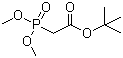 |
| Molecular Formula | C8H17O5P |
| Molecular Weight | 224.19 |
| CAS Registry Number | 62327-21-3 |
| EC Number | 629-650-9 |
| SMILES | CC(C)(C)OC(=O)CP(=O)(OC)OC |
| Density | 1.1±0.1 g/cm3 Calc.* |
|---|---|
| Boiling point | 275.6±23.0 °C 760 mmHg (Calc.)* |
| Flash point | 134.5±42.9 °C (Calc.)* |
| Index of refraction | 1.423 (Calc.)* |
| * | Calculated using Advanced Chemistry Development (ACD/Labs) Software. |
| Hazard Symbols |  GHS07 Warning Details GHS07 Warning Details | ||||||||||||||||
|---|---|---|---|---|---|---|---|---|---|---|---|---|---|---|---|---|---|
| Risk Statements | H315-H319-H335 Details | ||||||||||||||||
| Safety Statements | P261-P264-P264+P265-P271-P280-P302+P352-P304+P340-P305+P351+P338-P319-P321-P332+P317-P337+P317-P362+P364-P403+P233-P405-P501 Details | ||||||||||||||||
| Hazard Classification | |||||||||||||||||
| |||||||||||||||||
| SDS | Available | ||||||||||||||||
 chemBlink Chemical Story
|
tert-Butyl O,O-dimethylphosphonoacetate is an organophosphorus compound containing both phosphonate and ester functionalities within the same molecule. Structurally, it can be viewed as a phosphonoacetic acid derivative in which the phosphonic acid portion is present as a dimethyl phosphonate ester and the carboxylic acid portion is protected as a tert-butyl ester. Compounds of this type are commonly used as intermediates in synthetic organic chemistry, particularly in carbon–carbon bond-forming transformations. The molecule contains three principal structural components: a phosphonate group, an ester group, and a methylene linker connecting these functionalities. The phosphonate region has the general arrangement P(=O)(OCH₃)₂, in which phosphorus is bonded to one doubly bonded oxygen atom and two methoxy groups. The phosphorus center is tetrahedral and highly polarized because of the strong electronegativity difference between phosphorus and oxygen. The phosphoryl bond (P=O) is the most polarized region of the molecule and contributes strongly to intermolecular interactions. Although often represented as a double bond in conventional structures, the phosphorus–oxygen interaction has significant ionic and resonance character. The oxygen atom of this group is a strong hydrogen-bond acceptor and substantially influences the polarity of the molecule. Attached to the phosphorus center is a methylene unit connected to a carboxylate-derived tert-butyl ester. The tert-butyl ester portion consists of a carbonyl group attached to an oxygen atom bearing a tert-butyl substituent. Esterification masks the acidity of the corresponding carboxylic acid and generally increases hydrophobicity relative to the free acid. The tert-butyl group introduces substantial steric bulk around the ester functionality. This steric effect can influence reactivity and can also alter physical properties such as volatility and solubility. tert-Butyl esters are commonly used in synthesis because they can often be removed under acidic conditions while remaining stable under many other reaction environments. The methylene carbon positioned between the phosphonate and carbonyl-containing portions is chemically significant because it is adjacent to two electron-withdrawing groups. Such substitution substantially increases the acidity of the methylene hydrogens relative to ordinary alkanes. Deprotonation at this position can generate a resonance-stabilized carbanion equivalent, a feature that contributes to the synthetic utility of phosphonoacetate derivatives. Phosphonate-containing compounds of this general class are frequently used in reactions such as the Horner–Wadsworth–Emmons transformation, in which phosphorus-stabilized carbanions react with carbonyl compounds to form carbon–carbon double bonds. The electron-withdrawing effects of the phosphonate group help stabilize reactive intermediates involved in these processes. From a physicochemical standpoint, tert-butyl O,O-dimethylphosphonoacetate possesses both polar and hydrophobic regions. The phosphoryl and ester groups contribute significant polarity and hydrogen-bond-accepting ability, while the methoxy and tert-butyl substituents provide hydrophobic character. As a result, the molecule is generally compatible with a range of organic solvents. Chemically, the phosphonate ester groups and tert-butyl ester functionality are generally stable under neutral conditions but may undergo cleavage under suitable hydrolytic conditions. The phosphorus center itself is resistant to many reaction environments, while the activated methylene position often serves as the principal reactive site. Overall, tert-butyl O,O-dimethylphosphonoacetate is a multifunctional organophosphorus ester characterized by a polarized phosphonate group, a protected carboxyl functionality, and an activated methylene bridge. Its importance lies primarily in its role as a versatile synthetic intermediate for carbon–carbon bond-forming reactions. References 2009. Synthesis from Phosphonates and Enones or Enals. Science of Synthesis. DOI: https://science-of-synthesis.thieme.com/app/text/?id=SD-046-00015 2005. Curtius Rearrangements of α-Acylazido Phosphonates. Science of Synthesis. DOI: https://science-of-synthesis.thieme.com/app/text/?id=SD-021-00315 |
| Market Analysis Reports |