
Online Database of Chemicals from Around the World
| Xiamen Sunprochem Co., Ltd. | China | |||
|---|---|---|---|---|
 | www.sunprochem.com | |||
 | +86 (159) 8094-4750 | |||
 | sale@sunprochem.com | |||
 | QQ Chat | |||
 | WeChat: 15980944750 | |||
 | WhatsApp:+86 159 8094 4750 | |||
| Chemical manufacturer since 2026 | ||||
| chemBlink Standard supplier since 2026 | ||||
| Classification | Organic raw materials >> Carboxylic compounds and derivatives >> Carboxylic esters and their derivatives |
|---|---|
| Name | Polyoxyethylene sorbitol tetraoleate |
| Synonyms | Ethoxylated sorbitol tetraoleate; Poly(oxy-1,2-ethanediyl), alpha-hydro-omega-hydroxy-, ether with D-glucitol (6:1), tetra-(9Z)-9-octadecenoate; 2-[1-[1,2-Bis(2-Hydroxyethoxy)Ethyl]-2,3,4-Tris(2-Hydroxyethoxy)Butoxy]Ethanol; (Z)-Octadec-9-Enoic Acid; Nikkol Go 4; Nikkol Go 430 |
| Molecular Structure | 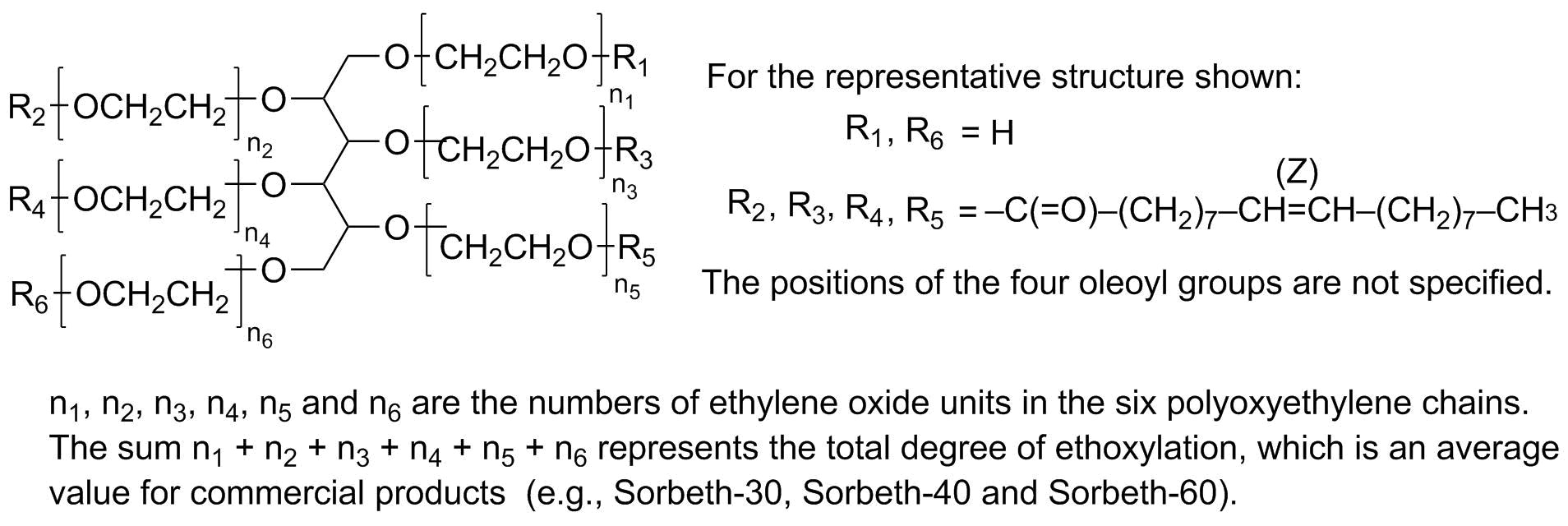 |
| Molecular Formula | (C2H4O)n(C2H4O)n(C2H4O)n(C2H4O)n(C2H4O)n(C2H4O)nC78H142O10 |
| CAS Registry Number | 63089-86-1 |
| EC Number | 684-590-0 |
| SMILES | C(OCCO)C(OCCO)C(OCCO)C(OCCO)C(OCCO)COCCO.C(C(=O)O)CCCCCCC=C/CCCCCCCC.C(C(=O)O)CCCCCCC=C/CCCCCCCC.C(C(=O)O)CCCCCCC=C/CCCCCCCC.C(C(=O)O)CCCCCCC=C/CCCCCCCC |
| Hazard Symbols |  GHS07 Warning Details GHS07 Warning Details | ||||||||
|---|---|---|---|---|---|---|---|---|---|
| Risk Statements | H315 Details | ||||||||
| Safety Statements | P264-P280-P302+P352-P321-P332+P317-P362+P364 Details | ||||||||
| Hazard Classification | |||||||||
| |||||||||
 chemBlink Chemical Story
|
Polyoxyethylene sorbitol tetraoleate, CAS 63089-86-1, is a compositionally distributed nonionic surfactant. Its chemical story is best understood by looking at how its structure creates function rather than by treating the name as a simple catalog label. The molecule or material combines a sorbitol-derived core, polyoxyethylene segments and several oleate chains, a combination that explains its relevance to emulsification, wetting, dispersion and solubilization. The polyoxyethylene region interacts favorably with water through ether oxygens, while long oleate chains prefer oil and other nonpolar phases. At an oil-water boundary the two regions orient toward their preferred environments, lowering interfacial free energy and slowing droplet coalescence. Changing ethoxylation and esterification changes hydrophilic-lipophilic balance and therefore formulation behavior. PubChem notes that this record may not represent one discrete molecular structure. That is typical of many industrial surfactants, whose useful properties arise from a controlled average composition rather than one perfectly uniform molecule. A broader lesson follows from this example. Chemical identity is only the starting point for performance. In polymers and surfactants, composition, molecular distribution and formulation can dominate behavior; in synthetic intermediates, the value may lie in transformations that occur only in later steps; in biologically active compounds, mechanism must be separated from clinical evidence. For Polyoxyethylene sorbitol tetraoleate, the most reliable interpretation is therefore the one supported by its documented chemistry and literature rather than an assumed application. The compound also illustrates why specialty chemicals often look more complicated than their job description suggests. Functional groups are selected to solve different parts of a practical problem: one region may provide reactivity, another solubility or interfacial affinity, and another stability or a controllable breaking point. Once those roles are separated, the long chemical name becomes a map of molecular design. References: PubChem, Polyoxyethylene sorbitol tetraoleate, CAS 63089-86-1, SID 505862774; CAS Common Chemistry, CAS 63089-86-1; Rosen MJ, Kunjappu JT. Surfactants and Interfacial Phenomena. 4th ed. Wiley, 2012. |
| Market Analysis Reports |