
Online Database of Chemicals from Around the World
| Nanjing Search Biotech Co., Ltd. | China | |||
|---|---|---|---|---|
 | www.searchbio.com.cn | |||
 | +86 (25) 8168-2922 8586-0978 +86 18913919581 | |||
 | +86 (25) 8586-0962 | |||
 | trade@searchbio.com.cn sales@searchbio.com.cn Linda@searchbio.com.cn | |||
 | QQ Chat | |||
| Chemical manufacturer since 2007 | ||||
| chemBlink Standard supplier since 2007 | ||||
| Simagchem Corporation | China | |||
|---|---|---|---|---|
| www.simagchem.com | |||
| +86 13806087780 | |||
| +86 (592) 268-0237 | |||
| sale@simagchem.com | |||
| Chemical manufacturer since 2002 | ||||
| chemBlink Standard supplier since 2008 | ||||
| LOBA Feinchemie AG | Austria | |||
|---|---|---|---|---|
| www.loba.co.at | |||
| +43 (223) 277-391 | |||
| +43 (223) 276-677 | |||
| sales@loba.co.at | |||
| Chemical distributor | ||||
| chemBlink Standard supplier since 2012 | ||||
| Biosynth AG. | Switzerland | |||
|---|---|---|---|---|
| www.biosynth.com | |||
| +41 (71) 858-2020 | |||
| +41 (71) 858-2030 | |||
| welcome@biosynth.ch | |||
| Chemical manufacturer | ||||
| chemBlink Standard supplier since 2014 | ||||
| Carbosynth China Ltd. | China | |||
|---|---|---|---|---|
| www.carbosynth.cn | |||
| +86 (512) 6260-5585 | |||
| +86 (512) 6260-5576 | |||
| sales@carbosynth.com | |||
| QQ Chat | |||
| Chemical manufacturer since 2006 | ||||
| chemBlink Standard supplier since 2016 | ||||
| Suzhou Laing Biological Technology Co., Ltd. | China | |||
|---|---|---|---|---|
| www.laingbiotec.com | |||
| +86 18100692919 | |||
| export@laingbiotec.com | |||
| Chemical manufacturer since 2013 | ||||
| chemBlink Standard supplier since 2019 | ||||
| HuNan Huibaiyi New Materials Co; Ltd. | China | |||
|---|---|---|---|---|
| www.hbsjxcl.com | |||
| +86 13319523173 | |||
| ivy@hnhbsj.com | |||
| QQ Chat | |||
 | WeChat: 13319523173 | |||
| Chemical manufacturer since 2014 | ||||
| chemBlink Standard supplier since 2026 | ||||
| Nanjing Greensynthesis Biochemical Co., Ltd. | China | |||
|---|---|---|---|---|
| www.greensynchem.com | |||
| +86 (25) 8549-3277 | |||
| +86 (25) 8330-2337 | |||
| sales@greensynchem.com | |||
| Chemical manufacturer since 2003 | ||||
| Dojindo Molecular Technologies, Inc. | USA | |||
|---|---|---|---|---|
| www.dojindo.com | |||
| +1 (301) 987-2667 | |||
| +1 (301) 987-2687 | |||
| info@dojindo.com | |||
| Chemical manufacturer | ||||
| Suzhou BEC Fine Chemicals Co., Ltd. | China | |||
|---|---|---|---|---|
| www.bek.com.cn | |||
| +86 (512) 6809-5917 +86 13806207098 | |||
| +86 (512) 6841-7933 | |||
| bek@bek.com.cn | |||
| Chemical manufacturer | ||||
| Luoyang Tiancheng Chemical Reagent Co., Ltd. | China | |||
|---|---|---|---|---|
| www.tcchemical.com | |||
| +86 13851387644 +86 13951399608 | |||
| tc66cn@126.com | |||
| Chemical manufacturer | ||||
| Cayman Chemical Company | USA | |||
|---|---|---|---|---|
| www.caymanchem.com | |||
| +1 (734) 971-3335 | |||
| +1 (734) 971-3640 | |||
| sales@caymanchem.com | |||
| Chemical manufacturer | ||||
| Classification | Biochemical >> Biochemical reagent >> Biological dye |
|---|---|
| Name | 3,3',5,5'-Tetramethylbenzidine dihydrochloride |
| Synonyms | 4,4'-Diamino-3,3',5,5'-tetramethylbiphenyl dihydrochloride |
| Molecular Structure | 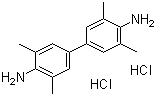 |
| Molecular Formula | C16H20N2.2(HCl) |
| Molecular Weight | 313.27 |
| CAS Registry Number | 64285-73-0 |
| EC Number | 264-769-6 |
| SMILES | CC1=CC(=CC(=C1N)C)C2=CC(=C(C(=C2)C)N)C.Cl.Cl |
| Melting point | >300 °C |
|---|---|
| Hazard Symbols |   GHS07;GHS08 Warning Details GHS07;GHS08 Warning Details |
|---|---|
| Risk Statements | H302-H312-H332-H341-H351-H413 Details |
| Safety Statements | P203-P261-P264-P270-P271-P273-P280-P301+P317-P302+P352-P304+P340-P317-P318-P321-P330-P362+P364-P405-P501 Details |
| SDS | Available |
 chemBlink Chemical Story
|
3,3′,5,5′-Tetramethylbenzidine dihydrochloride is an aromatic diamine salt commonly used as a chromogenic substrate in biochemical assays, particularly in enzyme-linked immunoassays. The compound is the protonated dihydrochloride form of 3,3′,5,5′-tetramethylbenzidine (TMB), a substituted biphenyl derivative containing two dimethyl-substituted aniline rings linked through a central benzidine-type bond. Structurally, the molecule consists of two benzene rings connected through a single carbon–carbon bond at the 4,4′ positions, forming a biphenyl (benzidine-like) core. Each aromatic ring carries two methyl substituents at the 3 and 5 positions, which increase steric hindrance and influence the rotational freedom around the central C–C bond. This substitution pattern also increases hydrophobic character and stabilizes the aromatic system. At the 4 and 4′ positions of the biphenyl core are primary aromatic amine groups (–NH2 in the free base form). In the dihydrochloride salt, these amines are protonated to form ammonium groups (–NH3+), with chloride ions serving as counterions. This protonation significantly increases water solubility and alters the electronic properties of the aromatic system by reducing the availability of the nitrogen lone pairs for resonance donation. The aromatic amine groups are electron-donating in the neutral form, contributing electron density into the benzene rings through resonance. However, in the protonated dihydrochloride form, this electron donation is suppressed, and the molecule becomes more electron-deficient and stabilized in aqueous environments. The protonation state is therefore important for storage and handling prior to use in assays. The methyl substituents at the 3 and 5 positions on each ring are electron-donating through inductive effects and contribute steric bulk that prevents excessive planarity between adjacent molecules. This steric hindrance affects crystal packing and can influence the compound’s solubility and solid-state behavior. The most important chemical property of 3,3′,5,5′-tetramethylbenzidine is its ability to undergo oxidation. In enzymatic assays, it is commonly oxidized by peroxidase enzymes in the presence of hydrogen peroxide. The oxidation process converts the colorless reduced form into a colored radical cation or diimine species, producing a blue-colored intermediate. This oxidized form is stabilized by delocalization of the unpaired electron or positive charge across the conjugated biphenyl system. Upon further oxidation, the compound can form a fully oxidized yellow diimine product. These distinct color transitions make TMB highly useful for quantitative spectrophotometric measurements. From a physicochemical perspective, the dihydrochloride form is highly polar and water-soluble due to the presence of protonated amine groups and chloride counterions. The aromatic core remains hydrophobic, giving the molecule amphiphilic character in solution. The biphenyl system is not fully planar due to steric repulsion between ortho-methyl substituents, which forces the two rings to adopt a twisted conformation. This non-planarity reduces conjugation between rings in the ground state but does not prevent electronic delocalization in oxidized forms. Chemically, the most reactive sites are the aromatic amine groups, which undergo reversible protonation and irreversible oxidation. The oxidation chemistry is central to its function as a chromogenic substrate, as the intensity of color formation is proportional to enzymatic activity in peroxidase-based detection systems. Overall, 3,3′,5,5′-tetramethylbenzidine dihydrochloride is a protonated biphenyl diamine salt with four methyl substituents that modulate its steric and electronic properties. Its ability to undergo enzyme-mediated oxidation into strongly colored species makes it a widely used reagent in immunoassays and biochemical detection systems. References 2026. Toxicity of ivermectin on multiple insecticide-resistant populations of Anopheles gambiae sensu lato, Aedes aegypti, and Culex mosquitoes. Parasites & Vectors. DOI: 10.1186/s13071-025-07227-7 2025. An influenza HA mRNA-LNP vaccine induces potent responses in newborn nonhuman primates that enhance protection from challenge. npj Vaccines. DOI: 10.1038/s41541-025-01317-4 2025. Synthesis and characterization of nanozyme-supported reduced graphene oxide/chitosan/Ag as an enzyme-like catalyst for carbaryl pesticide detection. Environmental science and pollution research international. DOI: 10.1007/s11356-025-37276-5 |
| Market Analysis Reports |