
Online Database of Chemicals from Around the World
| Discovery Fine Chemicals Ltd. | UK | |||
|---|---|---|---|---|
 | www.discofinechem.com | |||
 | +44 (1202) 874-517 | |||
 | +44 (845) 094-4385 | |||
 | pjc@discofinechem.com | |||
| Chemical manufacturer | ||||
| chemBlink Standard supplier since 2009 | ||||
| Hefei TNJ Chemical Industry Co., Ltd. | China | |||
|---|---|---|---|---|
| www.tnjchem.com | |||
| +86 (551) 6541-8684 | |||
| +86 (551) 6541-8697 | |||
| sales@tnjchem.com | |||
| Chemical manufacturer since 2001 | ||||
| chemBlink Standard supplier since 2010 | ||||
| BOC Sciences | USA | |||
|---|---|---|---|---|
| www.bocsci.com | |||
| +1 (631) 485-4226 | |||
| +1 (631) 614-7828 | |||
| info@bocsci.com | |||
| Chemical manufacturer | ||||
| chemBlink Standard supplier since 2010 | ||||
| Hangzhou TJM Chemical Co., Ltd. | China | |||
|---|---|---|---|---|
| www.tjmchem.com | |||
| +86 13388471767 | |||
| +86 (571) 8822-3279 | |||
| sales@tjmchem.com | |||
| Chemical manufacturer | ||||
| chemBlink Standard supplier since 2011 | ||||
| Hangzhou Leap Chem Co., Ltd. | China | |||
|---|---|---|---|---|
| www.leapchem.com | |||
| +86 (571) 8771-1850 | |||
| market19@leapchem.com | |||
 | QQ Chat | |||
| Chemical manufacturer since 2006 | ||||
| chemBlink Standard supplier since 2015 | ||||
| Carbosynth China Ltd. | China | |||
|---|---|---|---|---|
| www.carbosynth.cn | |||
| +86 (512) 6260-5585 | |||
| +86 (512) 6260-5576 | |||
| sales@carbosynth.com | |||
| QQ Chat | |||
| Chemical manufacturer since 2006 | ||||
| chemBlink Standard supplier since 2016 | ||||
| Finetech Industry Limited | China | |||
|---|---|---|---|---|
| www.finetechchem.com | |||
| +86 (27) 8746-5837 +86 18971612321 | |||
| +86 (27) 8777-2287 | |||
| sales@finetechnology-ind.com | |||
| QQ Chat | |||
| Chemical manufacturer since 2009 | ||||
| chemBlink Standard supplier since 2019 | ||||
| HuNan Huibaiyi New Materials Co; Ltd. | China | |||
|---|---|---|---|---|
| www.hbsjxcl.com | |||
| +86 13319523173 | |||
| ivy@hnhbsj.com | |||
| QQ Chat | |||
 | WeChat: 13319523173 | |||
| Chemical manufacturer since 2014 | ||||
| chemBlink Standard supplier since 2026 | ||||
| Chemos GmbH & Co. KG | Germany | |||
|---|---|---|---|---|
| www.chemos.de | |||
| +49 871-966346-0 | |||
| +49 871-966346-13 | |||
| chemos@chemos.de | |||
| Chemical distributor | ||||
| Melford Laboratories Limited | UK | |||
|---|---|---|---|---|
| www.melford.co.uk | |||
| +44 (1449) 741-178 | |||
| +44 (1449) 741-217 | |||
| pfranklin@melford.co.uk sales@melford.co.uk | |||
| Chemical manufacturer since 1985 | ||||
| Santa Cruz Biotechnology, Inc. | USA | |||
|---|---|---|---|---|
| www.scbt.com | |||
| +1 (831) 457-3800 | |||
| +1 (831) 457-3801 | |||
| scbt@scbt.com | |||
| Chemical manufacturer | ||||
| Avonchem/Chromos Express Ltd. | UK | |||
|---|---|---|---|---|
| www.avonchem.co.uk | |||
| +44 (1625) 434-300 | |||
| +44 (1625) 869-777 | |||
| info@avonchem.co.uk | |||
| Chemical manufacturer | ||||
| Atlantic Research Chemicals Ltd. | UK | |||
|---|---|---|---|---|
| www.atlantic-chemicals.com | |||
| +44 (8707) 746-454 | |||
| +44 (8707) 746-455 | |||
| info@atlantic-chemicals.com | |||
| Chemical manufacturer | ||||
| Classification | Analytical chemistry >> Standard >> Titration standard |
|---|---|
| Name | Ethylenebis(oxyethylenenitrilo)tetraacetic acid |
| Synonyms | 1,2-Di(2-aminoethoxy)ethane-N,N,N,N-tetraacetic acid; EGTA; Ethylene glycolbis(aminoethylether)-tetra-acetic acid; Egtazic acid |
| Molecular Structure | 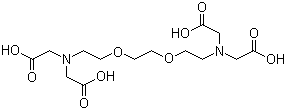 |
| Molecular Formula | C14H24N2O10 |
| Molecular Weight | 380.35 |
| CAS Registry Number | 67-42-5 |
| EC Number | 200-651-2 |
| SMILES | C(COCCOCCN(CC(=O)O)CC(=O)O)N(CC(=O)O)CC(=O)O |
| Density | 1.4±0.1 g/cm3 Calc.* |
|---|---|
| Melting point | 241 °C (Decomposes) (Expl.) |
| Boiling point | 678.0±55.0 °C 760 mmHg (Calc.)* |
| Flash point | 363.9±31.5 °C (Calc.)* |
| Solubility | Soluble to 100 mM in 1M NaOH (Expl.) |
| Index of refraction | 1.547 (Calc.)* |
| * | Calculated using Advanced Chemistry Development (ACD/Labs) Software. |
| Hazard Symbols |  GHS07 Warning Details GHS07 Warning Details | ||||||||||||||||
|---|---|---|---|---|---|---|---|---|---|---|---|---|---|---|---|---|---|
| Risk Statements | H315 Details | ||||||||||||||||
| Safety Statements | P264-P280-P302+P352-P321-P332+P317-P362+P364 Details | ||||||||||||||||
| Hazard Classification | |||||||||||||||||
| |||||||||||||||||
| SDS | Available | ||||||||||||||||
 chemBlink Chemical Story
|
Ethylenebis(oxyethylenenitrilo)tetraacetic acid is a synthetic polyaminocarboxylic acid belonging to the class of aminopolycarboxylate chelating agents. It is structurally related to EDTA-like ligands and is designed to strongly bind metal ions through multiple donor atoms, forming stable coordination complexes. The molecule contains a central ethylenediamine-derived framework in which two nitrogen atoms are connected through an ethylene bridge. Each nitrogen is further substituted with two carboxymethyl groups in the parent EDTA family; in this modified structure, the nitrogen atoms are linked through oxyethylene units, introducing ether oxygen atoms into the backbone. These ether linkages increase flexibility and alter the electronic environment of the ligand. The full structure consists of a combination of amine nitrogen atoms, ether oxygen atoms, and carboxylic acid groups. The nitrogen atoms act as strong Lewis bases due to their lone pairs, while the carboxyl groups (–COOH / –COO−) provide additional oxygen donor sites. The ether oxygen atoms contribute weaker coordination ability but increase the spatial reach and conformational adaptability of the ligand. In aqueous solution, the carboxylic acid groups can deprotonate to form carboxylate anions, resulting in a highly charged polyanionic species. This charge distribution is a key factor in the compound’s strong affinity for metal cations, particularly divalent and trivalent metals such as Ca2+, Mg2+, Fe3+, and transition metal ions. The defining chemical feature of ethylenebis(oxyethylenenitrilo)tetraacetic acid is its multidentate coordination capability. It can bind metal ions through several donor atoms simultaneously, typically forming hexadentate or higher coordination complexes. This chelation significantly increases the thermodynamic stability of metal complexes due to the chelate effect, which arises from the formation of multiple coordinate bonds within a single ligand framework. The presence of ether oxygen atoms distinguishes this compound from classical EDTA by increasing flexibility and modifying the geometry of metal binding. The oxyethylene segments allow the ligand to adapt its conformation to accommodate different metal ion sizes and coordination geometries, potentially improving selectivity for certain metals. From a structural standpoint, the molecule is highly flexible due to multiple single bonds in both the ethylene and oxyethylene linkages. This flexibility enables the ligand to wrap around metal ions, optimizing orbital overlap between donor atoms and the metal center. The carboxyl groups are the most important acidic sites and are responsible for the compound’s strong pH-dependent behavior. At low pH, protonation reduces metal-binding affinity, while at higher pH, deprotonation enhances chelation by increasing electron density on oxygen atoms. The nitrogen atoms serve as strong coordination centers due to their lone pairs, which can donate electron density to vacant orbitals of metal ions. The combination of nitrogen and oxygen donor atoms classifies this compound as a mixed N,O-donor ligand. Physicochemically, ethylenebis(oxyethylenenitrilo)tetraacetic acid is highly polar and water-soluble in its deprotonated forms. Its multiple acidic groups and potential for ionic states dominate its solubility and interaction with aqueous environments. Chemically, the most important property is its ability to sequester metal ions through stable coordination complexes. These complexes are often kinetically inert and thermodynamically favorable, making the ligand useful in controlling metal availability in chemical and biological systems. The compound does not typically participate in redox reactions itself; instead, its role is primarily coordination-based. By binding metal ions, it can modulate catalytic activity, prevent metal-catalyzed side reactions, or stabilize specific ionic environments. Overall, ethylenebis(oxyethylenenitrilo)tetraacetic acid is a flexible polyaminocarboxylic chelating agent composed of nitrogen, oxygen, and carboxyl donor groups arranged on an ethylene–oxyethylene backbone. Its multidentate binding capability and strong affinity for metal ions make it a useful ligand in coordination chemistry and biochemical applications where metal ion control is required. References 2026. Author Correction: MISO regulates mitochondrial dynamics and mtDNA homeostasis by establishing membrane subdomains. Nature Cell Biology. DOI: 10.1038/s41556-025-01829-0 2026. Lipid asymmetry disruption by XKR8 orchestrates neutrophil extracellular trap formation and inhibits fungal infection. Nature Immunology. DOI: 10.1038/s41590-026-02456-z 2026. Molecular mechanisms of cadmium uptake in Amanita muscaria: the role of AmNRAMP1. Folia Microbiologica. DOI: 10.1007/s12223-026-01451-z |
| Market Analysis Reports |