
Online Database of Chemicals from Around the World
| Changzhou Ditong Chemical Co., Ltd. | China | |||
|---|---|---|---|---|
 | www.edengenechem.com | |||
 | +86 (519) 8829-8848 +86 18118010980 | |||
 | info@edengenechem.com sale@edengenechem.com | |||
 | QQ Chat | |||
 | WeChat: 18118010980 | |||
| Chemical manufacturer since 2006 | ||||
| chemBlink Premium supplier since 2026 | ||||
| Classification | Chemical reagent >> Organic reagent >> Ether |
|---|---|
| Name | 3,3'-Dichlorodiphenyl ether |
| Synonyms | 1-chloro-3-(3-chlorophenoxy)benzene |
| Molecular Structure | 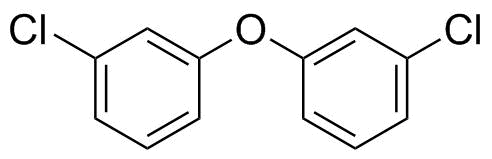 |
| Molecular Formula | C12H8Cl2O |
| Molecular Weight | 239.10 |
| CAS Registry Number | 6903-62-4 |
| SMILES | C1=CC(=CC(=C1)Cl)OC2=CC(=CC=C2)Cl |
| Density | 1.3±0.1 g/cm3 Calc.* |
|---|---|
| Boiling point | 315.6±27.0 °C 760 mmHg (Calc.)* |
| Flash point | 110.7±23.1 °C (Calc.)* |
| Index of refraction | 1.595 (Calc.)* |
| * | Calculated using Advanced Chemistry Development (ACD/Labs) Software. |
| Hazard Symbols |  GHS05 Danger Details GHS05 Danger Details |
|---|---|
| Risk Statements | H318 Details |
| Safety Statements | P280-P305+P351+P338+P310 Details |
| SDS | Available |
 chemBlink Chemical Story
|
3,3'-Dichlorodiphenyl ether is a halogenated aromatic ether consisting of two benzene rings connected by an oxygen atom, with one chlorine atom attached to the 3-position of each aromatic ring. It belongs to the family of diphenyl ethers, compounds characterized by an aryl–oxygen–aryl linkage that imparts both rigidity and conformational flexibility to the molecular framework. Structurally, the molecule contains two benzene rings joined through an ether oxygen atom (Ar–O–Ar). The oxygen atom is approximately sp3-hybridized and possesses two lone pairs of electrons. These lone pairs can partially delocalize into the adjacent aromatic π-systems through resonance, although steric interactions prevent complete coplanarity of the two benzene rings, limiting the extent of conjugation across the molecule. Each benzene ring is substituted with a chlorine atom at the meta (3-) position relative to the ether linkage. Chlorine atoms are electron-withdrawing through inductive effects but can donate electron density weakly through resonance because of their lone pairs. In the meta position, the resonance interaction with the ether substituent is limited, so the overall electronic influence is dominated by the inductive electron-withdrawing effect. The two aromatic rings are not coplanar under normal conditions. Rotation about the carbon–oxygen single bonds is possible, although steric interactions between hydrogen atoms adjacent to the ether linkage create a preferred dihedral angle between the rings. This twisted conformation reduces direct π-conjugation between the two aromatic systems while preserving the individual aromatic character of each benzene ring. The ether oxygen serves as a hydrogen bond acceptor but cannot donate hydrogen bonds because it lacks an O–H bond. The chlorine atoms do not participate in conventional hydrogen bonding but contribute to molecular polarizability and influence intermolecular interactions through dispersion forces. From an electronic perspective, the molecule contains two independent aromatic π-systems connected through the oxygen atom. The ether linkage contributes some electron donation into each benzene ring through resonance, while the chlorine substituents reduce electron density locally by induction. The resulting electronic distribution is relatively balanced, producing a chemically stable aromatic ether. Physicochemically, 3,3'-dichlorodiphenyl ether is predominantly hydrophobic. The two aromatic rings and chlorine substituents contribute extensive nonpolar surface area, while the single ether oxygen provides only localized polarity. Consequently, the compound exhibits low water solubility and good solubility in many nonpolar and moderately polar organic solvents. The chlorine substituents increase molecular mass and polarizability relative to unsubstituted diphenyl ether. They also strengthen intermolecular van der Waals interactions, which can influence melting point, boiling point, and crystal packing. Chemically, the aromatic ether linkage is relatively stable under neutral conditions and resistant to hydrolysis. Cleavage of the aryl–oxygen bond generally requires strong acidic conditions or specialized catalytic methods. The aromatic carbon–chlorine bonds are also chemically stable under ordinary conditions but can participate in nucleophilic aromatic substitution only under suitably activating conditions or undergo transition-metal-catalyzed cross-coupling reactions in synthetic chemistry. The aromatic rings retain the characteristic stability of benzene due to their delocalized π-electron systems. Electrophilic aromatic substitution reactions are possible, although the substitution pattern and the opposing electronic influences of the ether oxygen and chlorine atoms affect regioselectivity and reaction rates. Overall, 3,3'-dichlorodiphenyl ether is a halogenated diaryl ether composed of two meta-chlorinated benzene rings linked through an oxygen atom. Its structure combines chemically stable aromatic systems, a resonance-capable ether linkage, and inductively electron-withdrawing chlorine substituents, resulting in a predominantly hydrophobic molecule with well-defined structural and electronic properties. References 1974. Electron Impact Spectra of Several Aromatic Systems. Mass Spectrometry and NMR Spectroscopy in Pesticide Chemistry. DOI: 10.1007/978-1-4613-4526-8_6 |
| Market Analysis Reports |