
Online Database of Chemicals from Around the World
| Highpharm Medchem (Ningbo) Co., Ltd. | China | |||
|---|---|---|---|---|
 | www.highpharm.com | |||
 | +86 (574) 5566-3958 | |||
 | +86 (574) 5566-3960 | |||
 | highpharm@highpharm.com lisayang925@hotmail.com | |||
 | QQ Chat | |||
| Chemical manufacturer | ||||
| chemBlink Standard supplier since 2007 | ||||
| Simagchem Corporation | China | |||
|---|---|---|---|---|
| www.simagchem.com | |||
| +86 13806087780 | |||
| +86 (592) 268-0237 | |||
| sale@simagchem.com | |||
| Chemical manufacturer since 2002 | ||||
| chemBlink Standard supplier since 2008 | ||||
| BOC Sciences | USA | |||
|---|---|---|---|---|
| www.bocsci.com | |||
| +1 (631) 485-4226 | |||
| +1 (631) 614-7828 | |||
| info@bocsci.com | |||
| Chemical manufacturer | ||||
| chemBlink Standard supplier since 2010 | ||||
| Taizhou Tongxin Biopharmaceutical Technology Co., Ltd. | China | |||
|---|---|---|---|---|
| www.allyrise.com | |||
| +86 18652728585 | |||
| +86 (523) 8276-5215 | |||
| sales@allyrise.com | |||
| QQ Chat | |||
| Chemical manufacturer since 2013 | ||||
| chemBlink Standard supplier since 2013 | ||||
| Hangzhou Leap Chem Co., Ltd. | China | |||
|---|---|---|---|---|
| www.leapchem.com | |||
| +86 (571) 8771-1850 | |||
| market19@leapchem.com | |||
| QQ Chat | |||
| Chemical manufacturer since 2006 | ||||
| chemBlink Standard supplier since 2015 | ||||
| Carbosynth China Ltd. | China | |||
|---|---|---|---|---|
| www.carbosynth.cn | |||
| +86 (512) 6260-5585 | |||
| +86 (512) 6260-5576 | |||
| sales@carbosynth.com | |||
| QQ Chat | |||
| Chemical manufacturer since 2006 | ||||
| chemBlink Standard supplier since 2016 | ||||
| NANJING DAOGE BIOPHARMA CO., LTD. | China | |||
|---|---|---|---|---|
| www.daogepharm.com | |||
| +86 18021503536 | |||
| sale@daogepharm.com | |||
| QQ Chat | |||
| Chemical manufacturer since 2021 | ||||
| chemBlink Standard supplier since 2021 | ||||
| INA Pharmaceuticals Pvt. Ltd. | India | |||
|---|---|---|---|---|
| inapharma.in | |||
| +91 7815933367 | |||
| rd@inapharma.in | |||
| Chemical manufacturer since 2018 | ||||
| chemBlink Standard supplier since 2026 | ||||
| AOBChem USA | USA | |||
|---|---|---|---|---|
| www.aobchem.com | |||
| +1 (323) 382-7678 | |||
| +1 (213) 687-8698 | |||
| sales@aobchem.com | |||
| Chemical manufacturer | ||||
| Indofine Chemical Company, Inc. | USA | |||
|---|---|---|---|---|
| www.indofinechemical.com | |||
| +1 (888) 463-6346 | |||
| +1 (908) 359-1179 | |||
| info@indofinechemical.com | |||
| Chemical manufacturer since 1981 | ||||
| Shanghai Jiexiao Economic Trade Co., Ltd. | China | |||
|---|---|---|---|---|
| www.jiexiao.com | |||
| +86 (21) 6231-0939 | |||
| +86 (21) 6230-3768 | |||
| sales@jiexiao.com | |||
| Chemical distributor | ||||
| J & W PharmLab LLC | USA | |||
|---|---|---|---|---|
| www.jwpharmlab.com | |||
| +1 (215) 945-6595 | |||
| +1 (215) 945-6597 | |||
| services@jwpharmlab.com | |||
| Chemical manufacturer | ||||
| Anvia Chemicals, LLC | USA | |||
|---|---|---|---|---|
| www.anviachem.com | |||
| +1 (414) 534-7845 | |||
| +1 (414) 762-5539 | |||
| sales@anviachem.com | |||
| Chemical manufacturer | ||||
| Frontier Scientific Services, Inc. | USA | |||
|---|---|---|---|---|
| www.frontierssi.com | |||
| +1 (302) 266-6891 (888) 577-2734 | |||
| +1 (302) 266-8296 | |||
| customerservice@frontierssi.com | |||
| Chemical manufacturer | ||||
| Classification | Chemical reagent >> Organic reagent >> Aromatic aldehyde (containing acetal, hemiacetal) |
|---|---|
| Name | 3,5-Dimethoxybenzaldehyde |
| Molecular Structure | 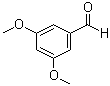 |
| Molecular Formula | C9H10O3 |
| Molecular Weight | 166.18 |
| CAS Registry Number | 7311-34-4 |
| EC Number | 230-772-6 |
| SMILES | COC1=CC(=CC(=C1)C=O)OC |
| Density | 1.1±0.1 g/cm3 Calc.* |
|---|---|
| Melting point | 45 - 48 °C (Expl.) |
| Boiling point | 276.5 °C 760 mmHg (Calc.)*, 303.2 °C (Expl.) |
| Flash point | 119.0±8.2 °C (Calc.)*, 113 °C (Expl.) |
| Solubility | water: insoluble (Expl.) |
| Index of refraction | 1.534 (Calc.)* |
| * | Calculated using Advanced Chemistry Development (ACD/Labs) Software. |
| Hazard Symbols |  GHS07 Warning Details GHS07 Warning Details | ||||||||||||||||||||
|---|---|---|---|---|---|---|---|---|---|---|---|---|---|---|---|---|---|---|---|---|---|
| Risk Statements | H315-H319-H335 Details | ||||||||||||||||||||
| Safety Statements | P261-P264-P264+P265-P271-P280-P302+P352-P304+P340-P305+P351+P338-P319-P321-P332+P317-P337+P317-P362+P364-P403+P233-P405-P501 Details | ||||||||||||||||||||
| Hazard Classification | |||||||||||||||||||||
| |||||||||||||||||||||
| SDS | Available | ||||||||||||||||||||
 chemBlink Chemical Story
|
3,5-Dimethoxybenzaldehyde, CAS 7311-34-4, is an aromatic aldehyde widely used as a building block in organic synthesis and natural-product chemistry. Its molecular formula is C9H10O3 and its molecular weight is 166.17. Structurally, it consists of a benzaldehyde bearing methoxy groups at the 3- and 5-positions. The molecule combines two distinct types of functionality. The aldehyde provides a highly versatile carbonyl center for carbon-carbon bond formation, while the two methoxy groups define a symmetrical oxygenation pattern on the aromatic ring. This 3,5-dimethoxy pattern is particularly useful in the synthesis of polyphenolic natural products. Many natural products contain a 3,5-dihydroxyphenyl or closely related resorcinol-derived structural unit. Free phenolic hydroxyl groups, however, can complicate multistep synthesis because they are acidic and can undergo oxidation, alkylation, acylation, metal coordination, and other unwanted reactions. Converting those hydroxyl groups into methyl ethers provides a simple form of protection. The methoxy groups of 3,5-dimethoxybenzaldehyde can therefore be viewed as masked phenolic hydroxyl groups. They allow chemists to construct the carbon skeleton while the oxygens remain relatively unreactive. Near the end of a synthesis, cleavage of the aryl methyl ethers can reveal the corresponding phenols. The aldehyde performs a different job. Carbonyl compounds are among the most useful starting points for carbon-carbon bond formation. The C=O group can undergo olefination, condensation, nucleophilic addition, oxidation, reduction, and numerous other transformations. Consequently, 3,5-dimethoxybenzaldehyde serves as a molecular combination of a protected aromatic oxygenation pattern and a reactive carbon-building site. A clear example appears in the synthesis of the natural isocoumarin thunberginol B. A published total synthesis began with commercially available 3,5-dimethoxybenzaldehyde and converted it by condensation with malonic acid into 3,5-dimethoxycinnamic acid. The reported yield for this first transformation was 86%. Reduction of the carbon-carbon double bond then gave 3-(3,5-dimethoxyphenyl)propionic acid. Intramolecular cyclization converted that open-chain intermediate into 5,7-dimethoxy-1-indanone, which was subsequently transformed through several additional steps into 3,5-dimethoxyhomophthalic acid. That intermediate was joined to another methoxy-substituted aromatic fragment to construct the isocoumarin framework. Only near the end of the sequence were the methyl ethers removed, revealing the four phenolic hydroxyl groups of thunberginol B. The route beautifully demonstrates why methoxy groups are useful in natural-product synthesis. The final molecule needs phenolic hydroxyl groups, but carrying all of those free OH groups through every reaction would often make the synthesis more difficult. Instead, chemists temporarily carry them as OCH3 and reveal them when construction is largely complete. 3,5-Dimethoxybenzaldehyde has also played an important role in the synthetic chemistry of resveratrol-derived natural products. Resveratrol contains a 3,5-dihydroxyphenyl unit connected through an alkene to another aromatic ring. Many naturally occurring resveratrol dimers and oligomers contain even more elaborate arrangements derived from this general oxygenation pattern. Synthetic researchers have repeatedly used 3,5-dimethoxybenzaldehyde as an entry point to these structures. In one study directed toward dimeric resveratrol natural products, two different coupling partners were both prepared from commercially available 3,5-dimethoxybenzaldehyde. One pathway converted the aldehyde into a brominated stilbene-derived fragment through a five-step sequence in 75% overall yield. Another transformed the aldehyde through Corey-Fuchs olefination into a terminal alkyne and then used Sonogashira coupling to create a diaryl alkyne. The two fragments could subsequently participate in palladium-catalyzed cascade chemistry designed to establish several carbon-carbon bonds and rapidly increase molecular complexity. This illustrates another important property of aromatic aldehydes: the aldehyde carbon can be transformed into very different types of carbon framework. It can become part of an alkene. It can be converted into an alkyne. It can participate in condensation reactions. Or it can be reduced or oxidized to other functional groups. Thus, the same small starting material can branch into several synthetic directions while preserving the useful 3,5-dimethoxyphenyl pattern. The compound has also appeared in the synthesis of modified stilbenes investigated in medicinal and biological chemistry. This connection is logical because olefination of an aromatic aldehyde is a direct way to construct the carbon-carbon double bond characteristic of a stilbene. It is important, however, to distinguish the synthetic precursor from the compounds ultimately studied for biological activity. 3,5-Dimethoxybenzaldehyde itself should not be assigned the biological properties of resveratrol, thunberginol B, or other natural products prepared from it. Its importance lies in molecular construction. The molecule provides chemists with a reactive aldehyde at one position and two oxygen substituents already arranged in a symmetrical 3,5-pattern. Those oxygen atoms can remain protected while the carbon skeleton grows, then be transformed into phenolic hydroxyl groups at an appropriate stage. 3,5-Dimethoxybenzaldehyde therefore illustrates an elegant principle of synthetic planning: sometimes the structure seen in a starting material is deliberately not the structure desired in the final product. The methoxy groups are convenient during construction. The hydroxyl groups may be wanted at the end. The aldehyde provides the place where the molecule begins to grow. A simple aromatic aldehyde can therefore contain both a construction site and a hidden version of the final functional pattern. References 1. PubChem. 3,5-Dimethoxybenzaldehyde, CID 81747. CAS 7311-34-4. Molecular formula C9H10O3; molecular weight 166.17. 2. Qadeer, G.; Rama, N. H.; Shah, S. J. H. (2007). "A new total synthesis of natural isocoumarin, thunberginol B." ARKIVOC, 2007(xiv), 12-19. 3. Jeffrey, J. L.; Sarpong, R. (2009). "An Approach to the Synthesis of Dimeric Resveratrol Natural Products via a Palladium-Catalyzed Cascade." Synthetic study using commercially available 3,5-dimethoxybenzaldehyde. 4. Keylor, M. H.; Matsuura, B. S.; Stephenson, C. R. J. (2015). "Chemistry and Biology of Resveratrol-Derived Natural Products." Chemical Reviews, 115, 8976-9027. 5. Synthetic studies of stilbene and resveratrol derivatives employing 3,5-dimethoxybenzaldehyde as an aromatic aldehyde precursor. |
| Market Analysis Reports |