
Online Database of Chemicals from Around the World
| Simagchem Corporation | China | |||
|---|---|---|---|---|
 | www.simagchem.com | |||
 | +86 13806087780 | |||
 | +86 (592) 268-0237 | |||
 | sale@simagchem.com | |||
| Chemical manufacturer since 2002 | ||||
| chemBlink Standard supplier since 2008 | ||||
| Discovery Fine Chemicals Ltd. | UK | |||
|---|---|---|---|---|
| www.discofinechem.com | |||
| +44 (1202) 874-517 | |||
| +44 (845) 094-4385 | |||
| pjc@discofinechem.com | |||
| Chemical manufacturer | ||||
| chemBlink Standard supplier since 2009 | ||||
| Wuhan Silworld Chemical Co., Ltd. | China | |||
|---|---|---|---|---|
| www.silworldchemical.com | |||
| +86 (27) 8561-3400 +86 15827173649 | |||
| +86 (27) 8561-3419 | |||
| info@silworldchemical.com | |||
 | QQ Chat | |||
| Chemical manufacturer since 2012 | ||||
| chemBlink Standard supplier since 2010 | ||||
| Hangzhou Leap Chem Co., Ltd. | China | |||
|---|---|---|---|---|
| www.leapchem.com | |||
| +86 (571) 8771-1850 | |||
| market19@leapchem.com | |||
| QQ Chat | |||
| Chemical manufacturer since 2006 | ||||
| chemBlink Standard supplier since 2015 | ||||
| Carbosynth China Ltd. | China | |||
|---|---|---|---|---|
| www.carbosynth.cn | |||
| +86 (512) 6260-5585 | |||
| +86 (512) 6260-5576 | |||
| sales@carbosynth.com | |||
| QQ Chat | |||
| Chemical manufacturer since 2006 | ||||
| chemBlink Standard supplier since 2016 | ||||
| Taixing Joxin Bio-tec Co., Ltd. | China | |||
|---|---|---|---|---|
| www.joxbio.com | |||
| +86 (523) 8755-8858 | |||
| +86 (523) 8755-8858 / 8761-2088 | |||
| yhj@joxbio.com | |||
| Chemical manufacturer since 2017 | ||||
| chemBlink Standard supplier since 2018 | ||||
| HuNan Huibaiyi New Materials Co; Ltd. | China | |||
|---|---|---|---|---|
| www.hbsjxcl.com | |||
| +86 13319523173 | |||
| ivy@hnhbsj.com | |||
| QQ Chat | |||
 | WeChat: 13319523173 | |||
| Chemical manufacturer since 2014 | ||||
| chemBlink Standard supplier since 2026 | ||||
| Chemos GmbH & Co. KG | Germany | |||
|---|---|---|---|---|
| www.chemos.de | |||
| +49 871-966346-0 | |||
| +49 871-966346-13 | |||
| chemos@chemos.de | |||
| Chemical distributor | ||||
| Polysciences, Inc. | USA | |||
|---|---|---|---|---|
| www.polysciences.com | |||
| +1 (215) 343-6484 | |||
| +1 (215) 343-0214 | |||
| info@polysciences.com | |||
| Chemical manufacturer since 1961 | ||||
| Classification | API >> Diagnostic medication >> Image inspection medication |
|---|---|
| Name | Diatrizoate sodium |
| Synonyms | Sodium amidotrizoate; 3,5-Diacetamido-2,4,6-triiodobenzoic acid sodium salt |
| Molecular Structure | 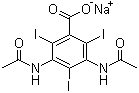 |
| Molecular Formula | C11H8I3N2NaO4 |
| Molecular Weight | 635.90 |
| CAS Registry Number | 737-31-5 |
| EC Number | 212-004-1 |
| SMILES | CC(=O)NC1=C(C(=C(C(=C1I)C(=O)[O-])I)NC(=O)C)I.[Na+] |
| Hazard Symbols |  GHS08 Danger Details GHS08 Danger Details | ||||||||||||
|---|---|---|---|---|---|---|---|---|---|---|---|---|---|
| Risk Statements | H317-H334 Details | ||||||||||||
| Safety Statements | P233-P260-P261-P271-P272-P280-P284-P302+P352-P304+P340-P321-P333+P317-P342+P316-P362+P364-P403-P501 Details | ||||||||||||
| Hazard Classification | |||||||||||||
| |||||||||||||
| SDS | Available | ||||||||||||
 chemBlink Chemical Story
|
Diatrizoate sodium is an iodinated, water-soluble organic salt used primarily as a radiographic contrast agent in medical imaging. It belongs to the class of triiodinated benzoic acid derivatives designed to absorb X-rays strongly due to the high atomic number of iodine atoms, enabling enhanced visualization of internal anatomical structures. Structurally, diatrizoate is derived from benzoic acid and contains a central benzene ring substituted with three iodine atoms at positions 2, 4, and 6. This tri-iodinated substitution pattern is a key feature of contrast agents in this class, as iodine’s high electron density significantly increases X-ray attenuation. The aromatic ring provides a rigid, planar scaffold that holds the iodine atoms in a fixed geometry. In addition to the iodine substituents, the benzene ring carries two acetamido groups at the 3 and 5 positions. These amide substituents introduce polar functional groups capable of hydrogen bonding and increase water solubility relative to the hydrophobic tri-iodinated aromatic core. The amide groups also contribute to chemical stability and reduce the tendency of the aromatic system to undergo unwanted reactions. The carboxylic acid group at the 1-position is present as a sodium salt (–COO⁻ Na⁺). This ionized carboxylate group is the primary site responsible for the compound’s high aqueous solubility. In physiological conditions, the sodium counterion dissociates, leaving the negatively charged carboxylate form, which enhances compatibility with biological fluids. The combination of heavy iodine atoms and polar functional groups creates a molecule that is both highly electron-dense and sufficiently water soluble for intravenous or oral administration. The iodine atoms are the principal contributors to radiopacity, as they strongly interact with X-rays through photoelectric absorption. From a structural perspective, the molecule is relatively rigid due to the aromatic ring and the steric bulk of the iodine substituents. The large iodine atoms at the ortho and para positions create significant steric hindrance, limiting rotational freedom and maintaining a defined molecular shape. The acetamido groups contain carbonyl (C=O) and amide (–NH–CO–CH3) functionalities, which engage in hydrogen bonding with water molecules. This interaction enhances solubility and reduces aggregation of the hydrophobic iodinated aromatic core in aqueous environments. Physicochemically, diatrizoate sodium is highly polar overall due to its ionic carboxylate group and amide functionalities, despite containing a highly hydrophobic iodinated benzene ring. The molecule is therefore amphiphilic but behaves predominantly as a water-soluble ionic compound in physiological conditions. Chemically, the compound is relatively stable under physiological conditions. The aromatic carbon–iodine bonds are strong and not easily cleaved under normal biological environments, ensuring that the iodine remains associated with the molecule during imaging procedures. The amide and carboxylate groups are also stable under neutral pH conditions. The primary functional role of diatrizoate sodium is not chemical reactivity but physical interaction with X-ray radiation. The presence of three iodine atoms dramatically increases X-ray attenuation, producing contrast between iodinated regions and surrounding tissues in imaging techniques such as angiography, urography, and gastrointestinal studies. Once administered, diatrizoate sodium is typically distributed in extracellular fluid and excreted unchanged via renal filtration, reflecting its chemical stability and lack of significant metabolism. Overall, diatrizoate sodium is a tri-iodinated benzoate derivative featuring a rigid aromatic core, electron-dense iodine substituents, polar amide groups, and an ionized carboxylate. Its combination of high X-ray attenuation and water solubility makes it an effective contrast agent for diagnostic imaging in medical applications. References 2026. Esophagopericardial fistula: a late complication of liver stereotactic body radiation therapy. Indian Journal of Thoracic and Cardiovascular Surgery. DOI: 10.1007/s12055-025-02154-9 2025. Clinical outcomes of combined transarterial chemoembolization and microwave ablation for hepatic hemangiomas: a comparative analysis of large versus giant tumors. BMC Gastroenterology. DOI: 10.1186/s12876-025-04443-4 2025. Impact of a collaborative small bowel obstruction imaging and care protocol with the general surgery service on radiology workflow and resource utilization: a pilot study. Abdominal radiology (New York). DOI: 10.1007/s00261-025-04993-x |
| Market Analysis Reports |