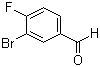
3-Bromo-4-fluorobenzaldehyde is a halogenated aromatic aldehyde in which a benzene ring is substituted with a bromine atom at the 3-position, a fluorine atom at the 4-position, and an aldehyde group at the 1-position. Aromatic aldehydes like this are important intermediates in organic synthesis and medicinal chemistry due to their electrophilic carbonyl group and the ability to undergo a wide range of condensation, oxidation, and substitution reactions. The halogen substituents influence the electronic properties of the aromatic ring, affecting reactivity and regioselectivity in subsequent transformations.
Structurally, the molecule consists of a benzene ring with the aldehyde group providing a highly electrophilic carbon at the 1-position. The bromine atom at the meta position and the fluorine atom at the para position modulate the electron density of the ring, increasing the selectivity of reactions at the aldehyde group or other positions on the aromatic ring. The bromine atom also serves as a handle for cross-coupling reactions such as Suzuki, Heck, or Buchwald–Hartwig reactions, while the fluorine atom contributes steric and electronic effects that can enhance stability and modulate reactivity.
The synthesis of 3-bromo-4-fluorobenzaldehyde is typically achieved via selective halogenation of 4-fluorobenzaldehyde or formylation of 3-bromo-4-fluorotoluene followed by oxidation. Careful control of reaction conditions is required to prevent over-bromination or degradation of the aldehyde functionality. The product is usually isolated as a stable, crystalline solid suitable for use in further synthetic transformations.
In medicinal chemistry, halogenated benzaldehydes like 3-bromo-4-fluorobenzaldehyde are used as building blocks for the synthesis of bioactive molecules, including heterocycles, Schiff bases, and amide derivatives. The aldehyde group can condense with amines to form imines or react with nucleophiles to produce alcohols and other functional groups. The bromine atom allows selective introduction of additional substituents through cross-coupling reactions, enabling the generation of derivatives for structure–activity relationship studies. The fluorine atom can improve metabolic stability and influence binding interactions in bioactive compounds.
Beyond pharmaceutical applications, 3-bromo-4-fluorobenzaldehyde is valuable in organic synthesis as a versatile intermediate. The aldehyde can undergo oxidation, reduction, or condensation reactions, while the bromine and fluorine atoms allow further functionalization, providing access to complex aromatic scaffolds. This combination of reactive and tunable groups makes it useful for synthesizing functional materials, fluorinated aromatics, and heterocyclic systems.
Overall, 3-bromo-4-fluorobenzaldehyde is a multifunctional halogenated aromatic aldehyde with electrophilic, nucleophilic, and electronically tunable properties. Its combination of aldehyde, bromine, and fluorine substituents makes it a valuable intermediate for organic synthesis, medicinal chemistry, and the development of bioactive or functionalized aromatic compounds.
References
2018. Linear diarylheptanoids as potential anticancer therapeutics: synthesis, biological evaluation, and structure–activity relationship studies. Archives of Pharmacal Research.
DOI: 10.1007/s12272-018-1004-8
|







 GHS07 Warning Details
 chemBlink Chemical Story