
Online Database of Chemicals from Around the World
| Dalian Synco Chemical Co., Ltd. | China | |||
|---|---|---|---|---|
 | www.syncochemie.com | |||
 | +86 (411) 8363-5150 | |||
 | +86 (411) 8368-4420 | |||
 | daisy@syncochemie.com | |||
 | QQ Chat | |||
| Chemical manufacturer | ||||
| chemBlink Standard supplier since 2009 | ||||
| BOC Sciences | USA | |||
|---|---|---|---|---|
| www.bocsci.com | |||
| +1 (631) 485-4226 | |||
| +1 (631) 614-7828 | |||
| info@bocsci.com | |||
| Chemical manufacturer | ||||
| chemBlink Standard supplier since 2010 | ||||
| Fluoropharm Co.,Ltd. | China | |||
|---|---|---|---|---|
| www.fluoropharm.com | |||
| +86 (571) 8558-6753 +86 13336034509 | |||
| +86 (571) 8558-6753 | |||
| sales@fluoropharm.com | |||
| QQ Chat | |||
| Chemical manufacturer | ||||
| chemBlink Standard supplier since 2013 | ||||
| Amadis Chemical Co., Ltd. | China | |||
|---|---|---|---|---|
| www.amadischem.com | |||
| +86 (571) 8992-5085 | |||
| +86 (571) 8992-5065 | |||
| sales@amadischem.com | |||
| Chemical manufacturer since 2010 | ||||
| chemBlink Standard supplier since 2015 | ||||
| INA Pharmaceuticals Pvt. Ltd. | India | |||
|---|---|---|---|---|
| inapharma.in | |||
| +91 7815933367 | |||
| rd@inapharma.in | |||
| Chemical manufacturer since 2018 | ||||
| chemBlink Standard supplier since 2026 | ||||
| Melford Laboratories Limited | UK | |||
|---|---|---|---|---|
| www.melford.co.uk | |||
| +44 (1449) 741-178 | |||
| +44 (1449) 741-217 | |||
| pfranklin@melford.co.uk sales@melford.co.uk | |||
| Chemical manufacturer since 1985 | ||||
| P and M Invest Ltd. | Russia | |||
|---|---|---|---|---|
| www.fluorine.ru | |||
| +7 (495) 135-6494 | |||
| +7 (495) 135-6509 | |||
| sales@fluorine1.ru | |||
| Chemical manufacturer | ||||
| Classification | Chemical reagent >> Organic reagent >> Acid halide |
|---|---|
| Name | 2,4,6-Trifluorobenzoyl chloride |
| Molecular Structure | 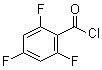 |
| Molecular Formula | C7H2ClF3O |
| Molecular Weight | 194.54 |
| CAS Registry Number | 79538-29-7 |
| EC Number | 642-590-8 |
| SMILES | C1=C(C=C(C(=C1F)C(=O)Cl)F)F |
| Density | 1.5±0.1 g/cm3 Calc.*, 1.499 g/mL (Expl.) |
|---|---|
| Boiling point | 151.8±35.0 °C 760 mmHg (Calc.)*, 167 - 168 °C (Expl.) |
| Flash point | 45.6±25.9 °C (Calc.)* |
| Index of refraction | 1.48 (Calc.)*, 1.484 (Expl.) |
| * | Calculated using Advanced Chemistry Development (ACD/Labs) Software. |
| Hazard Symbols |   GHS05;GHS07 Danger Details GHS05;GHS07 Danger Details | ||||||||||||||||
|---|---|---|---|---|---|---|---|---|---|---|---|---|---|---|---|---|---|
| Risk Statements | H314-H319-H335 Details | ||||||||||||||||
| Safety Statements | P260-P261-P264-P264+P265-P271-P280-P301+P330+P331-P302+P361+P354-P304+P340-P305+P351+P338-P305+P354+P338-P316-P319-P321-P337+P317-P363-P403+P233-P405-P501 Details | ||||||||||||||||
| Hazard Classification | |||||||||||||||||
| |||||||||||||||||
| SDS | Available | ||||||||||||||||
 chemBlink Chemical Story
|
2,4,6-Trifluorobenzoyl chloride, CAS 79538-29-7, is a fluorinated aromatic acid chloride used as an acylating reagent and synthetic intermediate. Its molecular formula is C7H2ClF3O and its molecular weight is 194.54. Structurally, it consists of a benzoyl chloride group surrounded by three fluorine atoms at the 2-, 4-, and 6-positions of the aromatic ring. The molecule contains two very different kinds of chlorine and fluorine chemistry. The chlorine belongs to an acid chloride group, -COCl. It is highly reactive and is normally intended to leave during acylation. The three fluorine atoms, in contrast, are attached directly to the aromatic ring. In many synthetic applications they remain in place and become part of the final molecular structure. This difference makes 2,4,6-trifluorobenzoyl chloride a useful example of how a small reagent can contain both a temporary atom and permanent structural information. Acid chlorides are activated derivatives of carboxylic acids. Replacing the OH of a carboxylic acid with chlorine makes the carbonyl carbon much more susceptible to attack by nucleophiles. When an amine reacts with an acid chloride, nitrogen attacks the carbonyl carbon, chloride leaves, and an amide is formed. In simplified form: Ar-COCl + H2N-R → Ar-CONH-R For 2,4,6-trifluorobenzoyl chloride, Ar represents the 2,4,6-trifluorophenyl group. The chlorine disappears. The carbonyl and fluorinated aromatic ring remain. A particularly interesting documented application of this chemistry appears in the synthesis of lasmiditan. Lasmiditan is a small-molecule drug developed for the acute treatment of migraine. Unlike the older triptan class, lasmiditan was designed as a selective serotonin 5-HT1F receptor agonist and does not belong structurally to the triptans. The early patent literature describing lasmiditan contains a remarkably direct use of 2,4,6-trifluorobenzoyl chloride. A pyridine intermediate bearing an amino group and a 1-methylpiperidine-4-carbonyl substituent was combined with 2,4,6-trifluorobenzoyl chloride in 1,4-dioxane and heated under reflux. The amino group reacted with the acid chloride. A new amide bond formed. The resulting molecule contained the 2,4,6-trifluorobenzoyl group that is characteristic of lasmiditan. This means that most of the atoms of 2,4,6-trifluorobenzoyl chloride survive directly into the pharmaceutical molecule. Only the acid-chloride chlorine performs a temporary job. Its role is to activate the carbonyl and then leave when the amide bond is constructed. The three fluorines have a completely different fate. They remain attached to the aromatic ring. This provides a useful way to understand the word "reagent." A reagent is not necessarily something that disappears after helping a reaction occur. Some reagents are structural building blocks whose atoms become a substantial part of the product. 2,4,6-Trifluorobenzoyl chloride is one of those building blocks. Its carbonyl carbon, oxygen, aromatic ring, and three fluorines can all be transferred together as a 2,4,6-trifluorobenzoyl unit. The three fluorines also create an unusual substitution pattern. Two fluorines occupy the ortho positions immediately adjacent to the carbonyl-bearing carbon, while the third occupies the para position. Fluorine is only slightly larger than hydrogen, but it is extremely electronegative. Multiple aromatic fluorines therefore change the electronic character of the benzoyl group without requiring a large substituent. In medicinal chemistry, aromatic fluorination is widely used to modify properties such as electronic distribution, conformation, lipophilicity, metabolic behavior, and molecular recognition. Those effects cannot be predicted from the presence of fluorine alone. They depend on the complete molecule and the exact position of each fluorine atom. For this reason, it would be incorrect to say that 2,4,6-trifluorobenzoyl chloride itself possesses the therapeutic properties of lasmiditan. Its documented role is synthetic. It delivers a precisely arranged fluorinated aromatic acyl fragment to a much larger molecular framework. The distinction between the reactive chlorine and persistent fluorines is also chemically instructive. All four atoms are halogens. Yet their behavior could hardly be more different. The chlorine is bonded to an acyl carbon and is deliberately chosen because it can leave readily during nucleophilic acyl substitution. The fluorines are bonded to aromatic carbon and, in the lasmiditan synthesis, remain embedded in the final structure. Chemical behavior therefore cannot be predicted simply by saying that chlorine and fluorine are both halogens. The atoms around them matter. The type of carbon to which they are bonded matters. The electronic environment matters. The molecule also illustrates why acid chlorides are so common in medicinal-chemistry laboratories. A researcher may spend many steps constructing a complicated amine-containing fragment. Once that fragment is available, an acid chloride can provide a relatively direct way to attach an aromatic acyl group. Changing the acid chloride can then generate related molecules containing different aromatic substitution patterns. This modular strategy is extremely useful when researchers want to prepare a family of compounds and study how structural changes affect their properties. 2,4,6-Trifluorobenzoyl chloride is commercially available as a liquid. Supplier specifications report a molecular weight of 194.54, a boiling point around 167-168 °C, and sensitivity to moisture. Moisture sensitivity is expected for an acid chloride. Water can attack the reactive carbonyl and hydrolyze the acid chloride back toward the corresponding carboxylic acid. This is essentially the same carbonyl reactivity that makes the compound useful for amide formation, except that water acts as the nucleophile instead of an amine. The molecule therefore has a simple chemical logic. The COCl group is the reactive attachment point. The fluorinated aromatic ring is the structural cargo. During amide formation, chlorine leaves and the cargo stays. In the published lasmiditan route, that distinction becomes visible in a real pharmaceutical structure: the acid-chloride chlorine is gone, while all three aromatic fluorines remain. 2,4,6-Trifluorobenzoyl chloride is thus a compact example of molecular construction in which different atoms within the same reagent have completely different destinies. One atom is there to leave. Three are there to stay. References 1. Fisher Scientific / Thermo Scientific Chemicals. 2,4,6-Trifluorobenzoyl chloride, CAS 79538-29-7. Molecular formula C7H2ClF3O; molecular weight 194.54. 2. Sigma-Aldrich / Apollo Scientific. 2,4,6-Trifluorobenzoyl chloride, CAS 79538-29-7. 3. WO 2003/084949 A2. Compounds including lasmiditan and preparation involving reaction of an aminopyridine intermediate with 2,4,6-trifluorobenzoyl chloride. 4. Published medicinal-chemistry and process literature concerning the synthesis and development of lasmiditan. |
| Market Analysis Reports |