
Online Database of Chemicals from Around the World
| Taizhou Crene Biotechnology Co., Ltd. | China | |||
|---|---|---|---|---|
 | www.pharm-intermediates.com | |||
 | +86 (576) 8881-3233 8820-5808 +86 13396860566 | |||
 | +86 (576) 8822-9589 | |||
 | sales@pharm-intermediates.com | |||
 | QQ Chat | |||
| Chemical manufacturer since 2011 | ||||
| chemBlink Standard supplier since 2009 | ||||
| Ningbo Kilo Biotechnology Co., Ltd. | China | |||
|---|---|---|---|---|
| www.kilobio.com | |||
| +8613989352104 | |||
| terry.zhang@kilobio.com | |||
| QQ Chat | |||
 | WeChat: Wenzhou Medical University | |||
| Chemical distributor since 2023 | ||||
| chemBlink Standard supplier since 2023 | ||||
| Classification | Organic raw materials >> Carboxylic compounds and derivatives |
|---|---|
| Name | 7-[(1R,2S)-2-[(1E,3S,5S)-3-Hydroxy-5-methyl-1-nonenyl]-5-oxo-3-cyclopenten-1-yl]-2-heptenoic acid |
| Synonyms | 7-[2-(3-hydroxy-5-methylnon-1-enyl)-5-oxocyclopent-3-en-1-yl]hept-2-enoic acid |
| Molecular Structure | 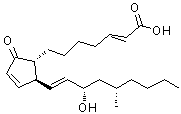 |
| Molecular Formula | C22H34O4 |
| Molecular Weight | 362.50 |
| CAS Registry Number | 853998-94-4 |
| SMILES | CCCCC(C)CC(C=CC1C=CC(=O)C1CCCCC=CC(=O)O)O |
| Solubility | Insoluble (3.4E-3 g/L) (25 °C), Calc.* |
|---|---|
| Density | 1.077±0.06 g/cm3 (20 °C 760 Torr), Calc.* |
| * | Calculated using Advanced Chemistry Development (ACD/Labs) Software V11.02 (©1994-2014 ACD/Labs) |
 chemBlink Chemical Story
|
The systematic name for this CAS entry describes a prostaglandin-related acid with an unsaturated five-membered ketone ring. It also specifies a hydroxylated, methyl-substituted side chain and a second side chain ending in a carboxylic acid. Several stereochemical descriptors are explicit. The name as supplied does not specify the geometry of the double bond on the acid-bearing chain, so that geometry should not be added on the basis of the name alone. A reference-material catalog identifies the CAS as a prostaglandin impurity. The skeleton is consistent with the ring structure discussed for the dehydration product of limaprost, a prostaglandin E1 derivative. Dehydration in this context is a molecular transformation: loss of the elements of water can leave a double bond in the ring, producing an unsaturated ketone. It is different from removing water physically from a sample. The parent drug and an impurity related to it are not interchangeable merely because both belong to the same structural family. A published study of limaprost tablets followed a degradation product named 11-deoxy-Δ10 under humid storage conditions. The researchers evaluated whether cyclodextrin in the formulation influenced stability. That work provides context for the related ring transformation; the article should not be taken as independent confirmation of every stereochemical detail associated with this CAS entry. A chromatographic peak, an assigned structure, and a registry number each answer a different identification question. The useful application here is analytical: distinguishing related compounds in a stability or impurity study. The growing amount of a product over time can help investigators learn which changes occurred in the formulation, but one peak does not establish all degradation pathways. Chemical standards must match the structure being assigned, including stereochemistry and isotope composition. No medicinal use is attributed to the impurity. Its significance is as an example of how a small change in a sensitive ring system can become an important measurement in pharmaceutical quality work. References: 1. QCS Standards. Prostaglandin impurity listing, CAS 853998-94-4. https://www.qcsrm.com/index.php/Indexes/products2?letter=z&mletter=Z&related=Prostaglandin 2. Stabilizing Effect of Beta-Cyclodextrin on Limaprost in Highly Humid Conditions. Chem Pharm Bull (2014). https://www.jstage.jst.go.jp/article/cpb/62/8/62_c14-00150/_html/-char/en |
| Market Analysis Reports |