
Online Database of Chemicals from Around the World
| Deyang Sinozyme Pharmaceutical Co., Ltd. | China | |||
|---|---|---|---|---|
 | www.sinozyme.cn | |||
 | +86 (838) 570-2999 570-3006 | |||
 | +86 (838) 570-1388 / 570-3000 | |||
 | sinozyme@163.com | |||
| Chemical manufacturer | ||||
| chemBlink Standard supplier since 2007 | ||||
| Nanjing Search Biotech Co., Ltd. | China | |||
|---|---|---|---|---|
| www.searchbio.com.cn | |||
| +86 (25) 8168-2922 8586-0978 +86 18913919581 | |||
| +86 (25) 8586-0962 | |||
| trade@searchbio.com.cn sales@searchbio.com.cn Linda@searchbio.com.cn | |||
 | QQ Chat | |||
| Chemical manufacturer since 2007 | ||||
| chemBlink Standard supplier since 2007 | ||||
| Simagchem Corporation | China | |||
|---|---|---|---|---|
| www.simagchem.com | |||
| +86 13806087780 | |||
| +86 (592) 268-0237 | |||
| sale@simagchem.com | |||
| Chemical manufacturer since 2002 | ||||
| chemBlink Standard supplier since 2008 | ||||
| Jiagen Biotechnologies Inc. | Canada | |||
|---|---|---|---|---|
| www.jiagen.com | |||
| +1 (514) 779-9623 | |||
| info@jiagen.com | |||
| Chemical manufacturer | ||||
| chemBlink Standard supplier since 2008 | ||||
| Discovery Fine Chemicals Ltd. | UK | |||
|---|---|---|---|---|
| www.discofinechem.com | |||
| +44 (1202) 874-517 | |||
| +44 (845) 094-4385 | |||
| pjc@discofinechem.com | |||
| Chemical manufacturer | ||||
| chemBlink Standard supplier since 2009 | ||||
| Hefei TNJ Chemical Industry Co., Ltd. | China | |||
|---|---|---|---|---|
| www.tnjchem.com | |||
| +86 (551) 6541-8684 | |||
| +86 (551) 6541-8697 | |||
| sales@tnjchem.com | |||
| Chemical manufacturer since 2001 | ||||
| chemBlink Standard supplier since 2010 | ||||
| Apexbio Technology LLC | USA | |||
|---|---|---|---|---|
| www.apexbt.com | |||
| +1 (832) 696-8203 | |||
| +1 (855) 527-3928 | |||
| info@apexbt.com | |||
| Chemical manufacturer since 2012 | ||||
| chemBlink Standard supplier since 2013 | ||||
| Hangzhou Leap Chem Co., Ltd. | China | |||
|---|---|---|---|---|
| www.leapchem.com | |||
| +86 (571) 8771-1850 | |||
| market19@leapchem.com | |||
| QQ Chat | |||
| Chemical manufacturer since 2006 | ||||
| chemBlink Standard supplier since 2015 | ||||
| Carbosynth China Ltd. | China | |||
|---|---|---|---|---|
| www.carbosynth.cn | |||
| +86 (512) 6260-5585 | |||
| +86 (512) 6260-5576 | |||
| sales@carbosynth.com | |||
| QQ Chat | |||
| Chemical manufacturer since 2006 | ||||
| chemBlink Standard supplier since 2016 | ||||
| Shanghai Yingrui Biopharm Co., Ltd. | China | |||
|---|---|---|---|---|
| www.shyrchem.com | |||
| +86 (21) 3358-5366 3466-6753 +86 13311639313 | |||
| +86 (21) 3497-9012 | |||
| sales02@shyrchem.com | |||
| QQ Chat | |||
 | Skype Chat | |||
| Chemical manufacturer since 2009 | ||||
| chemBlink Standard supplier since 2017 | ||||
| Nanjing Ultra Pure Biotech Co., Ltd. | China | |||
|---|---|---|---|---|
| www.ultrapurebio.com | |||
| +86 (25) 8226-3158 | |||
| +86 (25) 8226-3168 | |||
| sales@ultrapurebio.com | |||
| QQ Chat | |||
| Chemical manufacturer since 2015 | ||||
| chemBlink Standard supplier since 2017 | ||||
| Aajiang Jiuzhou Chem Co., Ltd. | China | |||
|---|---|---|---|---|
| www.jiuzhou-chem.com | |||
| +86 13454675544 | |||
| jamie@jiuzhou-chem.com | |||
| QQ Chat | |||
 | WeChat: +86 18632988332 | |||
 | WhatsApp:+86 18632988332 | |||
| Chemical manufacturer since 2007 | ||||
| chemBlink Standard supplier since 2023 | ||||
| HuNan Huibaiyi New Materials Co; Ltd. | China | |||
|---|---|---|---|---|
| www.hbsjxcl.com | |||
| +86 13319523173 | |||
| ivy@hnhbsj.com | |||
| QQ Chat | |||
| WeChat: 13319523173 | |||
| Chemical manufacturer since 2014 | ||||
| chemBlink Standard supplier since 2026 | ||||
| Melford Laboratories Limited | UK | |||
|---|---|---|---|---|
| www.melford.co.uk | |||
| +44 (1449) 741-178 | |||
| +44 (1449) 741-217 | |||
| pfranklin@melford.co.uk sales@melford.co.uk | |||
| Chemical manufacturer since 1985 | ||||
| Lee Biosolutions, Inc. | USA | |||
|---|---|---|---|---|
| www.leebio.com | |||
| +1 (314) 968-1091 | |||
| +1 (314) 968-9851 | |||
| info@leebio.com | |||
| Chemical manufacturer | ||||
| LKT Laboratories, Inc. | USA | |||
|---|---|---|---|---|
| www.lktlabs.com | |||
| +1 (888) 558-5227 | |||
| +1 (651) 644-8357 | |||
| peacerli@mbolin-lktlabs.com | |||
| Chemical manufacturer | ||||
| Chemos GmbH & Co. KG | Germany | |||
|---|---|---|---|---|
| www.chemos.de | |||
| +49 871-966346-0 | |||
| +49 871-966346-13 | |||
| chemos@chemos.de | |||
| Chemical distributor | ||||
| BioVectra, Inc. | Canada | |||
|---|---|---|---|---|
| www.biovectra.com | |||
| +1 (902) 566-9116 (866) 883-2872 | |||
| +1 (902) 628-2045 | |||
| info@biovectra.com | |||
| Chemical manufacturer since 1970 | ||||
| Apollo Scientific Ltd. | UK | |||
|---|---|---|---|---|
| www.apolloscientific.co.uk | |||
| +44 (161) 406-0505 | |||
| +44 (161) 406-0506 | |||
| sales@apolloscientific.co.uk | |||
| Chemical manufacturer | ||||
| Indofine Chemical Company, Inc. | USA | |||
|---|---|---|---|---|
| www.indofinechemical.com | |||
| +1 (888) 463-6346 | |||
| +1 (908) 359-1179 | |||
| info@indofinechemical.com | |||
| Chemical manufacturer since 1981 | ||||
| Classification | Biochemical >> Enzymes and coenzymes |
|---|---|
| Name | Aprotinin |
| Synonyms | Trypsin Inhibitor |
| Molecular Structure | 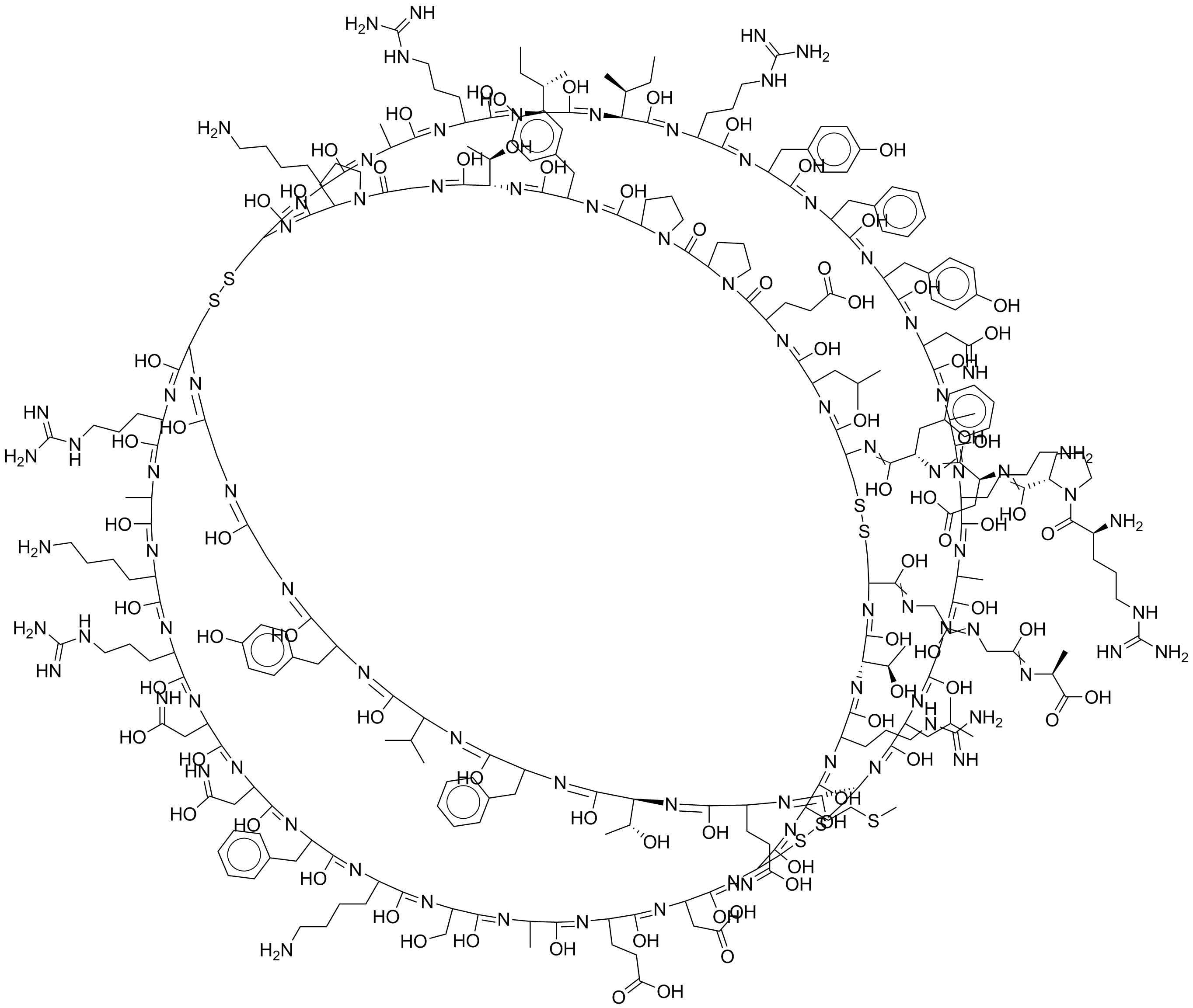 |
| Molecular Formula | C284H432N84O79S7 |
| Molecular Weight | 6511.83 |
| CAS Registry Number | 9087-70-1 (9004-04-0) |
| EC Number | 232-994-9 |
| SMILES | CC[C@H](C)[C@@H]1/N=C(/O)C(CCCNC(=N)N)/N=C(/O)C(C)/N=C(/O)C(CCCCN)/N=C(/O)[C@@H]2CSSCC3/N=C(/O)C/N=C(/O)C/N=C(/O)C(Cc4ccc(O)cc4)/N=C(/O)C(C(C)C)/N=C(/O)C(Cc4ccccc4)/N=C(/O)[C@H]([C@@H](C)O)/N=C(/O)C(CCC(=N)O)/N=C(/O)[C@H](CSSC[C@H](/N=C(/O)C(CC(=O)O)/N=C(/O)C(CCC(=O)O)/N=C(/O)C(C)/N=C(/O)C(CO)/N=C(/O)C(CCCCN)/N=C(/O)C(Cc4ccccc4)/N=C(/O)C(CC(=N)O)/N=C(/O)C(CC(=N)O)/N=C(/O)C(CCCNC(=N)N)/N=C(/O)C(CCCCN)/N=C(/O)C(C)/N=C(/O)C(CCCNC(=N)N)/N=C3O)/C(O)=NC(CCSC)/C(O)=NC(CCCNC(=N)N)/C(O)=N[C@@H]([C@@H](C)O)/C(O)=NC(C(O)=NCC(O)=NCC(O)=N[C@@H](C)C(=O)O)CSSCC(N=C(O)[C@H](Cc3ccccc3)N=C(O)[C@H](CC(=O)O)N=C(O)[C@@H]3CCCN3C(=O)[C@@H](N)CCCNC(=N)N)/C(O)=NC(CC(C)C)/C(O)=NC(CCC(=O)O)C(=O)N3CCCC3C(=O)N3CCCC3/C(O)=NC(Cc3ccc(O)cc3)/C(O)=N[C@@H]([C@@H](C)O)/C(O)=NCC(=O)N3CCCC3/C(O)=N2)/N=C(/O)C(CC(C)C)/N=C(/O)C/N=C(/O)C(C)/N=C(/O)C(CCCCN)/N=C(/O)C(C)/N=C(/O)C(CC(=N)O)/N=C(/O)C(Cc2ccc(O)cc2)/N=C(/O)C(Cc2ccccc2)/N=C(/O)C(Cc2ccc(O)cc2)/N=C(/O)C(CCCNC(=N)N)/N=C(/O)[C@H]([C@@H](C)CC)/N=C1O |
| Hazard Symbols |  Xn Details Xn Details | ||||||||||||
|---|---|---|---|---|---|---|---|---|---|---|---|---|---|
| Risk Statements | R42/43 Details | ||||||||||||
| Safety Statements | S22;S36/37;S45 Details | ||||||||||||
| Hazard Classification | |||||||||||||
| |||||||||||||
| SDS | Available | ||||||||||||
 chemBlink Chemical Story
|
Aprotinin is a small, naturally occurring protein that functions as a serine protease inhibitor. It is widely known for its ability to inhibit enzymes such as trypsin, chymotrypsin, plasmin, and kallikrein, and it has been used clinically and experimentally to reduce excessive proteolysis and control bleeding. Structurally, aprotinin is a single-chain polypeptide composed of approximately 58 amino acids. It is derived originally from bovine sources, particularly bovine lung tissue. Despite its small size, it adopts a highly compact and stable three-dimensional structure that is rich in disulfide bonds. Specifically, aprotinin contains multiple intramolecular disulfide bridges that lock the peptide into a rigid conformation, making it highly resistant to thermal denaturation and proteolytic degradation. The overall fold of aprotinin is characteristic of small protease inhibitors and consists of a tightly packed globular structure stabilized by a network of hydrogen bonds and disulfide linkages. The protein surface contains both hydrophobic and hydrophilic regions, but the dense disulfide bonding significantly reduces conformational flexibility compared with many other peptides of similar size. The functional activity of aprotinin arises from its ability to bind tightly to the active sites of serine proteases. It acts as a reversible, competitive inhibitor, forming a stable enzyme–inhibitor complex that blocks substrate access. The binding interaction is highly specific and is mediated by a reactive loop region of the inhibitor that fits into the enzyme’s catalytic cleft. This reactive site loop mimics the natural substrates of serine proteases. It contains a specific sequence of amino acids that interacts with the catalytic triad of the target enzyme (typically serine, histidine, and aspartate residues in the protease active site). A key lysine residue in aprotinin plays a central role in binding, fitting into the specificity pocket of trypsin-like enzymes. Although aprotinin binds strongly to proteases, it is not cleaved efficiently by them due to its rigid structure. This rigidity prevents the conformational changes necessary for enzymatic hydrolysis, allowing it to act as a tight-binding inhibitor rather than a substrate. From a biochemical perspective, aprotinin’s inhibition of plasmin is particularly important in clinical contexts. Plasmin is a key enzyme involved in fibrinolysis, the breakdown of blood clots. By inhibiting plasmin, aprotinin reduces fibrin degradation and can help control bleeding during surgical procedures. The protein is highly stable in physiological environments due to its disulfide-rich architecture. These covalent bonds provide strong structural constraints that maintain its folded state even under conditions that would denature many other proteins. As a result, aprotinin retains inhibitory activity across a relatively wide range of pH and temperature conditions. Physicochemically, aprotinin is water-soluble and behaves like a typical small globular protein in solution. Its solubility is driven by the presence of multiple charged and polar amino acid side chains on its surface, which interact favorably with water molecules. Aprotinin does not require cofactors or metal ions for its inhibitory activity. Its function is entirely based on direct protein–protein interaction with target enzymes, making it a classic example of a proteinaceous inhibitor. Overall, aprotinin is a small, disulfide-stabilized protein that inhibits serine proteases through tight, reversible binding to their active sites. Its compact structure, high stability, and strong affinity for enzymes such as trypsin and plasmin underlie its biological and clinical significance as a regulator of proteolytic activity. References 2025. The Effect of Prophylactic Use of Antifibrinolytics During Pediatric Non‐Cardiac Surgeries on Bleeding and Transfusions: A Systematic Review and Meta‐Analysis. Paediatric anaesthesia. DOI: 10.1111/pan.15137 2024. Liposome-encapsulated aprotinin biodistribution in mice: Side-by-side comparison with free drug formulation. Biochemical and Biophysical Research Communications. DOI: 10.1016/j.bbrc.2024.150636 2024. Cost analysis study comparing the impact of treatment with aprotinin versus tranexamic acid in cardiac surgery under cardiopulmonary bypass. Annales Pharmaceutiques Françaises. DOI: 10.1016/j.pharma.2024.07.005 |
| Market Analysis Reports |