
Online Database of Chemicals from Around the World
| Changzhou Ditong Chemical Co., Ltd. | China | |||
|---|---|---|---|---|
 | www.edengenechem.com | |||
 | +86 (519) 8829-8848 +86 18118010980 | |||
 | info@edengenechem.com sale@edengenechem.com | |||
 | QQ Chat | |||
 | WeChat: 18118010980 | |||
| Chemical manufacturer since 2006 | ||||
| chemBlink Premium supplier since 2026 | ||||
| Classification | Pharmaceutical intermediate >> Heterocyclic compound intermediate >> Pyrimidine compound >> Amine |
|---|---|
| Name | N,N-Didecyl-1-decanamine |
| Molecular Structure | 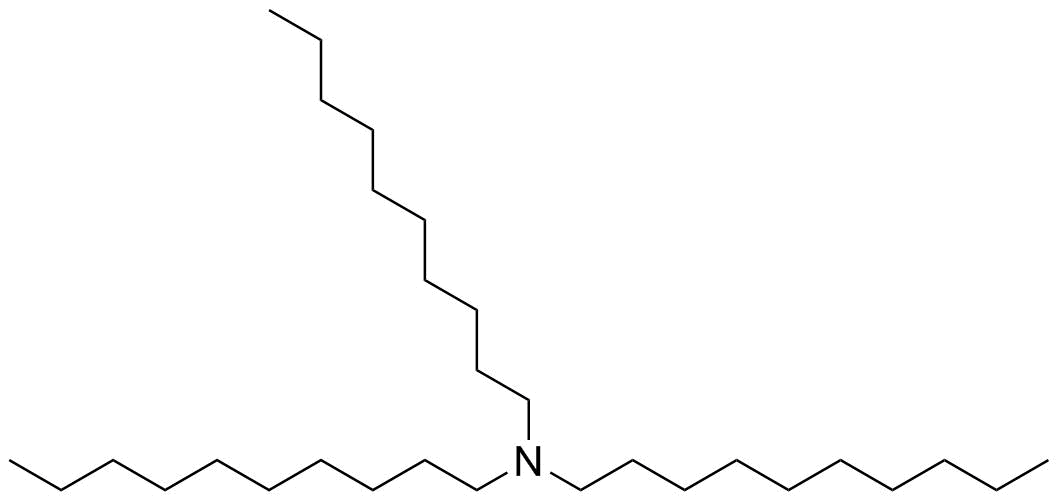 |
| Molecular Formula | C30H63N |
| Molecular Weight | 437.83 |
| CAS Registry Number | 1070-01-5 |
| EC Number | 213-966-5 |
| SMILES | CCCCCCCCCCN(CCCCCCCCCC)CCCCCCCCCC |
| Density | 0.8±0.1 g/cm3 Calc.* |
|---|---|
| Boiling point | 504.4±19.0 °C 760 mmHg (Calc.)* |
| Flash point | 224.7±18.4 °C (Calc.)* |
| Index of refraction | 1.458 (Calc.)* |
| * | Calculated using Advanced Chemistry Development (ACD/Labs) Software. |
| Hazard Symbols |  GHS09; Details GHS09; Details | ||||||||||||||||||||||||
|---|---|---|---|---|---|---|---|---|---|---|---|---|---|---|---|---|---|---|---|---|---|---|---|---|---|
| Risk Statements | H411 Details | ||||||||||||||||||||||||
| Safety Statements | P273-P391-P501 Details | ||||||||||||||||||||||||
| Hazard Classification | |||||||||||||||||||||||||
| |||||||||||||||||||||||||
| SDS | Available | ||||||||||||||||||||||||
 chemBlink Chemical Story
|
N,N-Didecyl-1-decanamine is a tertiary aliphatic amine consisting of a central nitrogen atom bonded to three linear decyl (C10) alkyl groups. It belongs to the class of trialkylamines and is a highly hydrophobic organic compound characterized by a long-chain hydrocarbon framework and a single tertiary amine functional group. Structurally, the molecule contains one nitrogen atom that is covalently bonded to three decyl substituents. Each decyl group is a straight-chain saturated hydrocarbon containing ten carbon atoms connected exclusively by carbon–carbon single bonds. The carbon atoms within the alkyl chains are predominantly sp3-hybridized, giving the chains considerable conformational flexibility through free rotation about the C–C bonds. The nitrogen atom is sp3-hybridized and adopts a trigonal pyramidal geometry. In the neutral form, it possesses a lone pair of electrons that can act as a Lewis base. Under acidic conditions, the nitrogen readily accepts a proton to form the corresponding trialkylammonium cation. This reversible protonation significantly increases the compound's polarity and water compatibility. The three decyl chains dominate the molecular structure and impart pronounced hydrophobic character. Because of their length and flexibility, these hydrocarbon chains can adopt numerous conformations in solution and participate in extensive van der Waals interactions. The large nonpolar surface area results in strong affinity for hydrophobic environments while limiting intrinsic water solubility of the free amine. Unlike primary or secondary amines, N,N-didecyl-1-decanamine contains no N–H bonds. Consequently, the molecule cannot function as a hydrogen bond donor. However, the nitrogen lone pair allows it to serve as a hydrogen bond acceptor until protonation occurs. This distinction influences both its intermolecular interactions and its chemical behavior. From an electronic perspective, the alkyl substituents donate electron density to the nitrogen through inductive effects, increasing the basicity of the tertiary amine relative to aromatic amines. The electron-rich nitrogen readily participates in acid–base reactions and coordination with suitable Lewis acids. Physicochemically, the molecule is overwhelmingly lipophilic because the three C10 hydrocarbon chains greatly outweigh the contribution of the single nitrogen atom to overall polarity. In its neutral form, it exhibits low water solubility but dissolves readily in many nonpolar and moderately polar organic solvents. Upon protonation or conversion into ammonium salts, aqueous solubility increases substantially due to the formation of ionic species. Chemically, the tertiary amine is the principal reactive center. It undergoes protonation with mineral and organic acids to produce trialkylammonium salts. The nitrogen lone pair can also react with alkylating agents to form quaternary ammonium compounds. Because the nitrogen lacks an N–H bond, it does not undergo reactions characteristic of primary or secondary amines, such as direct amide formation without prior dealkylation. The saturated hydrocarbon chains are chemically stable under ordinary conditions. They generally undergo only the reactions typical of alkanes, such as combustion or free-radical halogenation under appropriate conditions, while remaining largely inert in most synthetic environments. The overall molecular shape is determined by the flexible arrangement of the three long alkyl chains around the central nitrogen atom. The absence of rigid aromatic rings or multiple bonds allows considerable conformational freedom, enabling the molecule to adopt numerous low-energy conformations in solution. Overall, N,N-didecyl-1-decanamine is a tertiary trialkylamine composed of a trigonal pyramidal nitrogen center attached to three linear decyl groups. Its structure combines a strongly basic tertiary amine with an extensive hydrophobic hydrocarbon framework, resulting in a highly lipophilic molecule whose principal chemical behavior is governed by acid–base chemistry and reactions at the tertiary nitrogen center. References 2024. Third-Generation L-Lactic Acid Biorefinery Approaches: Exploring the Viability of Macroalgae Detritus. BioEnergy Research. DOI: 10.1007/s12155-024-10801-z 2024. Simultaneous fermentation and enzymatic biocatalysis—a useful process option? Biotechnology for Biofuels and Bioproducts. DOI: 10.1186/s13068-024-02519-z 2019. Lactic Acid Extraction from Aqueous Systems by Emulsion Liquid Membrane Separation Process Using Statistical Experimental Design. Polytechnica. DOI: 10.1007/s41050-019-00015-0 |
| Market Analysis Reports |