
Online Database of Chemicals from Around the World
| Taizhou Crene Biotechnology Co., Ltd. | China | |||
|---|---|---|---|---|
 | www.pharm-intermediates.com | |||
 | +86 (576) 8881-3233 8820-5808 +86 13396860566 | |||
 | +86 (576) 8822-9589 | |||
 | sales@pharm-intermediates.com | |||
 | QQ Chat | |||
| Chemical manufacturer since 2011 | ||||
| chemBlink Standard supplier since 2009 | ||||
| BOC Sciences | USA | |||
|---|---|---|---|---|
| www.bocsci.com | |||
| +1 (631) 485-4226 | |||
| +1 (631) 614-7828 | |||
| info@bocsci.com | |||
| Chemical manufacturer | ||||
| chemBlink Standard supplier since 2010 | ||||
| Shanghai Forever Synthesis Co.,Ltd. | China | |||
|---|---|---|---|---|
| www.foreversyn.com | |||
| +86 (551) 6288-8437 +86 18096409024 | |||
| sales@foreversyn.com sales02@foreversyn.com | |||
| QQ Chat | |||
 | Skype Chat | |||
| Chemical distributor since 2013 | ||||
| chemBlink Standard supplier since 2018 | ||||
| Shanghai Finetech pharm Co., Ltd. | China | |||
|---|---|---|---|---|
| www.finetechpharm.cn | |||
| +86 18221039705 | |||
| ad@finetechpharm.cn | |||
| Chemical manufacturer since 2016 | ||||
| chemBlink Standard supplier since 2026 | ||||
| Cayman Chemical Company | USA | |||
|---|---|---|---|---|
| www.caymanchem.com | |||
| +1 (734) 971-3335 | |||
| +1 (734) 971-3640 | |||
| sales@caymanchem.com | |||
| Chemical manufacturer | ||||
| Dalton Pharma Services | Canada | |||
|---|---|---|---|---|
| www.dalton.com | |||
| +1 (416) 661-2102 | |||
| +1 (416) 661-2108 | |||
| chemist@dalton.com | |||
| Chemical manufacturer | ||||
| Classification | API >> Inhibitor drug |
|---|---|
| Name | 15-ketobimatoprost |
| Synonyms | (5Z)-7-[(1R,2R,3R,5S)-3,5-Dihydroxy-2-[(1E)-3-oxo-5-phenyl-1-penten-1-yl]cyclopentyl]-N-ethyl-5-heptenamide |
| Molecular Structure | 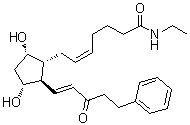 |
| Molecular Formula | C25H35NO4 |
| Molecular Weight | 413.55 |
| CAS Registry Number | 1163135-96-3 |
| EC Number | 810-194-6 |
| SMILES | CCNC(=O)CCC/C=CC[C@H]1[C@H](C[C@H]([C@@H]1/C=C/C(=O)CCC2=CC=CC=C2)O)O |
| Solubility | Practically insoluble (0.05 g/L) (25 °C), Calc.* |
|---|---|
| Density | 1.142±0.06 g/cm3 (20 °C 760 Torr), Calc.* |
| Boiling point | 626.7±55.0 °C 760 mmHg (Calc.)* |
| Flash point | 332.8±31.5 °C (Calc.)* |
| Index of refraction | 1.584 (Calc.)* |
| * | Calculated using Advanced Chemistry Development (ACD/Labs) Software. |
| Hazard Symbols |   GHS07;GHS08 Danger Details GHS07;GHS08 Danger Details |
|---|---|
| Risk Statements | H302-H319-H340-H360 Details |
| Safety Statements | P203-P264-P264+P265-P270-P280-P301+P317-P305+P351+P338-P318-P330-P337+P317-P405-P501 Details |
 chemBlink Chemical Story
|
15-ketobimatoprost is an oxidized derivative of the prostamide compound bimatoprost, belonging to the broader class of prostaglandin-related lipid analogues. It is characterized by the presence of a ketone functional group at the C-15 position of the prostanoid backbone, replacing the corresponding hydroxyl group found in bimatoprost. This structural modification places the compound within a group of metabolic transformation products generated through oxidation of prostaglandin analogues in biological systems. Bimatoprost is a synthetic prostamide analogue structurally related to prostaglandin F2α (PGF2α), an endogenous eicosanoid derived from arachidonic acid. Prostaglandins and their analogues are 20-carbon lipid mediators that play important roles in physiological processes such as inflammation, vascular regulation, and ocular homeostasis. Synthetic prostamides such as bimatoprost were developed to improve metabolic stability and therapeutic performance relative to naturally occurring prostaglandins, which are rapidly inactivated in vivo. The formation of 15-ketobimatoprost reflects a common metabolic pathway observed in prostaglandin chemistry, in which hydroxyl groups at specific positions on the prostanoid chain are oxidized to ketone functionalities. In the case of prostaglandin F2α and related analogues, oxidation at the C-15 position is a well-documented metabolic transformation mediated by dehydrogenase-type enzymes. This reaction converts a secondary alcohol into a ketone, typically resulting in a change in both polarity and biological activity of the molecule. Structurally, 15-ketobimatoprost retains the core prostanoid framework, including the cyclopentane ring and extended aliphatic side chains characteristic of eicosanoids. The introduction of a carbonyl group at C-15 alters the hydrogen-bonding properties of the molecule, replacing a hydrogen-bond donor (hydroxyl group) with a hydrogen-bond acceptor (carbonyl oxygen). This change can influence the compound’s interaction profile with biological targets and its overall physicochemical behavior. The stereochemical integrity of the remaining chiral centers in the prostanoid backbone is preserved during this oxidation process. Stereochemistry is a defining feature of prostaglandin-related compounds, as receptor recognition and biological activity are highly dependent on the three-dimensional arrangement of functional groups along the carbon chain. Even small changes in configuration or oxidation state can significantly affect receptor binding affinity and downstream signaling responses. In the context of drug metabolism, 15-ketobimatoprost is considered a biotransformation product of bimatoprost. Metabolic oxidation reactions of prostaglandin analogues typically occur through enzymatic pathways involving dehydrogenases that act on hydroxyl-containing carbon centers. These transformations are part of phase I metabolic processes, which introduce or expose polar functional groups to facilitate further conjugation and elimination. Bimatoprost itself is used in ophthalmic medicine to reduce intraocular pressure in conditions such as glaucoma and ocular hypertension. It functions primarily by increasing aqueous humor outflow through the uveoscleral pathway. The biological activity of its metabolites, including oxidized derivatives like 15-ketobimatoprost, is generally lower or altered compared with the parent compound, although specific activity profiles depend on receptor interactions and tissue distribution. From a chemical perspective, 15-ketobimatoprost retains the amphiphilic character typical of prostanoid molecules. The long hydrocarbon chain contributes hydrophobic properties, while the ketone and other oxygen-containing functional groups introduce localized polarity. This balance influences membrane association, solubility in biological fluids, and interaction with protein binding sites. The study of prostaglandin and prostamide metabolites such as 15-ketobimatoprost is important in understanding the pharmacokinetics and metabolic fate of therapeutic agents. Metabolite profiling provides insight into drug stability, duration of action, and potential secondary biological effects. In many cases, oxidation products serve as inactive or less active forms that facilitate clearance from the body, although exceptions exist where metabolites retain or modify biological activity. Analytical identification of compounds like 15-ketobimatoprost typically involves chromatographic separation techniques coupled with mass spectrometry. These methods allow detection of small structural differences, such as oxidation state changes at specific carbon positions, within complex biological matrices. Nuclear magnetic resonance spectroscopy may also be used in structural elucidation when sufficient quantities of the compound are isolated. Overall, 15-ketobimatoprost is an oxidized metabolite of the prostamide drug bimatoprost, characterized by conversion of a hydroxyl group at the C-15 position into a ketone. Its significance lies in its role within the metabolic pathway of prostaglandin analogues and in contributing to the understanding of how structural modifications influence the biological activity and elimination of eicosanoid-based therapeutic agents. |
| Market Analysis Reports |