
Online Database of Chemicals from Around the World
| Nile Chemicals | India | |||
|---|---|---|---|---|
 | www.nilechemicals.com | |||
 | +91 (22) 6631-3162 | |||
 | +91 (22) 2205-4833 | |||
 | sales@nilechemicals.com | |||
| Chemical manufacturer | ||||
| chemBlink Standard supplier since 2009 | ||||
| Alfa Chemistry | USA | |||
|---|---|---|---|---|
| www.alfa-chemistry.com | |||
| +1 (516) 734-6573 | |||
| +1 (516) 927-0118 | |||
| support@alfa-chemistry.com | |||
| Chemical manufacturer since 2005 | ||||
| chemBlink Standard supplier since 2012 | ||||
| Hangzhou Leap Chem Co., Ltd. | China | |||
|---|---|---|---|---|
| www.leapchem.com | |||
| +86 (571) 8771-1850 | |||
| market19@leapchem.com | |||
 | QQ Chat | |||
| Chemical manufacturer since 2006 | ||||
| chemBlink Standard supplier since 2015 | ||||
| Wuhan Carnoss Technology Co., Ltd. | China | |||
|---|---|---|---|---|
| www.carnoss.com | |||
| +86 18064039730 | |||
| +86 (27) 8349-6462 | |||
| frank@carnosschem.com | |||
 | WeChat: kanuosi_wxid | |||
| Chemical manufacturer since 2012 | ||||
| chemBlink Standard supplier since 2018 | ||||
| Classification | Inorganic chemical industry >> Inorganic acid |
|---|---|
| Name | Silicotungstic acid hydrate |
| Synonyms | Tungsten hydroxide oxide silicate hydrate |
| Molecular Structure | 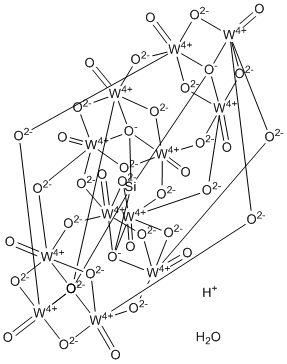 |
| Molecular Formula | H4[Si(W3O10)4] .xH2O |
| CAS Registry Number | 12027-43-9 |
| EC Number | 681-167-2 |
| SMILES | O.O[Si](O)(O)O.O=[W]1(=O)O[W](=O)(=O)O[W](=O)(=O)O1.O=[W]2(=O)O[W](=O)(=O)O[W](=O)(=O)O2.O=[W]3(=O)O[W](=O)(=O)O[W](=O)(=O)O3.O=[W]4(=O)O[W](=O)(=O)O[W](=O)(=O)O4 |
| Hazard Symbols |  GHS07 Warning Details GHS07 Warning Details | ||||||||||||||||||||||||||||
|---|---|---|---|---|---|---|---|---|---|---|---|---|---|---|---|---|---|---|---|---|---|---|---|---|---|---|---|---|---|
| Risk Statements | H315-H319-H335 Details | ||||||||||||||||||||||||||||
| Safety Statements | P261-P264-P264+P265-P271-P280-P302+P352-P304+P340-P305+P351+P338-P319-P321-P332+P317-P337+P317-P362+P364-P403+P233-P405-P501 Details | ||||||||||||||||||||||||||||
| Hazard Classification | |||||||||||||||||||||||||||||
| |||||||||||||||||||||||||||||
| SDS | Available | ||||||||||||||||||||||||||||
 chemBlink Chemical Story
|
Silicotungstic acid is an acid, but it is also something much more architecturally interesting: a molecular metal oxide cluster. Its best-known anion is the Keggin ion [SiW12O40]4-, in which a central silicate tetrahedron is surrounded by twelve tungsten-oxygen octahedra arranged in a highly symmetric cage. The hydrate sold under CAS 12027-43-9 contains water associated with this polyoxometalate acid, and the exact hydration level can vary with material and conditions. The Keggin structure was one of the landmarks of early polyoxometalate chemistry because it showed that metal oxides need not exist only as infinite solids. They can form discrete, well-defined nanoscale anions with reproducible structures. In silicotungstic acid, the large delocalized oxide framework stabilizes several acidic protons, giving the material very strong Bronsted acidity. At the same time, the tungsten-oxide skeleton can participate in reversible redox chemistry. This combination explains why heteropolyacids became important catalysts. They can catalyze reactions normally promoted by strong mineral acids while offering a molecularly defined oxide environment. Silicotungstic acid has been studied for etherification, esterification, dehydration, biomass conversion, and other acid-catalyzed processes. It can be used in homogeneous solution or dispersed on porous supports to create a more easily recoverable solid catalyst. Glycerol dehydration provides a useful example. As biodiesel production expanded, glycerol became an abundant by-product, creating interest in upgrading it to higher-value chemicals such as acrolein. Supported silicotungstic acid catalysts have been investigated for this conversion. Performance depends not merely on 'acidity' but on pore structure, water tolerance, dispersion, and whether the Keggin ion remains intact under reaction conditions. Too strong an interaction with a support or excessive decomposition can destroy the molecular architecture responsible for the desired behavior. Polyoxometalates can also act as coupled stores of protons and electrons. A 2019 catalytic study used silicotungstic acid as an electron-coupled-proton buffer in hydrogen-evolution and semihydrogenation chemistry, illustrating how the same cluster can move beyond the conventional role of a static acid catalyst. The tungsten centers and oxide framework can accept and redistribute reduction equivalents while the acidic protons participate in complementary steps. Silicotungstic acid is memorable because it blurs categories. It is a strong acid, an oxide, a discrete molecular ion, and a redox-active catalyst scaffold at the same time. The Keggin cluster demonstrates that inorganic chemistry can build molecule-sized pieces of a metal oxide with properties that can be tuned by composition, support, hydration, and oxidation state. References: 1. Pope M.T. Heteropoly and Isopoly Oxometalates. Springer. DOI: 10.1007/978-3-662-12004-0. 2. Katryniok B. et al. Glycerol dehydration over silicotungstic-acid-based catalysts. ChemSusChem. 2012. DOI: 10.1002/cssc.201100635. 3. Journal of Catalysis. Supported silicotungstic acid for glycerol dehydration. 2012. DOI: 10.1016/j.jcat.2011.11.004. 4. Journal of Catalysis. Silicotungstic acid as an electron-coupled-proton buffer in catalytic hydrogen chemistry. 2019. DOI: 10.1016/j.jcat.2019.09.011. |
| Market Analysis Reports |