
Online Database of Chemicals from Around the World
| Laizhou Laiyu Chemical Co., Ltd. | China | |||
|---|---|---|---|---|
 | www.laiyu.com | |||
 | +86 (535) 271-9337 | |||
 | liyunxia0707@163.com | |||
 | QQ Chat | |||
 | WeChat: 15864067774 | |||
 | WhatsApp:8615864067774 | |||
| Chemical manufacturer since 1998 | ||||
| chemBlink Standard supplier since 2008 | ||||
| Simagchem Corporation | China | |||
|---|---|---|---|---|
| www.simagchem.com | |||
| +86 13806087780 | |||
 | +86 (592) 268-0237 | |||
| sale@simagchem.com | |||
| Chemical manufacturer since 2002 | ||||
| chemBlink Standard supplier since 2008 | ||||
| Hefei TNJ Chemical Industry Co., Ltd. | China | |||
|---|---|---|---|---|
| www.tnjchem.com | |||
| +86 (551) 6541-8684 | |||
| +86 (551) 6541-8697 | |||
| sales@tnjchem.com | |||
| Chemical manufacturer since 2001 | ||||
| chemBlink Standard supplier since 2010 | ||||
| Chembridge International Corp. Taipei / Dongguan / Nanjing | China | |||
|---|---|---|---|---|
| www.chembridge.com.tw | |||
| +886 (2) 2649-6320 +86 (769) 2250-4087 +86 (25) 8471-2192 | |||
| +886 (2) 2704-3915 / +86 (769) 2246-8225 / +86 (25) 8471-2052 | |||
| cnservice@chembridge.net | |||
| Chemical manufacturer | ||||
| chemBlink Standard supplier since 2011 | ||||
| Hangzhou Leap Chem Co., Ltd. | China | |||
|---|---|---|---|---|
| www.leapchem.com | |||
| +86 (571) 8771-1850 | |||
| market19@leapchem.com | |||
| QQ Chat | |||
| Chemical manufacturer since 2006 | ||||
| chemBlink Standard supplier since 2015 | ||||
| Chengdu Yuanda Chemical Co., Ltd. | China | |||
|---|---|---|---|---|
| www.ydachem.com | |||
| +86 (28) 8535-6300 | |||
| +86 (28) 8535-6300 | |||
| sales@ydachem.com | |||
| Chemical manufacturer since 2009 | ||||
| chemBlink Standard supplier since 2017 | ||||
| Qingdao Highcloud Tech Material Co., Ltd. | China | |||
|---|---|---|---|---|
| www.highcloudtech.com.cn | |||
| +86 86-15864067774 | |||
| info@highcloudtech.com.cn | |||
| QQ Chat | |||
| WeChat: 8615864067774 | |||
| WhatsApp:8615864067774 | |||
| Chemical manufacturer since 2023 | ||||
| chemBlink Standard supplier since 2026 | ||||
| Wako Pure Chemical Industries, Ltd. | Japan | |||
|---|---|---|---|---|
| www.wako-chem.co.jp | |||
| +81 (6) 6203-3741 | |||
| +81 (6) 6201-5964 | |||
| wkhk.info@fujifilm.com | |||
| Chemical manufacturer since 1922 | ||||
| Changzhou Suntton Co., Ltd. | USA | |||
|---|---|---|---|---|
| www.suntton.com | |||
| +1 (914) 965-2077 +86 (519) 8513-6089 | |||
| +1 (914) 375-2093 / +86 (519) 8513-6133 | |||
| luke.verdet@suntton.com lily.chen@suntton.com | |||
| Chemical manufacturer | ||||
| Classification | Chemical reagent >> Organic reagent >> Imide |
|---|---|
| Name | 1,1'-(Methylenedi-4,1-phenylene)bismaleimide |
| Synonyms | Bismaleimide |
| Molecular Structure | 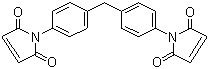 |
| Molecular Formula | C21H14N2O4 |
| Molecular Weight | 358.35 |
| CAS Registry Number | 13676-54-5 |
| EC Number | 237-163-4 |
| SMILES | C1=CC(=CC=C1CC2=CC=C(C=C2)N3C(=O)C=CC3=O)N4C(=O)C=CC4=O |
| Density | 1.4±0.1 g/cm3 Calc.* |
|---|---|
| Melting point | 156 - 158 °C (Expl.) |
| Boiling point | 584.9±43.0 °C 760 mmHg (Calc.)* |
| Flash point | 278.3±20.5 °C (Calc.)* |
| Index of refraction | 1.69 (Calc.)* |
| * | Calculated using Advanced Chemistry Development (ACD/Labs) Software. |
| Hazard Symbols |   GHS06;GHS07 Danger Details GHS06;GHS07 Danger Details | ||||||||||||||||||||||||||||||||||||||||||||||||||||||||
|---|---|---|---|---|---|---|---|---|---|---|---|---|---|---|---|---|---|---|---|---|---|---|---|---|---|---|---|---|---|---|---|---|---|---|---|---|---|---|---|---|---|---|---|---|---|---|---|---|---|---|---|---|---|---|---|---|---|
| Risk Statements | H315-H317-H319-H330-H335 Details | ||||||||||||||||||||||||||||||||||||||||||||||||||||||||
| Safety Statements | P260-P261-P264-P264+P265-P271-P272-P280-P284-P302+P352-P304+P340-P305+P351+P338-P316-P319-P320-P321-P332+P317-P333+P317-P337+P317-P362+P364-P403+P233-P405-P501 Details | ||||||||||||||||||||||||||||||||||||||||||||||||||||||||
| Hazard Classification | |||||||||||||||||||||||||||||||||||||||||||||||||||||||||
| |||||||||||||||||||||||||||||||||||||||||||||||||||||||||
| Transport Information | UN 2811 | ||||||||||||||||||||||||||||||||||||||||||||||||||||||||
| SDS | Available | ||||||||||||||||||||||||||||||||||||||||||||||||||||||||
 chemBlink Chemical Story
|
1,1′-(Methylenedi-4,1-phenylene)bismaleimide is an aromatic bismaleimide compound composed of two maleimide groups connected through a methylene-bridged para-phenylene linker. The structure belongs to the class of thermosetting resin monomers widely used in high-performance polymer chemistry due to their ability to undergo addition polymerization reactions forming highly crosslinked networks. The central structural feature is the bismaleimide functionality. A maleimide group consists of a five-membered cyclic imide containing a carbon–carbon double bond conjugated with two carbonyl groups. This arrangement creates an electron-deficient alkene that is highly reactive toward nucleophiles and dienes. The conjugation between the double bond and imide carbonyls stabilizes the system while also enhancing its electrophilic character. In this molecule, two maleimide units are present, each attached to a para-substituted phenyl ring. These phenyl rings are connected through a methylene bridge at their para positions, forming a 4,4′-methylenedianiline-derived backbone. The methylene linkage introduces a flexible sp³-hybridized carbon between two aromatic rings, allowing limited rotational freedom while maintaining overall structural rigidity due to the aromatic framework. Each phenylene unit is symmetrically substituted at the para positions with maleimide groups, resulting in a linear, symmetric molecular architecture. This symmetry contributes to uniform reactivity and predictable behavior in polymerization processes. The maleimide double bonds are the most chemically reactive sites in the molecule. They are strongly electron-deficient due to the adjacent carbonyl groups, making them highly susceptible to Michael-type additions and Diels–Alder reactions. These reactions are fundamental to the curing chemistry of bismaleimide resins, where the compound reacts with diamines, dienes, or other nucleophiles to form thermally stable polymer networks. From a structural standpoint, the molecule combines rigid aromatic segments with reactive unsaturated imide termini. The aromatic phenylene rings contribute stiffness and thermal stability, while the methylene bridge provides slight conformational flexibility. The imide rings themselves are planar and electron-deficient, reinforcing rigidity and reactivity at the same time. Physicochemically, 1,1′-(methylenedi-4,1-phenylene)bismaleimide is relatively nonpolar in its aromatic core but contains strongly polar imide carbonyl groups. This combination gives it a balanced amphiphilic character at the molecular scale, although overall it behaves as a relatively hydrophobic solid with high thermal stability. The imide carbonyls are capable of accepting hydrogen bonds, but the molecule lacks hydrogen-bond donors. In polymer chemistry applications, bismaleimides are valued for their ability to form thermally resistant and mechanically strong networks. Upon curing, the double bonds in the maleimide groups participate in addition reactions that link molecules together into three-dimensional crosslinked structures. These networks exhibit high glass transition temperatures and resistance to thermal degradation. The methylene-bridged diphenyl structure contributes to rigidity while avoiding excessive steric hindrance at the reactive maleimide sites. This allows efficient polymerization while maintaining structural integrity in the resulting materials. Chemically, aside from the maleimide double bonds, the aromatic rings are relatively stable under normal conditions, while the imide groups are resistant to hydrolysis compared with simple esters but can undergo degradation under harsh hydrolytic or basic environments. The methylene bridge is generally stable under standard conditions. Overall, 1,1′-(methylenedi-4,1-phenylene)bismaleimide is a symmetric aromatic bismaleimide monomer featuring two electron-deficient maleimide units linked through a methylene-bridged biphenyl core. Its structure combines rigidity, thermal stability, and highly reactive unsaturated imide groups, making it a key precursor in high-performance thermosetting polymer systems. References 2025. Macromonomer derived from tung oil and bismaleimide: synthesis via Diels-Alder reaction and production of renewable polyesters. Journal of Polymer Research. DOI: 10.1007/s10965-025-04586-8 2025. Polyurethanes synthesized from diisocyanate trimers and polyethylene glycol undergo crosslinking via thermally reversible Diels–Alder reactions. Macromolecular Research. DOI: 10.1007/s13233-025-00400-y 2025. 3D-printed high-stiffness and antiswelling Diels-Alder crosslinked polycarbonate-based polyurethane for meniscal substitution. Science China Technological Sciences. DOI: 10.1007/s11431-025-2924-0 |
| Market Analysis Reports |