
Online Database of Chemicals from Around the World
| Lengshi Chemical (Qingzhou) Co., Ltd. | China | |||
|---|---|---|---|---|
 | www.xinnuopharma.cn | |||
 | +86 18615688656 | |||
 | sales@xinnuopharma.com | |||
 | WeChat: 18615688656 | |||
| Chemical distributor since 2024 | ||||
| chemBlink Standard supplier since 2026 | ||||
| Classification | Biochemical >> Inhibitor >> G protein coupled receptor(GPCR & G Protein) >> CGRP receptor antagonist |
|---|---|
| Name | Ubrogepant |
| Synonyms | (3S)-N-[(3S,5S,6R)-6-methyl-2-oxo-5-phenyl-1-(2,2,2-trifluoroethyl)piperidin-3-yl]-2-oxospiro[1H-pyrrolo[2,3-b]pyridine-3,6'-5,7-dihydrocyclopenta[b]pyridine]-3'-carboxamide |
| Molecular Structure | 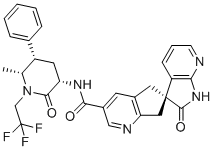 |
| Molecular Formula | C29H26F3N5O3 |
| Molecular Weight | 549.54 |
| CAS Registry Number | 1374248-77-7 |
| SMILES | C[C@@H]1[C@@H](C[C@@H](C(=O)N1CC(F)(F)F)NC(=O)C2=CC3=C(C[C@@]4(C3)C5=C(NC4=O)N=CC=C5)N=C2)C6=CC=CC=C6 |
| Density | 1.5±0.1 g/cm3 Calc.* |
|---|---|
| Boiling point | 729.4±60.0 °C 760 mmHg (Calc.)* |
| Flash point | 394.9±32.9 °C (Calc.)* |
| Index of refraction | 1.649 (Calc.)* |
| * | Calculated using Advanced Chemistry Development (ACD/Labs) Software. |
| Hazard Symbols |  GHS07 Warning Details GHS07 Warning Details |
|---|---|
| Risk Statements | H302-H315-H319-H350 Details |
| Safety Statements | P280-P305+P351+P338 Details |
| SDS | Available |
 chemBlink Chemical Story
|
Ubrogepant is a small-molecule drug belonging to the class of calcitonin gene-related peptide (CGRP) receptor antagonists, commonly referred to as “gepants.” It is used in the acute treatment of migraine. Unlike older migraine therapies such as triptans, which act on serotonin (5-HT) receptors and cause vasoconstriction, ubrogepant targets the CGRP signaling pathway, which plays a central role in migraine pathophysiology. The discovery and development of ubrogepant are rooted in advances in neurovascular biology during the late twentieth and early twenty-first centuries. CGRP, a 37-amino-acid neuropeptide, was identified as a potent vasodilator and pain-associated signaling molecule. Elevated levels of CGRP were observed during migraine attacks, leading to the hypothesis that blocking CGRP signaling could provide therapeutic benefit without the vascular side effects associated with triptans. This spurred the development of small-molecule CGRP receptor antagonists, including ubrogepant. Structurally, ubrogepant is a non-peptide organic molecule designed to bind selectively to the CGRP receptor complex. The CGRP receptor is a heteromeric structure composed of the calcitonin receptor-like receptor (CLR), receptor activity-modifying protein 1 (RAMP1), and receptor component protein (RCP). By inhibiting this receptor, ubrogepant prevents CGRP from activating downstream signaling pathways involved in pain transmission and neurogenic inflammation. Unlike peptide-based therapeutics, ubrogepant is orally bioavailable, which represents a significant advantage in migraine treatment. The development of orally active CGRP antagonists required extensive medicinal chemistry optimization to achieve adequate potency, metabolic stability, and pharmacokinetic properties. Early CGRP antagonists faced challenges related to liver toxicity and limited bioavailability, but later compounds such as ubrogepant were designed with improved safety profiles. From a chemical perspective, ubrogepant contains multiple heteroaromatic and aliphatic functional groups arranged in a rigid, drug-like scaffold. The molecule incorporates polar functional groups that contribute to receptor binding through hydrogen bonding and electrostatic interactions, as well as hydrophobic regions that facilitate binding within the receptor pocket. This balance of polarity and lipophilicity is typical of modern small-molecule receptor antagonists. The pharmacological activity of ubrogepant is highly selective for the CGRP receptor, minimizing off-target interactions with related peptide receptors. This selectivity is achieved through precise molecular complementarity between the drug and the receptor binding site, a result of structure-based drug design and iterative optimization during development. In clinical use, ubrogepant is indicated for the acute treatment of migraine attacks with or without aura in adults. It is not intended for preventive therapy but rather for symptomatic relief during migraine episodes. By blocking CGRP-mediated signaling, it helps reduce headache pain and associated symptoms such as photophobia and phonophobia. CGRP itself is widely distributed in both the central and peripheral nervous systems, particularly in trigeminal sensory pathways that are strongly implicated in migraine pathogenesis. During migraine attacks, CGRP release leads to vasodilation and sensitization of pain pathways. Ubrogepant interrupts this cascade by competitively antagonizing the receptor, thereby reducing neuronal activation and inflammatory signaling. From a pharmacokinetic perspective, ubrogepant is designed for oral administration with sufficient absorption and systemic exposure to reach target sites within the trigeminovascular system. It undergoes metabolic processing primarily in the liver, and its dosing regimen reflects its half-life and clearance characteristics. Overall, ubrogepant is a modern, orally active CGRP receptor antagonist developed for the acute treatment of migraine. Its significance lies in its mechanism-based targeting of CGRP signaling, representing a shift from vasoconstrictive migraine therapies toward neuropeptide modulation, and it is an important example of rational drug design based on neurobiological disease mechanisms. References 2026. Identifying cardiac safety signals of disproportionate reporting for CGRP antagonists: evidence from the FDA Adverse Event Reporting System. Naunyn-Schmiedeberg's Archives of Pharmacology. DOI: 10.1007/s00210-026-05116-z 2026. Hypothalamic and sex-related hormones in migraine. The Journal of Headache and Pain. URL: https://www.ncbi.nlm.nih.gov/pmc/articles/PMC12927229 2026. Neuroinflammation and RAMP1: the Role of the Peripheral and Central Nervous System in Tumor Progression. Cell Biochemistry and Biophysics. DOI: 10.1007/s12013-026-02009-z |
| Market Analysis Reports |