
Online Database of Chemicals from Around the World
| Changzhou Ditong Chemical Co., Ltd. | China | |||
|---|---|---|---|---|
 | www.edengenechem.com | |||
 | +86 (519) 8829-8848 +86 18118010980 | |||
 | info@edengenechem.com sale@edengenechem.com | |||
 | QQ Chat | |||
 | WeChat: 18118010980 | |||
| Chemical manufacturer since 2006 | ||||
| chemBlink Premium supplier since 2026 | ||||
| Classification | Organic raw materials >> Carboxylic compounds and derivatives >> Carboxylic esters and their derivatives |
|---|---|
| Name | 3-Amino-2-butenoic acid (1,4-butanediyl) ester |
| Synonyms | 4-(3-aminobut-2-enoyloxy)butyl 3-aminobut-2-enoate |
| Molecular Structure | 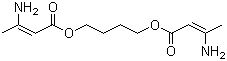 |
| Molecular Formula | C12H20N2O4 |
| Molecular Weight | 256.30 |
| CAS Registry Number | 14205-47-1 |
| EC Number | 238-059-1 |
| SMILES | CC(=CC(=O)OCCCCOC(=O)C=C(C)N)N |
| Density | 1.1±0.1 g/cm3 Calc.* |
|---|---|
| Melting point | 146 - 150 °C (Expl.) |
| Boiling point | 426.8±30.0 °C 760 mmHg (Calc.)* |
| Flash point | 191.2±20.9 °C (Calc.)* |
| Index of refraction | 1.509 (Calc.)* |
| * | Calculated using Advanced Chemistry Development (ACD/Labs) Software. |
| Hazard Symbols |  GHS07 Warning Details GHS07 Warning Details | ||||||||||||||||
|---|---|---|---|---|---|---|---|---|---|---|---|---|---|---|---|---|---|
| Risk Statements | H315-H319-H335 Details | ||||||||||||||||
| Safety Statements | P261-P264-P264+P265-P271-P280-P302+P352-P304+P340-P305+P351+P338-P319-P321-P332+P317-P337+P317-P362+P364-P403+P233-P405-P501 Details | ||||||||||||||||
| Hazard Classification | |||||||||||||||||
| |||||||||||||||||
| SDS | Available | ||||||||||||||||
 chemBlink Chemical Story
|
3-Amino-2-butenoic acid (1,4-butanediyl) ester is an organic compound belonging to the class of amino-substituted enamine esters. It is derived from 3-amino-2-butenoic acid, also known as an amino-substituted crotonic acid derivative, in which the carboxylic acid group has been converted into an ester with a 1,4-butanediyl linking group. The structure contains an α,β-unsaturated carbonyl system, an amino substituent, and an internal diol-derived ester framework. The molecule is based on 3-amino-2-butenoic acid, which contains a four-carbon unsaturated chain with a carboxyl group at one end, a carbon–carbon double bond between the 2- and 3-positions, and an amino group attached to the β-carbon. The characteristic structural unit is the conjugated system involving the carbon–carbon double bond and the ester carbonyl group. The ester functionality is formed by replacement of the carboxylic acid hydrogen with a 1,4-butanediyl group. This indicates that the compound contains a butylene chain connecting ester oxygen atoms, resulting in a diester-type structure when both ends of the butylene unit are involved in ester formation. The butanediyl segment consists of four saturated carbon atoms connected by single bonds, giving the molecule flexibility through rotation around carbon–carbon bonds. The α,β-unsaturated carbonyl system is the most important electronic feature of the molecule. The carbonyl carbon is sp2-hybridized and has a trigonal planar geometry. The adjacent carbon–carbon double bond allows conjugation between the alkene and carbonyl groups, creating an extended π-system. This conjugation stabilizes the molecule and influences its reactivity toward nucleophilic and electrophilic reagents. The amino group attached to the double bond forms an enamine-like structure. The nitrogen lone pair can interact with the adjacent π-system, allowing resonance delocalization between the amino group, carbon–carbon double bond, and carbonyl group. This conjugation reduces the basicity of the amino nitrogen compared with simple aliphatic amines and contributes to the stability of the conjugated system. The molecule can exist in different tautomeric forms due to proton transfer between the amino group, carbon–carbon double bond, and carbonyl oxygen. These tautomeric equilibria influence electronic distribution and can affect physical properties such as hydrogen bonding and reactivity. The amino group provides hydrogen-bonding capability. It can act as a hydrogen bond donor through N–H bonds and as a hydrogen bond acceptor through the nitrogen lone pair, depending on its electronic state. The ester oxygen atoms also function as hydrogen bond acceptors, increasing the overall polarity of the molecule. The 1,4-butanediyl portion is a flexible aliphatic chain composed of sp3-hybridized carbon atoms. It contributes hydrophobic character and increases conformational freedom. Compared with aromatic or cyclic substituents, the butylene chain allows greater rotational flexibility and influences the overall three-dimensional shape of the molecule. From a physicochemical perspective, 3-amino-2-butenoic acid (1,4-butanediyl) ester has both polar and nonpolar regions. The amino and ester functionalities provide polarity and hydrogen-bonding interactions, while the saturated butylene chain contributes hydrophobic character. The balance between these regions determines its solubility and intermolecular behavior. Chemically, the conjugated double bond and amino group are the most reactive features. The β-amino-α,β-unsaturated ester system can participate in addition reactions, condensation reactions, and transformations involving the amino functionality. The ester groups can undergo hydrolysis under strongly acidic or basic conditions, yielding the corresponding carboxylic acid derivatives and alcohol components. Overall, 3-amino-2-butenoic acid (1,4-butanediyl) ester is a conjugated amino ester containing an enamine-like β-amino acrylate framework linked with a flexible butylene unit. Its combination of π-conjugation, hydrogen-bonding functionality, and flexible aliphatic structure defines its chemical properties and places it among functionalized unsaturated amino acid ester derivatives used in organic synthesis. |
| Market Analysis Reports |