
Online Database of Chemicals from Around the World
| Earlier HK Company Limited | China | |||
|---|---|---|---|---|
 | www.earlierchem.com | |||
 | +86 (10) 6142-6769 +86 18616907430 | |||
 | +86 (10) 6142-6769 | |||
 | info@earlierchem.com | |||
 | QQ Chat | |||
| Chemical manufacturer since 2011 | ||||
| chemBlink Premium supplier since 2014 | ||||
| Hangzhou Verychem Science And Technology Co., Ltd. | China | |||
|---|---|---|---|---|
| www.verychem.com | |||
| +86 (571) 8816-2785 +86 13606544505 | |||
| +86 (571) 8816-2787 | |||
| lucy@verychem.com | |||
| Chemical manufacturer since 2004 | ||||
| chemBlink Premium supplier since 2022 | ||||
| Classification | Organic raw materials >> Organometallic compound >> Organic lithium |
|---|---|
| Name | Lithium borohydride |
| Synonyms | Lithium tetrahydroborate |
| Molecular Structure | 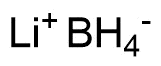 |
| Molecular Formula | LiBH4 |
| Molecular Weight | 21.78 |
| CAS Registry Number | 16949-15-8 |
| EC Number | 241-021-7 |
| SMILES | [Li+].[BH4-] |
| Density | 0.66 g/mL (Expl.) |
|---|---|
| Melting point | 280 °C (Decomposes) (Expl.) |
| Boiling point | 66 °C (Expl.) |
| Flash point | -17 °C (Expl.) |
| Solubility | soluble in ether, slightly soluble in ethanol (decomposes) (Expl.) |
| Hazard Symbols |    GHS02;GHS05;GHS06 Danger Details GHS02;GHS05;GHS06 Danger Details | ||||||||||||||||||||||||||||||||||||||||||||||||||||||||
|---|---|---|---|---|---|---|---|---|---|---|---|---|---|---|---|---|---|---|---|---|---|---|---|---|---|---|---|---|---|---|---|---|---|---|---|---|---|---|---|---|---|---|---|---|---|---|---|---|---|---|---|---|---|---|---|---|---|
| Risk Statements | H260-H261-H301-H311-H314-H331 Details | ||||||||||||||||||||||||||||||||||||||||||||||||||||||||
| Safety Statements | P223-P231+P232-P260-P261-P262-P264-P270-P271-P280-P301+P316-P301+P330+P331-P302+P335+P334-P302+P352-P302+P361+P354-P304+P340-P305+P354+P338-P316-P321-P330-P361+P364-P363-P370+P378-P402+P404-P403+P233-P405-P501 Details | ||||||||||||||||||||||||||||||||||||||||||||||||||||||||
| Hazard Classification | |||||||||||||||||||||||||||||||||||||||||||||||||||||||||
| |||||||||||||||||||||||||||||||||||||||||||||||||||||||||
| Transport Information | UN 1413 | ||||||||||||||||||||||||||||||||||||||||||||||||||||||||
| SDS | Available | ||||||||||||||||||||||||||||||||||||||||||||||||||||||||
 chemBlink Chemical Story
|
Lithium borohydride (LiBH4) is an inorganic borohydride that has become one of the most important hydride reagents in synthetic chemistry and an extensively studied material in hydrogen storage research. Composed of lithium cations and tetrahydroborate anions, the compound is a white crystalline solid that exhibits strong reducing properties and high hydrogen content. Since its discovery in the early twentieth century, lithium borohydride has found applications in organic synthesis, inorganic chemistry, materials science, and energy-related research. Lithium borohydride was first reported in 1940 by Hermann I. Schlesinger and Herbert C. Brown during their pioneering investigations of metal borohydrides. Their work demonstrated that diborane reacted with organolithium compounds to produce a new crystalline substance whose composition and chemical behavior were consistent with the ionic formula LiBH4. This study established lithium borohydride as the first well-characterized alkali metal borohydride and laid the foundation for the chemistry of borohydride compounds. The discovery also contributed to the rapid development of boron hydride chemistry that eventually led to numerous synthetic reagents and, decades later, earned Herbert C. Brown the Nobel Prize in Chemistry for his contributions to organoboron chemistry. Structurally, lithium borohydride consists of lithium ions and tetrahedral borohydride anions (BH4−). The borohydride ion contains four covalent B–H bonds arranged in a nearly tetrahedral geometry, while electrostatic interactions with lithium ions generate a crystalline lattice. The compound undergoes several temperature-dependent phase transitions, and its crystal structure has been investigated extensively by X-ray diffraction, neutron diffraction, and spectroscopic techniques. These studies have provided valuable information on hydrogen bonding, ionic motion, and structural dynamics in complex hydrides. One of the most important properties of lithium borohydride is its exceptionally high hydrogen content, approaching 18 wt%. This characteristic has attracted considerable attention in the field of hydrogen storage, where researchers seek lightweight materials capable of storing hydrogen safely and releasing it under controlled conditions. Although practical implementation remains challenging because of the high temperatures required for hydrogen release and the difficulty of regeneration, lithium borohydride continues to serve as a model compound for developing advanced solid-state hydrogen storage materials. In synthetic chemistry, lithium borohydride is widely employed as a selective reducing agent. It readily reduces esters, lactones, acid chlorides, and many other carbonyl-containing compounds to the corresponding alcohols. Compared with sodium borohydride, lithium borohydride generally exhibits greater reducing power and higher solubility in organic solvents such as ethers, allowing reactions to proceed under relatively mild conditions. Because of these properties, it has become an important reagent in both laboratory-scale organic synthesis and the preparation of pharmaceutical intermediates. The reagent also plays an important role in organometallic chemistry. Lithium borohydride is used in the preparation of transition-metal borohydride complexes, which have been investigated as catalysts, precursors for advanced materials, and intermediates in inorganic synthesis. The borohydride ligand exhibits versatile coordination behavior, making lithium borohydride an important starting material for studying metal-hydride interactions. Beyond its traditional chemical applications, lithium borohydride has attracted increasing interest in energy materials. Researchers have investigated its use in all-solid-state lithium batteries, where its relatively high lithium-ion conductivity at elevated temperatures makes it a candidate solid electrolyte. It has also been studied as a component of composite hydride systems designed to improve hydrogen absorption and desorption kinetics through catalytic additives or nanostructuring. These investigations continue to expand the understanding of complex hydrides as functional materials. Lithium borohydride is highly reactive toward water, alcohols, and acids, producing hydrogen gas and corresponding borate species. Consequently, it must be handled under dry, inert conditions to prevent decomposition and maintain reagent quality. Commercial samples are typically supplied under moisture-free conditions and stored in tightly sealed containers. More than eighty years after its discovery, lithium borohydride remains both an indispensable synthetic reagent and an important research material. Its combination of unique reducing ability, distinctive borohydride chemistry, and exceptionally high hydrogen content has ensured its continuing significance in organic synthesis, inorganic chemistry, materials science, and emerging energy technologies. References 1. Schlesinger, H.I. and Brown, H.C. (1940) 'Metallo Borohydrides. III. Lithium Borohydride', Journal of the American Chemical Society, 62(12), pp. 3429–3435. https://doi.org/10.1021/ja01869a039 2. Kollonitsch, J., Fuchs, O. and Gábor, V. (1954) 'New and Known Complex Borohydrides and some of their Applications in Organic Syntheses', Nature, 173, pp. 125–126. https://doi.org/10.1038/173125a0 3. Brown, D.A. (1961) 'The Borohydride Ion in the Lithium Borohydride Lattice', Nature, 190, p. 804. https://doi.org/10.1038/190804b0 |
| Market Analysis Reports |