
Online Database of Chemicals from Around the World
| Taizhou Crene Biotechnology Co., Ltd. | China | |||
|---|---|---|---|---|
 | www.pharm-intermediates.com | |||
 | +86 (576) 8881-3233 8820-5808 +86 13396860566 | |||
 | +86 (576) 8822-9589 | |||
 | sales@pharm-intermediates.com | |||
 | QQ Chat | |||
| Chemical manufacturer since 2011 | ||||
| chemBlink Standard supplier since 2009 | ||||
| BOC Sciences | USA | |||
|---|---|---|---|---|
| www.bocsci.com | |||
| +1 (631) 485-4226 | |||
| +1 (631) 614-7828 | |||
| info@bocsci.com | |||
| Chemical manufacturer | ||||
| chemBlink Standard supplier since 2010 | ||||
| Hangzhou Leap Chem Co., Ltd. | China | |||
|---|---|---|---|---|
| www.leapchem.com | |||
| +86 (571) 8771-1850 | |||
| market19@leapchem.com | |||
| QQ Chat | |||
| Chemical manufacturer since 2006 | ||||
| chemBlink Standard supplier since 2015 | ||||
| Amadis Chemical Co., Ltd. | China | |||
|---|---|---|---|---|
| www.amadischem.com | |||
| +86 (571) 8992-5085 | |||
| +86 (571) 8992-5065 | |||
| sales@amadischem.com | |||
| Chemical manufacturer since 2010 | ||||
| chemBlink Standard supplier since 2015 | ||||
| Yaopu (Shanghai) Pharma Tech Co., Ltd. | China | |||
|---|---|---|---|---|
| www.ypptech.com.cn | |||
| +86 (021) 5092-9289 | |||
| sales@ypptech.com.cn | |||
| QQ Chat | |||
 | WeChat: 13764387674 | |||
| Chemical manufacturer since 2007 | ||||
| chemBlink Standard supplier since 2023 | ||||
| Lengshi Chemical (Qingzhou) Co., Ltd. | China | |||
|---|---|---|---|---|
| www.xinnuopharma.cn | |||
| +86 18615688656 | |||
| sales@xinnuopharma.com | |||
| WeChat: 18615688656 | |||
| Chemical distributor since 2024 | ||||
| chemBlink Standard supplier since 2026 | ||||
| Alsachim SAS | France | |||
|---|---|---|---|---|
| www.alsachim.com | |||
| +33 (0) 390 402 200 | |||
| +33 (0) 390 402 199 | |||
| contact@alsachim.com | |||
| Chemical manufacturer | ||||
| Classification | API >> Antibiotics |
|---|---|
| Name | Pretomanid |
| Synonyms | PA-824; (S)-6,7-Dihydro-2-nitro-6-[[4-(trifluoromethoxy)phenyl]methoxy]-5H-imidazo[2,1-b][1,3]oxazine; (6S)-6,7-Dihydro-2-nitro-6-[[4-(trifluoromethoxy)phenyl]methoxy]-5H-imidazo[2,1-b][1,3]oxazine |
| Molecular Structure | 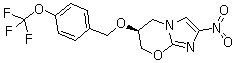 |
| Molecular Formula | C14H12F3N3O5 |
| Molecular Weight | 359.26 |
| CAS Registry Number | 187235-37-6 |
| SMILES | C1[C@@H](COC2=NC(=CN21)[N+](=O)[O-])OCC3=CC=C(C=C3)OC(F)(F)F |
| Density | 1.6±0.1 g/cm3 Calc.* |
|---|---|
| Melting point | 149-150 °C (Expl.) |
| Boiling point | 462.3±55.0 °C 760 mmHg (Calc.)* |
| Flash point | 233.4±31.5 °C (Calc.)* |
| Solubility | 10 mM in DMSO (Expl.) |
| Index of refraction | 1.589 (Calc.)* |
| * | Calculated using Advanced Chemistry Development (ACD/Labs) Software. |
| Hazard Symbols |  GHS07 Warning Details GHS07 Warning Details |
|---|---|
| Risk Statements | H315-H319-H335 Details |
| Safety Statements | P261-P264-P264+P265-P271-P280-P302+P352-P304+P340-P305+P351+P338-P319-P321-P332+P317-P337+P317-P362+P364-P403+P233-P405-P501 Details |
| SDS | Available |
 chemBlink Chemical Story
|
Pretomanid is a synthetic nitroimidazooxazine antimicrobial agent used in the treatment of drug-resistant tuberculosis. It belongs to a relatively modern class of bicyclic nitroimidazole-derived compounds designed to target Mycobacterium tuberculosis, the causative agent of tuberculosis. Pretomanid is notable for its role in combination regimens for multidrug-resistant (MDR) and extensively drug-resistant (XDR) tuberculosis, where conventional first-line therapies are ineffective. The development of pretomanid is part of a broader effort in late twentieth- and early twenty-first-century medicinal chemistry to design novel agents active against mycobacterial pathogens. Tuberculosis remains a major global infectious disease, and the rise of drug resistance created a need for new drugs with novel mechanisms of action. Nitroimidazole scaffolds were investigated because of their ability to undergo bioreductive activation under low-oxygen conditions, which are characteristic of the intracellular environment of M. tuberculosis. Pretomanid is a prodrug, meaning it requires enzymatic activation within the bacterial cell to exert its antimicrobial effects. Inside M. tuberculosis, the compound is reduced by bacterial nitroreductase enzymes, leading to the formation of reactive nitrogen species. These reactive intermediates are responsible for multiple antibacterial effects, including inhibition of cell wall synthesis and disruption of respiratory processes. The dual mechanism of action contributes to its effectiveness against both replicating and non-replicating bacterial populations. Structurally, pretomanid contains a nitroimidazole core fused to an oxazine ring system, forming a rigid bicyclic scaffold. The nitro group is essential for its bioactivation, as it undergoes enzymatic reduction within the mycobacterial cell. The overall structure is designed to balance chemical stability with the ability to penetrate bacterial cells and undergo selective activation in the pathogen rather than in human host tissues. The discovery of pretomanid is closely associated with research into bicyclic nitroimidazole compounds such as delamanid and related analogues. These compounds were optimized for improved pharmacokinetic properties, reduced toxicity, and enhanced antimycobacterial activity. Pretomanid emerged from structure–activity relationship studies aimed at improving efficacy against both active and dormant forms of M. tuberculosis. One of the key pharmacological features of pretomanid is its activity under hypoxic conditions. Tuberculosis lesions often contain oxygen-depleted environments, particularly within granulomas, where bacterial persistence is a major challenge. Pretomanid is activated more efficiently in such conditions, allowing it to target dormant bacterial populations that are less susceptible to many conventional antibiotics. The compound is used clinically in combination regimens, rather than as monotherapy, to reduce the risk of resistance development. In particular, pretomanid is part of standardized treatment combinations for resistant tuberculosis, where it is administered alongside other antimycobacterial agents. Combination therapy is essential in tuberculosis treatment due to the organism’s ability to rapidly develop drug resistance when exposed to single agents. From a chemical perspective, pretomanid is a relatively lipophilic, heterocyclic compound containing multiple nitrogen and oxygen atoms. The nitro group contributes to both its biological activity and its metabolic activation pathway. The bicyclic framework provides conformational rigidity, which is important for maintaining consistent binding and activation characteristics within the bacterial environment. The pharmacokinetics of pretomanid involve oral administration, absorption into systemic circulation, and distribution into infected tissues, including lung lesions where M. tuberculosis resides. Its metabolic activation occurs primarily within bacterial cells rather than human tissues, which helps to limit host toxicity while maintaining antimicrobial efficacy. Safety considerations for pretomanid are closely linked to its mechanism of action. Because it generates reactive nitrogen species upon activation, careful dosing and combination therapy are required to minimize potential adverse effects while maintaining therapeutic benefit. Its clinical use is therefore carefully regulated within specific treatment protocols for resistant tuberculosis. Overall, pretomanid is a nitroimidazooxazine antitubercular drug that functions as a prodrug activated within Mycobacterium tuberculosis to generate reactive intermediates that disrupt bacterial survival. Its significance lies in its novel mechanism of action, its activity against drug-resistant and dormant bacterial populations, and its role in modern combination therapies for tuberculosis treatment. References 2026. A novel antituberculosis agent exhibits potent clinical efficacy and good safety profile: an open-label, randomized-controlled, multicenter, phase 2a trial. Signal Transduction and Targeted Therapy. URL: https://www.ncbi.nlm.nih.gov/pmc/articles/PMC12748780 2026. A bactericidal tuberculosis drug regimen driven by inhibition of the terminal oxidases by pretomanid. EMBO Molecular Medicine. URL: https://www.ncbi.nlm.nih.gov/pmc/articles/PMC12988230 2000. A small-molecule nitroimidazopyran drug candidate for the treatment of tuberculosis. Nature. DOI: 10.1038/35016103 |
| Market Analysis Reports |