
Online Database of Chemicals from Around the World
| Nanjing Search Biotech Co., Ltd. | China | |||
|---|---|---|---|---|
 | www.searchbio.com.cn | |||
 | +86 (25) 8168-2922 8586-0978 +86 18913919581 | |||
 | +86 (25) 8586-0962 | |||
 | trade@searchbio.com.cn sales@searchbio.com.cn Linda@searchbio.com.cn | |||
 | QQ Chat | |||
| Chemical manufacturer since 2007 | ||||
| chemBlink Standard supplier since 2007 | ||||
| Suzhou Bichal Biological Technology Co., Ltd. | China | |||
|---|---|---|---|---|
| www.bichal.com | |||
| +86 (512) 6805-1130 | |||
| +86 (512) 6805-2322 | |||
| info@bichal.com | |||
| QQ Chat | |||
| Chemical manufacturer since 2008 | ||||
| chemBlink Standard supplier since 2014 | ||||
| Hangzhou Leap Chem Co., Ltd. | China | |||
|---|---|---|---|---|
| www.leapchem.com | |||
| +86 (571) 8771-1850 | |||
| market19@leapchem.com | |||
| QQ Chat | |||
| Chemical manufacturer since 2006 | ||||
| chemBlink Standard supplier since 2015 | ||||
| Zhangshu Hongyuan Biomedical Technology Co., Ltd. | China | |||
|---|---|---|---|---|
| www.zsshysw.cn | |||
| +86 19195036662 | |||
| 335864138@qq.com | |||
| QQ Chat | |||
| Chemical manufacturer since 2022 | ||||
| chemBlink Standard supplier since 2022 | ||||
| HuNan Huibaiyi New Materials Co; Ltd. | China | |||
|---|---|---|---|---|
| www.hbsjxcl.com | |||
| +86 13319523173 | |||
| ivy@hnhbsj.com | |||
| QQ Chat | |||
 | WeChat: 13319523173 | |||
| Chemical manufacturer since 2014 | ||||
| chemBlink Standard supplier since 2026 | ||||
| Molekula Ltd | UK | |||
|---|---|---|---|---|
| www.molekula.com | |||
| +44 (1747) 831-066 | |||
| +44 (1747) 831-199 | |||
| info@molekula.com | |||
| Chemical manufacturer | ||||
| Classification | Organic raw materials >> Heterocyclic compound |
|---|---|
| Name | 2-(2-Methoxy-4-nitrophenyl)-3-(4-nitrophenyl)-5-(2,4-disulfophenyl)-2H-tetrazolium sodium salt |
| Synonyms | WST-8; 5-(2,4-Disulfophenyl)-3-(2-methoxy-4-nitrophenyl)-2-(4-nitrophenyl)-2H-tetrazolium inner salt sodium salt (1:1) |
| Molecular Structure | 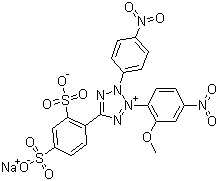 |
| Molecular Formula | C20H13N6NaO11S2 |
| Molecular Weight | 600.47 |
| CAS Registry Number | 193149-74-5 |
| EC Number | 693-016-8 |
| SMILES | COC1=C(C=CC(=C1)[N+](=O)[O-])[N+]2=NC(=NN2C3=CC=C(C=C3)[N+](=O)[O-])C4=C(C=C(C=C4)S(=O)(=O)[O-])S(=O)(=O)[O-].[Na+] |
| Hazard Symbols |  GHS05 Danger Details GHS05 Danger Details | ||||||||||||||||||||
|---|---|---|---|---|---|---|---|---|---|---|---|---|---|---|---|---|---|---|---|---|---|
| Risk Statements | H314 Details | ||||||||||||||||||||
| Safety Statements | P260-P264-P280-P301+P330+P331-P302+P361+P354-P304+P340-P305+P354+P338-P316-P321-P363-P405-P501 Details | ||||||||||||||||||||
| Hazard Classification | |||||||||||||||||||||
| |||||||||||||||||||||
| SDS | Available | ||||||||||||||||||||
 chemBlink Chemical Story
|
2-(2-Methoxy-4-nitrophenyl)-3-(4-nitrophenyl)-5-(2,4-disulfophenyl)-2H-tetrazolium sodium salt is a highly substituted tetrazolium compound containing multiple aromatic rings, electron-withdrawing nitro groups, a methoxy substituent, sulfonate functionalities, and sodium counterions. The molecule belongs to the class of tetrazolium salts, compounds characterized by a positively charged nitrogen-rich heterocyclic core that is often associated with redox activity and chromogenic properties. The central structural element is the tetrazolium ring, a five-membered heterocycle containing four nitrogen atoms and one carbon atom. Tetrazolium systems possess extensive electron delocalization and carry a formal positive charge distributed across the heterocyclic framework. This delocalized cationic character contributes significantly to the electronic properties of the molecule and influences interactions with surrounding substituents. Attached to the tetrazolium core are three substituted phenyl rings, each contributing distinct electronic and structural effects. At the 2-position is a 2-methoxy-4-nitrophenyl group. The methoxy substituent (–OCH3) is electron-donating through resonance, increasing electron density in portions of the aromatic system. In contrast, the nitro group (–NO2) is strongly electron-withdrawing through both inductive and resonance effects. The simultaneous presence of electron-donating and electron-withdrawing groups creates an electronically differentiated aromatic ring with complex charge distribution. At the 3-position of the tetrazolium ring is a 4-nitrophenyl substituent. The para nitro group withdraws electron density from the aromatic ring and influences the conjugated electronic system extending toward the tetrazolium center. Nitro groups are planar functionalities consisting of a nitrogen atom bonded to two oxygen atoms, with substantial resonance stabilization contributing to their strong electron-withdrawing nature. At the 5-position is a 2,4-disulfophenyl group. Sulfonate groups (–SO3−) are strongly acidic functionalities that generally exist in ionized form under most conditions. The two sulfonate groups introduce substantial hydrophilicity and negative charge into the molecule. Because of these negatively charged sites, sodium ions are present as counterions to maintain overall charge neutrality. The sodium ions primarily participate through electrostatic interactions with the sulfonate groups and generally become dissociated in aqueous environments. The ionic character provided by the sulfonate functionalities substantially increases water compatibility compared with non-sulfonated aromatic tetrazolium compounds. Structurally, the molecule combines rigid aromatic regions with a highly conjugated nitrogen-containing heterocycle. The aromatic rings and tetrazolium core form an extended π-electron system that allows substantial electron delocalization across the molecule. The various substituents modulate electron distribution within this conjugated framework. From a physicochemical perspective, the compound contains both highly polar and relatively hydrophobic regions. The aromatic rings contribute hydrophobic surface area, while the sulfonate groups and ionic interactions contribute pronounced hydrophilicity. This produces a strongly amphiphilic molecular profile. Chemically, the tetrazolium ring is the most electronically distinctive feature. Tetrazolium systems can participate in reduction processes in which the positively charged tetrazolium core is converted into corresponding formazan derivatives. Electron-withdrawing nitro groups further influence reduction potential and electron distribution throughout the molecule. The aromatic methoxy group generally remains chemically stable under neutral conditions, while the sulfonate groups primarily function as strongly acidic ionic substituents. The nitro substituents are also generally stable under ordinary conditions but can undergo reduction under appropriate chemical environments. Overall, 2-(2-methoxy-4-nitrophenyl)-3-(4-nitrophenyl)-5-(2,4-disulfophenyl)-2H-tetrazolium sodium salt is a highly functionalized tetrazolium compound characterized by a positively charged nitrogen-rich heterocyclic core, multiple electronically differentiated aromatic substituents, and strongly hydrophilic sulfonate groups balanced by sodium counterions. Its structure combines extended conjugation, ionic character, and complex electronic behavior within a single molecular framework. References 2025. Impact of Komagataeibacter xylinus-derived bacterial nanocellulose on tetrazolium salt viability assays for cytotoxicity testing. Cellulose. DOI: 10.1007/s10570-025-06582-z |
| Market Analysis Reports |