
Online Database of Chemicals from Around the World
| Changzhou Ditong Chemical Co., Ltd. | China | |||
|---|---|---|---|---|
 | www.edengenechem.com | |||
 | +86 (519) 8829-8848 +86 18118010980 | |||
 | info@edengenechem.com sale@edengenechem.com | |||
 | QQ Chat | |||
 | WeChat: 18118010980 | |||
| Chemical manufacturer since 2006 | ||||
| chemBlink Premium supplier since 2026 | ||||
| Classification | Organic raw materials >> Carboxylic compounds and derivatives >> Carboxylic esters and their derivatives |
|---|---|
| Name | Methyl cyclopentylphenylglycolate |
| Synonyms | Methyl 2-cyclopentyl-2-hydroxyphenylacetate |
| Molecular Structure | 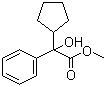 |
| Molecular Formula | C14H18O3 |
| Molecular Weight | 234.29 |
| CAS Registry Number | 19833-96-6 |
| EC Number | 243-359-0 |
| SMILES | COC(=O)C(C1CCCC1)(C2=CC=CC=C2)O |
| Density | 1.2±0.1 g/cm3 Calc.* |
|---|---|
| Boiling point | 357.5±22.0 °C 760 mmHg (Calc.)* |
| Flash point | 147.7±15.1 °C (Calc.)* |
| Index of refraction | 1.551 (Calc.)* |
| * | Calculated using Advanced Chemistry Development (ACD/Labs) Software. |
| Hazard Symbols |  GHS07 Warning Details GHS07 Warning Details | ||||||||||||||||||||||||||||
|---|---|---|---|---|---|---|---|---|---|---|---|---|---|---|---|---|---|---|---|---|---|---|---|---|---|---|---|---|---|
| Risk Statements | H302-H312-H315-H319-H335 Details | ||||||||||||||||||||||||||||
| Safety Statements | P261-P264-P264+P265-P270-P271-P280-P301+P317-P302+P352-P304+P340-P305+P351+P338-P317-P319-P321-P330-P332+P317-P337+P317-P362+P364-P403+P233-P405-P501 Details | ||||||||||||||||||||||||||||
| Hazard Classification | |||||||||||||||||||||||||||||
| |||||||||||||||||||||||||||||
| SDS | Available | ||||||||||||||||||||||||||||
 chemBlink Chemical Story
|
Methyl cyclopentylphenylglycolate is an ester derivative of a substituted glycolic acid in which a methyl ester group is attached to an α-hydroxy carbon bearing both cyclopentyl and phenyl substituents. It belongs to the class of α-hydroxy esters and contains a combination of aromatic, alicyclic, hydroxyl, and ester functionalities. The molecular framework is based on glycolic acid derivatives, which are characterized by a carbon atom adjacent to the carboxyl group bearing a hydroxyl substituent. In methyl cyclopentylphenylglycolate, the α-carbon is substituted with a hydroxyl group, a phenyl group, a cyclopentyl group, and the ester carbonyl group. Because these four substituents are different, the α-carbon represents a stereogenic center, and the compound can exist as a pair of enantiomers. The ester functional group consists of a carbonyl carbon bonded to a methoxy group. The carbonyl carbon is sp2-hybridized and adopts trigonal planar geometry. The carbonyl oxygen is strongly electron-withdrawing and serves as a hydrogen bond acceptor, while the methoxy oxygen also contributes electron density and acts as a hydrogen bond acceptor. The hydroxyl group attached to the α-carbon is an important polar functionality. It can act as both a hydrogen bond donor and a hydrogen bond acceptor. The presence of the hydroxyl group adjacent to the ester carbonyl creates an α-hydroxy ester arrangement that can participate in intra- and intermolecular hydrogen bonding, influencing molecular conformation and physical properties. The phenyl group consists of a planar aromatic benzene ring containing a delocalized π-electron system. This aromatic portion provides rigidity and contributes hydrophobic character. The phenyl ring can participate in π-related intermolecular interactions and contributes significantly to the molecule’s overall lipophilicity. The cyclopentyl group is a saturated five-membered carbocyclic ring composed of sp3-hybridized carbon atoms. Unlike the phenyl ring, it is nonaromatic and adopts flexible puckered conformations. The cyclopentyl substituent increases the three-dimensional character of the molecule and adds hydrophobic surface area. The α-carbon linking the hydroxyl group, ester group, phenyl group, and cyclopentyl group has tetrahedral geometry. The presence of this stereogenic center results in optical activity when a single enantiomer is present. Different enantiomers have identical physical properties in achiral environments but may interact differently with chiral biological molecules. From an electronic perspective, the molecule contains localized functional groups rather than an extended conjugated system. The ester carbonyl group is electronically isolated from the phenyl ring by the saturated α-carbon, preventing direct conjugation between the aromatic system and the carbonyl functionality. The hydroxyl group influences polarity through hydrogen bonding rather than through extensive electron delocalization. Physicochemically, methyl cyclopentylphenylglycolate has both hydrophilic and hydrophobic regions. The ester and hydroxyl groups provide polarity and hydrogen-bonding capability, whereas the phenyl and cyclopentyl groups contribute significant hydrophobic character. This combination gives the molecule amphiphilic behavior and favors solubility in many organic solvents. Chemically, the ester group can undergo hydrolysis under strongly acidic or basic conditions to produce the corresponding glycolic acid derivative and methanol or methoxide-containing products depending on the reaction environment. The hydroxyl group can participate in esterification, etherification, or oxidation reactions under suitable conditions. The aromatic ring is relatively stable and can undergo typical benzene reactions such as electrophilic aromatic substitution under appropriate conditions. The cyclopentyl group is chemically stable under ordinary conditions and generally participates only in reactions typical of saturated hydrocarbons. Overall, methyl cyclopentylphenylglycolate is a chiral α-hydroxy ester composed of a methyl ester group attached to a stereogenic carbon bearing hydroxyl, phenyl, and cyclopentyl substituents. Its combination of hydrogen-bonding functionality, aromatic rigidity, and flexible alicyclic character defines its structural and chemical properties as a substituted glycolate ester. References 2024. From Tertiary Methoxymethyl Ethers. Science of Synthesis. URL: https://science-of-synthesis.thieme.com/app/text/?id=SD-243-00009 2003. Glycopyrronium bromide. Pharmaceutical Substances. URL: https://pharmaceutical-substances.thieme.com/ps/search-results?docUri=KD-07-0037 |
| Market Analysis Reports |