
Online Database of Chemicals from Around the World
| BOC Sciences | USA | |||
|---|---|---|---|---|
 | www.bocsci.com | |||
 | +1 (631) 485-4226 | |||
 | +1 (631) 614-7828 | |||
 | info@bocsci.com | |||
| Chemical manufacturer | ||||
| chemBlink Standard supplier since 2010 | ||||
| Apexbio Technology LLC | USA | |||
|---|---|---|---|---|
| www.apexbt.com | |||
| +1 (832) 696-8203 | |||
| +1 (855) 527-3928 | |||
| info@apexbt.com | |||
| Chemical manufacturer since 2012 | ||||
| chemBlink Standard supplier since 2013 | ||||
| Suzhou Myland Pharm & Nutrition Inc. | China | |||
|---|---|---|---|---|
| www.mylandpharm.com | |||
| +86 (512) 6615-0687 | |||
| +86 (512) 6615-7101 | |||
| info@mylandpharm.com | |||
 | QQ Chat | |||
| Chemical manufacturer since 2013 | ||||
| chemBlink Standard supplier since 2014 | ||||
| Chengdu Biopurify Phytochemicals Ltd. | China | |||
|---|---|---|---|---|
| www.phytopurify.com | |||
| +86 (28) 8263-3860 8263-3987 | |||
| +86 (28) 8263-3165 | |||
| sales@biopurify.com biopurify@gmail.com | |||
| QQ Chat | |||
 | Skype Chat | |||
| Chemical manufacturer | ||||
| chemBlink Standard supplier since 2017 | ||||
| R&D Scientific Inc. | Canada | |||
|---|---|---|---|---|
| www.rdscientific.com | |||
| +1 (226) 600-0236 | |||
| sales@rdscientific.com | |||
| Chemical manufacturer since 2016 | ||||
| chemBlink Standard supplier since 2023 | ||||
| Dalton Pharma Services | Canada | |||
|---|---|---|---|---|
| www.dalton.com | |||
| +1 (416) 661-2102 | |||
| +1 (416) 661-2108 | |||
| chemist@dalton.com | |||
| Chemical manufacturer | ||||
| Santa Cruz Biotechnology, Inc. | USA | |||
|---|---|---|---|---|
| www.scbt.com | |||
| +1 (831) 457-3800 | |||
| +1 (831) 457-3801 | |||
| scbt@scbt.com | |||
| Chemical manufacturer | ||||
| VDM Biochemicals | USA | |||
|---|---|---|---|---|
| www.vdmbio.com | |||
| +1 (330) 252-8181 | |||
| +1 (330) 252-8171 | |||
| sales@vdmbio.com info@vdmbio.com | |||
| Chemical manufacturer | ||||
| Classification | Natural product >> Alkaloid |
|---|---|
| Name | Piperlongumine |
| Synonyms | Piplartin; Piplartine; 5,6-Dihydro-1-(3,4,5-trimethoxycinnamoyl)-2(1H)-pyridone |
| Molecular Structure | 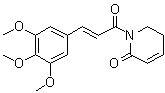 |
| Molecular Formula | C17H19NO5 |
| Molecular Weight | 317.34 |
| CAS Registry Number | 20069-09-4 |
| EC Number | 812-597-2 |
| SMILES | COC1=CC(=CC(=C1OC)OC)/C=C/C(=O)N2CCC=CC2=O |
| Solubility | Practically insoluble (0.067 g/L) (25 °C), Calc.* |
|---|---|
| Density | 1.223±0.06 g/cm3 (20 °C 760 Torr), Calc.* |
| Melting point | 124 °C** |
| Boiling point | 475.6±45.0 °C 760 mmHg (Calc.)* |
| Flash point | 241.4±28.7 °C (Calc.)* |
| Index of refraction | 1.581 (Calc.)* |
| * | Calculated using Advanced Chemistry Development (ACD/Labs) Software V11.02 (©1994-2013 ACD/Labs) |
| ** | Chatterjee, A. |
| Hazard Symbols |  GHS07 Warning Details GHS07 Warning Details | ||||||||||||||||||||||||
|---|---|---|---|---|---|---|---|---|---|---|---|---|---|---|---|---|---|---|---|---|---|---|---|---|---|
| Risk Statements | H302-H315-H319-H335 Details | ||||||||||||||||||||||||
| Safety Statements | P261-P264-P264+P265-P270-P271-P280-P301+P317-P302+P352-P304+P340-P305+P351+P338-P319-P321-P330-P332+P317-P337+P317-P362+P364-P403+P233-P405-P501 Details | ||||||||||||||||||||||||
| Hazard Classification | |||||||||||||||||||||||||
| |||||||||||||||||||||||||
| SDS | Available | ||||||||||||||||||||||||
 chemBlink Chemical Story
|
Piperlongumine is a naturally occurring alkaloid amide isolated primarily from the fruit of Piper longum (long pepper), a plant used in traditional medicinal systems in South and Southeast Asia. Chemically, it belongs to the class of cinnamoyl amides and is characterized by a conjugated lactam-like amide structure connected to two α,β-unsaturated carbonyl systems. Structurally, piperlongumine consists of a piperidine-derived nitrogen-containing backbone linked to two cinnamoyl-type side chains. These side chains contain conjugated double bonds and carbonyl groups, forming electrophilic α,β-unsaturated carbonyl (Michael acceptor) motifs. These conjugated systems are a defining feature of the molecule’s reactivity, as they can undergo nucleophilic addition reactions with biological nucleophiles such as thiol groups in cysteine residues. The molecule contains multiple functional groups, including amide linkages, aromatic rings, and conjugated enone systems. The amide bonds provide structural stability through resonance delocalization between the nitrogen and carbonyl oxygen. The aromatic rings contribute hydrophobic character and π-electron interactions, while the conjugated carbonyl systems introduce significant electrophilicity. A key chemical feature of piperlongumine is its bifunctional electrophilic nature. The presence of two α,β-unsaturated carbonyl groups increases its ability to participate in Michael addition reactions. This reactivity is important in chemical biology contexts, where such compounds can form covalent bonds with nucleophilic amino acid side chains in proteins under appropriate conditions. From a physicochemical perspective, piperlongumine is moderately hydrophobic due to its aromatic rings and extended conjugated system, but it also contains polar amide and carbonyl groups that contribute to hydrogen bonding capacity. This balance influences its solubility and partitioning behavior in biological systems. In terms of natural occurrence, piperlongumine is one of several biologically active amide alkaloids found in Piper longum. These compounds are biosynthesized in plants through coupling of cinnamic acid derivatives with amine-containing precursors. Piperlongumine represents a structurally distinctive member of this family due to its highly conjugated and electrophilic framework. Without verified literature-specific interpretation beyond structural chemistry, no claims should be made about therapeutic effects or clinical applications. Based on established chemical structure, piperlongumine can be described as a conjugated bis-α,β-unsaturated amide alkaloid featuring two electrophilic Michael acceptor systems, aromatic rings, and amide linkages that together define its reactivity and chemical behavior. References 2026. Synthesis and application of silk fibroin nanoparticles for drug delivery. Communications Materials. DOI: 10.1038/s43246-026-01108-x 2026. Revolutionizing cancer treatment with senotherapeutics: a current perspective. Cancer Chemotherapy and Pharmacology. DOI: https://pubmed.ncbi.nlm.nih.gov/41615494 |
| Market Analysis Reports |