
Online Database of Chemicals from Around the World
| Taizhou Crene Biotechnology Co., Ltd. | China | |||
|---|---|---|---|---|
 | www.pharm-intermediates.com | |||
 | +86 (576) 8881-3233 8820-5808 +86 13396860566 | |||
 | +86 (576) 8822-9589 | |||
 | sales@pharm-intermediates.com | |||
 | QQ Chat | |||
| Chemical manufacturer since 2011 | ||||
| chemBlink Standard supplier since 2009 | ||||
| Shanghai Forever Synthesis Co.,Ltd. | China | |||
|---|---|---|---|---|
| www.foreversyn.com | |||
| +86 (551) 6288-8437 +86 18096409024 | |||
| sales@foreversyn.com sales02@foreversyn.com | |||
| QQ Chat | |||
 | Skype Chat | |||
| Chemical distributor since 2013 | ||||
| chemBlink Standard supplier since 2018 | ||||
| Shanghai Finetech pharm Co., Ltd. | China | |||
|---|---|---|---|---|
| www.finetechpharm.cn | |||
| +86 18221039705 | |||
| ad@finetechpharm.cn | |||
| Chemical manufacturer since 2016 | ||||
| chemBlink Standard supplier since 2026 | ||||
| Cayman Chemical Company | USA | |||
|---|---|---|---|---|
| www.caymanchem.com | |||
| +1 (734) 971-3335 | |||
| +1 (734) 971-3640 | |||
| sales@caymanchem.com | |||
| Chemical manufacturer | ||||
| Pure Research Chemicals | China | |||
|---|---|---|---|---|
| www.purerechem.com | |||
| +86 (551) 6288-8437 +86 18096409024 | |||
| info@purerechem.com | |||
| QQ Chat | |||
| Skype Chat | |||
 | WeChat: 18856022585 | |||
| Chemical manufacturer since 2018 | ||||
| Santa Cruz Biotechnology, Inc. | USA | |||
|---|---|---|---|---|
| www.scbt.com | |||
| +1 (831) 457-3800 | |||
| +1 (831) 457-3801 | |||
| scbt@scbt.com | |||
| Chemical manufacturer | ||||
| Classification | API >> Inhibitor drug |
|---|---|
| Name | Tafluprost (free acid) |
| Synonyms | AFP 172 |
| Molecular Structure | 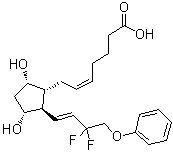 |
| Molecular Formula | C22H28F2O5 |
| Molecular Weight | 410.45 |
| CAS Registry Number | 209860-88-8 |
| EC Number | 859-365-7 |
| SMILES | C1[C@@H]([C@@H]([C@H]([C@@H]1O)/C=C/C(COC2=CC=CC=C2)(F)F)C/C=CCCCC(=O)O)O |
| Solubility | Practically insoluble (0.086 g/L) (25 °C), Calc.* |
|---|---|
| Density | 1.271±0.06 g/cm3 (20 °C 760 Torr), Calc.* |
| Boiling point | 575.9±50.0 °C 760 mmHg (Calc.)* |
| Flash point | 302.1±30.1 °C (Calc.)* |
| Index of refraction | 1.579 (Calc.)* |
| * | Calculated using Advanced Chemistry Development (ACD/Labs) Software. |
| Hazard Symbols |   GHS07;GHS08 Danger Details GHS07;GHS08 Danger Details | ||||||||||||
|---|---|---|---|---|---|---|---|---|---|---|---|---|---|
| Risk Statements | H302-H360-H361d Details | ||||||||||||
| Safety Statements | P203-P264-P270-P280-P301+P317-P318-P330-P405-P501 Details | ||||||||||||
| Hazard Classification | |||||||||||||
| |||||||||||||
| SDS | Available | ||||||||||||
 chemBlink Chemical Story
|
Tafluprost (free acid) is the biologically active carboxylic acid form of tafluprost, a synthetic prostaglandin F2α (PGF2α) analogue used in ophthalmology for the reduction of elevated intraocular pressure. It belongs to the class of prostanoid receptor agonists, which are structurally derived from endogenous eicosanoid signaling molecules and designed to mimic or modulate their physiological activity in ocular tissues. The development of tafluprost is rooted in research on prostaglandins and their role in regulating intraocular pressure and aqueous humor dynamics. Prostaglandins are lipid mediators derived from arachidonic acid through cyclooxygenase pathways and are involved in a wide range of physiological processes, including inflammation, smooth muscle tone, and vascular regulation. Synthetic prostaglandin analogues were developed to improve metabolic stability and ocular bioavailability compared with native prostaglandins, which are rapidly degraded in vivo. Tafluprost itself is administered as an isopropyl ester prodrug. After topical administration to the eye, it is rapidly hydrolyzed by esterases in the cornea and surrounding tissues to yield tafluprost (free acid), which is the pharmacologically active species. This free acid form binds to prostanoid FP receptors in ocular tissues, particularly in the ciliary body, where it influences aqueous humor outflow. The primary mechanism of action of tafluprost (free acid) involves activation of the prostanoid FP receptor, a G protein–coupled receptor. Activation of this receptor leads to biochemical and structural changes in the extracellular matrix of the uveoscleral outflow pathway, increasing the drainage of aqueous humor from the anterior chamber of the eye. This reduction in aqueous humor volume results in decreased intraocular pressure, which is a key therapeutic goal in the management of glaucoma and ocular hypertension. Structurally, tafluprost (free acid) is a synthetic analogue of prostaglandin F2α and retains the characteristic 20-carbon prostanoid backbone with multiple stereocenters and oxygenated functional groups. It contains a carboxylic acid group, hydroxyl functionalities, and a cis-configured double bond pattern typical of prostaglandin derivatives. The stereochemical configuration is critical for receptor binding and biological activity, as prostanoid receptors are highly stereospecific. The free acid form differs from the ester prodrug in that it possesses a negatively charged carboxylate group at physiological pH, which influences its polarity, solubility, and receptor interaction profile. This ionizable group plays an important role in binding to the FP receptor, contributing to ionic and hydrogen-bonding interactions within the receptor binding site. Tafluprost (free acid) is part of a broader class of prostaglandin F2α analogues that includes other ophthalmic agents used for similar indications. These compounds share a common mechanism of enhancing uveoscleral outflow, but differ in potency, metabolic stability, and side effect profiles based on specific structural modifications such as fluorination and stereochemical configuration. From a pharmacological perspective, tafluprost is valued for its high affinity for the FP receptor and its ability to produce sustained intraocular pressure reduction with once-daily dosing. The conversion from prodrug to active acid form is essential for its activity, and this metabolic activation step is a key feature of its pharmacokinetic profile. Prostaglandin analogues such as tafluprost represent one of the most effective classes of first-line therapies for glaucoma. Their mechanism is distinct from agents that reduce aqueous humor production, as they primarily enhance outflow rather than suppress formation, providing an alternative physiological approach to pressure reduction. Overall, tafluprost (free acid) is the active prostaglandin F2α analogue responsible for the intraocular pressure–lowering effects of tafluprost therapy. Its significance lies in its receptor-mediated action on FP prostanoid receptors, leading to increased aqueous humor outflow through the uveoscleral pathway and its established role in the medical management of glaucoma and ocular hypertension. References 2023. Ligand-induced activation and G protein coupling of prostaglandin F2α receptor. Nature Communications. DOI: 10.1038/s41467-023-38411-x 2020. Synthesis of Tafluprost. Synfacts. DOI: 10.1055/s-0040-1707020 2004. Pharmacological characteristics of AFP-168 (tafluprost), a new prostanoid FP receptor agonist, as an ocular hypotensive drug. Experimental Eye Research. DOI: 10.1016/j.exer.2003.12.007 |
| Market Analysis Reports |