
Online Database of Chemicals from Around the World
| Win-Win Chemical Co., Ltd. | China | |||
|---|---|---|---|---|
 | www.win-winchemical.com | |||
 | +86 (577) 6449-8589 +86 15325081899 | |||
 | +86 (577) 5699-4596 | |||
 | sales@win-winchemical.com winwinchemical@gmail.com | |||
 | QQ Chat | |||
 | Skype Chat | |||
| Chemical manufacturer since 2007 | ||||
| chemBlink Standard supplier since 2011 | ||||
| Aromsyn Co., Ltd. | China | |||
|---|---|---|---|---|
| www.aromsyn.com | |||
| +86 (571) 8558-5865 +86 13336024896 | |||
| +86 (571) 8558-5865 | |||
| service@aromsyn.com | |||
| QQ Chat | |||
| Chemical manufacturer | ||||
| chemBlink Standard supplier since 2012 | ||||
| Hangzhou Leap Chem Co., Ltd. | China | |||
|---|---|---|---|---|
| www.leapchem.com | |||
| +86 (571) 8771-1850 | |||
| market19@leapchem.com | |||
| QQ Chat | |||
| Chemical manufacturer since 2006 | ||||
| chemBlink Standard supplier since 2015 | ||||
| Amadis Chemical Co., Ltd. | China | |||
|---|---|---|---|---|
| www.amadischem.com | |||
| +86 (571) 8992-5085 | |||
| +86 (571) 8992-5065 | |||
| sales@amadischem.com | |||
| Chemical manufacturer since 2010 | ||||
| chemBlink Standard supplier since 2015 | ||||
| Shanghai Fuxin Pharmaceutical Co., Ltd. | China | |||
|---|---|---|---|---|
| www.fuxinpharm.com | |||
| +86 (21) 3130-0828 +86 18645121291 | |||
| +86 (21) 3130-0828 | |||
| contact@fuxinpharm.com | |||
| Chemical manufacturer since 2016 | ||||
| chemBlink Standard supplier since 2018 | ||||
| Zison Pharmaceutical (shandong)co., Ltd. | China | |||
|---|---|---|---|---|
| www.zisonpharm.com | |||
| +86 (0531) 8825-9693 +86 15069083822 | |||
| tracy.li@zisonpharm.com | |||
| QQ Chat | |||
| Chemical manufacturer since 2021 | ||||
| chemBlink Standard supplier since 2023 | ||||
| Suzhou Higen Pharmaceutical Technology Co., Ltd. | China | |||
|---|---|---|---|---|
| www.higentech.com.cn | |||
| +86 (0512) 6299-2936 | |||
| 2503890038@qq.com | |||
| QQ Chat | |||
 | WeChat: 17786580220 | |||
| Chemical manufacturer since 2021 | ||||
| chemBlink Standard supplier since 2023 | ||||
| Guangzhou Wanqian Pharmaceutical Technology Co., Ltd. | China | |||
|---|---|---|---|---|
| www.wqpharma.cn | |||
| +86 13928768873 | |||
| sales@wqpharma.cn | |||
| QQ Chat | |||
| WeChat: 13928768873 | |||
| Chemical distributor since 2013 | ||||
| chemBlink Standard supplier since 2026 | ||||
| Classification | Chemical reagent >> Organic reagent >> Aromatic hydrocarbon reagent |
|---|---|
| Name | 4-Cyano-2-methoxybenzaldehyde |
| Synonyms | 2-Methoxy-4-cyanobenzaldehyde |
| Molecular Structure | 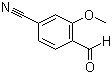 |
| Molecular Formula | C9H7NO2 |
| Molecular Weight | 161.16 |
| CAS Registry Number | 21962-45-8 |
| EC Number | 804-777-4 |
| SMILES | COC1=C(C=CC(=C1)C#N)C=O |
| Density | 1.2±0.1 g/cm3 Calc.* |
|---|---|
| Melting point | 109 - 111 °C (Expl.) |
| Boiling point | 318.2±32.0 °C 760 mmHg (Calc.)* |
| Flash point | 138.3±15.3 °C (Calc.)* |
| Index of refraction | 1.54 (Calc.)* |
| * | Calculated using Advanced Chemistry Development (ACD/Labs) Software. |
| Hazard Symbols |  GHS07 Warning Details GHS07 Warning Details | ||||||||||||||||||||||||||||||||||||
|---|---|---|---|---|---|---|---|---|---|---|---|---|---|---|---|---|---|---|---|---|---|---|---|---|---|---|---|---|---|---|---|---|---|---|---|---|---|
| Risk Statements | H302+H312+H332-H302-H312-H315-H319-H332-H335-H412 Details | ||||||||||||||||||||||||||||||||||||
| Safety Statements | P261-P264-P264+P265-P270-P271-P273-P280-P301+P317-P302+P352-P304+P340-P305+P351+P338-P317-P319-P321-P330-P332+P317-P337+P317-P362+P364-P403+P233-P405-P501 Details | ||||||||||||||||||||||||||||||||||||
| Hazard Classification | |||||||||||||||||||||||||||||||||||||
| |||||||||||||||||||||||||||||||||||||
| SDS | Available | ||||||||||||||||||||||||||||||||||||
 chemBlink Chemical Story
|
4-Cyano-2-methoxybenzaldehyde is a substituted aromatic aldehyde with the molecular formula C9H7NO2. It consists of a benzene ring bearing three functional elements: an aldehyde group, a methoxy substituent, and a cyano group. The combination of electron-donating and electron-withdrawing substituents creates a chemically differentiated aromatic system with distinctive electronic properties. The central structural framework is a benzene ring, a planar six-membered aromatic system containing delocalized π-electrons. Aromaticity contributes substantial thermodynamic stability and influences the distribution of electron density throughout the molecule. Substituents attached to the ring alter this electron distribution through inductive and resonance effects. The aldehyde group (–CHO) serves as the principal functional group of the molecule and defines it as a benzaldehyde derivative. An aldehyde consists of a carbonyl group attached to one hydrogen atom and one carbon substituent. The carbonyl bond is highly polarized because oxygen is significantly more electronegative than carbon, producing a partially positive carbonyl carbon and a partially negative oxygen atom. This polarization makes the carbonyl carbon electrophilic and susceptible to nucleophilic attack. At the 2-position of the aromatic ring relative to the aldehyde group is a methoxy substituent (–OCH3). The methoxy group contains an oxygen atom bonded to a methyl group and the aromatic ring. Through resonance, the oxygen atom can donate electron density into the aromatic π-system, increasing electron density at certain positions of the ring. The methoxy group therefore acts as an electron-donating substituent through resonance, although it also exerts a weak electron-withdrawing inductive effect. At the 4-position relative to the aldehyde group is a cyano substituent (–C≡N). The cyano group contains a carbon atom triple-bonded to nitrogen and is strongly electron-withdrawing through both inductive and resonance effects. This functionality introduces significant polarity into the molecule and reduces electron density in parts of the aromatic system. The carbon–nitrogen triple bond is short, linear, and highly polarized. The coexistence of the electron-donating methoxy group and electron-withdrawing cyano and aldehyde groups creates a molecule with electronically differentiated regions. The methoxy group increases electron density locally, while the aldehyde and cyano groups withdraw electron density. These opposing influences affect the overall reactivity of the aromatic ring and the carbonyl functionality. From a structural standpoint, the aromatic ring remains largely planar. The aldehyde and cyano groups are generally oriented to permit conjugative interaction with the aromatic π-system. The methoxy group can adopt conformations that maximize overlap between the oxygen lone pairs and the aromatic ring. Physicochemically, the molecule contains both hydrophobic and polar features. The aromatic ring contributes hydrophobic character, whereas the aldehyde, methoxy oxygen, and cyano group contribute polarity. The compound can participate in dipole–dipole interactions because of the strongly polarized carbonyl and nitrile groups, while the oxygen atoms can act as hydrogen-bond acceptors. Chemically, the aldehyde group is the most reactive functionality under ordinary conditions and can undergo oxidation, reduction, condensation, and nucleophilic addition reactions. The cyano group can participate in transformations such as hydrolysis or reduction under appropriate conditions. The methoxy substituent is generally stable and primarily influences the molecule through electronic effects rather than pronounced chemical reactivity. Overall, 4-cyano-2-methoxybenzaldehyde is a multifunctional aromatic compound featuring an electrophilic aldehyde group, an electron-donating methoxy substituent, and a strongly electron-withdrawing cyano group arranged on a benzene framework, resulting in a molecule with distinctive electronic and structural characteristics. References 2022. Finerenone. Pharmaceutical Substances. URL: https://pharmaceutical-substances.thieme.com/ps/search-results?docUri=KD-06-0143 |
| Market Analysis Reports |