
Online Database of Chemicals from Around the World
| Changzhou Ditong Chemical Co., Ltd. | China | |||
|---|---|---|---|---|
 | www.edengenechem.com | |||
 | +86 (519) 8829-8848 +86 18118010980 | |||
 | info@edengenechem.com sale@edengenechem.com | |||
 | QQ Chat | |||
 | WeChat: 18118010980 | |||
| Chemical manufacturer since 2006 | ||||
| chemBlink Premium supplier since 2026 | ||||
| Classification | Chemical reagent >> Organic reagent >> Cyanide/nitrile |
|---|---|
| Name | 2,4,5,6-Tetrafluoroisophthalonitrile |
| Synonyms | 1,3-Dicyanotetrafluorobenzene |
| Molecular Structure | 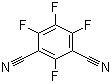 |
| Molecular Formula | C8F4N2 |
| Molecular Weight | 200.09 |
| CAS Registry Number | 2377-81-3 |
| EC Number | 623-653-9 |
| SMILES | C(#N)C1=C(C(=C(C(=C1F)F)F)C#N)F |
| Density | 1.5±0.1 g/cm3 Calc.* |
|---|---|
| Melting point | 76 - 78 °C (Expl.) |
| Boiling point | 212.5±35.0 °C 760 mmHg (Calc.)* |
| Flash point | 82.3±25.9 °C (Calc.)* |
| Index of refraction | 1.474 (Calc.)* |
| * | Calculated using Advanced Chemistry Development (ACD/Labs) Software. |
| Hazard Symbols |  GHS07 Warning Details GHS07 Warning Details | ||||||||||||||||||||||||||||||||
|---|---|---|---|---|---|---|---|---|---|---|---|---|---|---|---|---|---|---|---|---|---|---|---|---|---|---|---|---|---|---|---|---|---|
| Risk Statements | H302-H312-H315-H319-H332-H335 Details | ||||||||||||||||||||||||||||||||
| Safety Statements | P261-P264-P264+P265-P270-P271-P280-P301+P317-P302+P352-P304+P340-P305+P351+P338-P317-P319-P321-P330-P332+P317-P337+P317-P362+P364-P403+P233-P405-P501 Details | ||||||||||||||||||||||||||||||||
| Hazard Classification | |||||||||||||||||||||||||||||||||
| |||||||||||||||||||||||||||||||||
| SDS | Available | ||||||||||||||||||||||||||||||||
 chemBlink Chemical Story
|
2,4,5,6-Tetrafluoroisophthalonitrile is a highly fluorinated aromatic dinitrile compound consisting of a benzene ring bearing two cyano groups and four fluorine substituents. It belongs to the class of fluorinated aromatic nitriles and is characterized by an electron-deficient aromatic system, strong C–F bonds, and reactive cyano functionalities. Structurally, the molecule is based on an **isophthalonitrile** framework, meaning a benzene ring substituted with two nitrile groups (–C≡N) at the 1,3-positions. The remaining four positions of the aromatic ring (2,4,5,6) are occupied by fluorine atoms. This substitution pattern leaves the benzene ring fully substituted and gives the molecule a highly symmetrical and compact structure. The benzene ring retains its planar aromatic geometry, with six sp2-hybridized carbon atoms forming a delocalized π-electron system. The two nitrile groups are directly attached to the aromatic ring through carbon–carbon single bonds that are conjugated with the aromatic π-system. The cyano carbon and nitrogen atoms are sp-hybridized, producing a linear C≡N bond. The nitrile groups are strongly electron-withdrawing substituents. Through inductive effects and π-acceptor interactions, they decrease electron density in the aromatic ring and make the ring more electrophilic. The cyano nitrogen atoms contain lone pairs and act as hydrogen bond acceptors, although the nitrile groups do not donate hydrogen bonds. The four fluorine atoms exert strong inductive electron-withdrawing effects due to the high electronegativity of fluorine. Although fluorine can participate weakly in resonance donation through lone-pair interactions, this effect is generally much smaller than its inductive withdrawal. The combined influence of four fluorine atoms and two cyano groups produces a highly electron-deficient aromatic system. The carbon–fluorine bonds are highly polarized because fluorine is significantly more electronegative than carbon. These bonds are among the strongest single bonds in organic chemistry, contributing to the compound’s thermal and chemical stability. However, the electron-deficient aromatic ring can make the fluorinated positions susceptible to nucleophilic aromatic substitution under appropriate conditions. From an electronic perspective, 2,4,5,6-tetrafluoroisophthalonitrile contains a strongly activated aromatic ring. The cyano groups withdraw electron density through both inductive and resonance effects, while fluorine atoms further reduce ring electron density. This activation facilitates attack by nucleophiles at carbon atoms bearing fluorine, allowing replacement of fluorine atoms in synthetic transformations. The molecule is rigid and planar because of its fully substituted aromatic framework. The absence of rotatable substituents and the symmetrical substitution pattern reduce conformational flexibility. The compact structure promotes efficient molecular packing and can influence melting point and solid-state properties. Physicochemically, the compound is predominantly nonpolar to moderately polar. The fluorinated aromatic ring provides hydrophobic character and high polarizability, while the nitrile groups introduce dipole moments and hydrogen-bond acceptor capability. The molecule contains no hydrogen bond donors because it lacks N–H or O–H functionalities. Chemically, the nitrile groups are relatively stable under ordinary conditions but can undergo transformations such as hydrolysis to carboxamides or carboxylic acids under strong acidic or basic conditions. They may also participate in coordination interactions through the nitrile nitrogen atoms. The fluorinated aromatic ring is the most important reactive feature. The electron-deficient nature of the ring allows nucleophilic aromatic substitution reactions in which one or more fluorine atoms can be replaced by nucleophiles such as amines, alcohols, thiols, or other nucleophilic species. This reactivity is a consequence of stabilization of the intermediate anionic σ-complex by the cyano substituents. Overall, **2,4,5,6-tetrafluoroisophthalonitrile** is a fully substituted fluorinated aromatic dinitrile composed of an electron-poor benzene core bearing four fluorine atoms and two cyano groups. Its combination of strong C–F bonds, nitrile-based electron withdrawal, aromatic rigidity, and susceptibility to nucleophilic aromatic substitution defines its chemical behavior and makes it a valuable fluorinated building block in organic synthesis and materials chemistry. References 2026. Peripheral host engineering in TADF dendrimers: integrating radiative promotion and well-balanced bipolar transport for high-luminance, low-roll-off solution-processable OLEDs. Science China Chemistry. DOI: 10.1007/s11426-025-3232-y 2023. Controlled radical copolymerization of fluoroalkenes by using light-driven redox-relay catalysis. Nature Synthesis. DOI: 10.1038/s44160-023-00284-9 2019. Photocatalytic 1,2-Formylarylation of N-Arylacrylamides. Synfacts. DOI: 10.1055/s-0039-1690175 |
| Market Analysis Reports |