
Online Database of Chemicals from Around the World
| Alway Chem, China | China | |||
|---|---|---|---|---|
 | www.alwaychem.net | |||
 | +86 (532) 8586-4000 | |||
 | +86 (532) 8589-3133 | |||
 | alwaychem@gmail.com alwaychem@hotmail.com | |||
| Chemical manufacturer | ||||
| chemBlink Standard supplier since 2006 | ||||
| Simagchem Corporation | China | |||
|---|---|---|---|---|
| www.simagchem.com | |||
| +86 13806087780 | |||
| +86 (592) 268-0237 | |||
| sale@simagchem.com | |||
| Chemical manufacturer since 2002 | ||||
| chemBlink Standard supplier since 2008 | ||||
| Ningbo Ocean Chemical New Materials Technology Co., Ltd. | China | |||
|---|---|---|---|---|
| www.nboceanchem.com | |||
| +86 (574) 8650-8062 | |||
| +86 (574) 8713-2055 | |||
| sales@nboceanchem.com | |||
| Chemical manufacturer since 2008 | ||||
| chemBlink Standard supplier since 2010 | ||||
| BOC Sciences | USA | |||
|---|---|---|---|---|
| www.bocsci.com | |||
| +1 (631) 485-4226 | |||
| +1 (631) 614-7828 | |||
| info@bocsci.com | |||
| Chemical manufacturer | ||||
| chemBlink Standard supplier since 2010 | ||||
| Win-Win Chemical Co., Ltd. | China | |||
|---|---|---|---|---|
| www.win-winchemical.com | |||
| +86 (577) 6449-8589 +86 15325081899 | |||
| +86 (577) 5699-4596 | |||
| sales@win-winchemical.com winwinchemical@gmail.com | |||
 | QQ Chat | |||
 | Skype Chat | |||
| Chemical manufacturer since 2007 | ||||
| chemBlink Standard supplier since 2011 | ||||
| Gansu Hairuida Chemical Technology Co., Ltd. | China | |||
|---|---|---|---|---|
| www.hrdchem.com | |||
| +86 (931) 874-7686 | |||
| +86 (931) 864-9928 | |||
| amy.chen@hrdchem.com | |||
| QQ Chat | |||
| Chemical manufacturer since 2013 | ||||
| chemBlink Standard supplier since 2014 | ||||
| Hangzhou Leap Chem Co., Ltd. | China | |||
|---|---|---|---|---|
| www.leapchem.com | |||
| +86 (571) 8771-1850 | |||
| market19@leapchem.com | |||
| QQ Chat | |||
| Chemical manufacturer since 2006 | ||||
| chemBlink Standard supplier since 2015 | ||||
| Ningbo Simbon Chemical Co., Ltd. | China | |||
|---|---|---|---|---|
| www.simbonchem.com | |||
| +86 (574) 8791-6584 | |||
| +86 (574) 8907-9401 | |||
| service@simbonchem.com | |||
| Chemical manufacturer since 2015 | ||||
| chemBlink Standard supplier since 2015 | ||||
| Carbosynth China Ltd. | China | |||
|---|---|---|---|---|
| www.carbosynth.cn | |||
| +86 (512) 6260-5585 | |||
| +86 (512) 6260-5576 | |||
| sales@carbosynth.com | |||
| QQ Chat | |||
| Chemical manufacturer since 2006 | ||||
| chemBlink Standard supplier since 2016 | ||||
| Huzhou Zhuorui Chemical Technology Co., Ltd. | China | |||
|---|---|---|---|---|
| www.zrchemtech.com | |||
| +86 189 6805 0179 | |||
| sales@zrchemtech.com | |||
| Chemical distributor | ||||
| chemBlink Standard supplier since 2020 | ||||
| Guangzhou Wanqian Pharmaceutical Technology Co., Ltd. | China | |||
|---|---|---|---|---|
| www.wqpharma.cn | |||
| +86 13928768873 | |||
| sales@wqpharma.cn | |||
| QQ Chat | |||
 | WeChat: 13928768873 | |||
| Chemical distributor since 2013 | ||||
| chemBlink Standard supplier since 2026 | ||||
| Chem Service, Inc. | USA | |||
|---|---|---|---|---|
| www.chemservice.com | |||
| +1 (610) 692-3026 | |||
| +1 (610) 692-8729 | |||
| info@chemservice.com | |||
| Chemical manufacturer since 1962 | ||||
| Toronto Research Chemicals Inc. | Canada | |||
|---|---|---|---|---|
| www.trc-canada.com | |||
| +1 (416) 665-9696 | |||
| +1 (416) 665-4439 | |||
| info@trc-canada.com | |||
| Chemical manufacturer since 1982 | ||||
| Aisuo Chem Co., Ltd. | China | |||
|---|---|---|---|---|
| www.aisuochem.com | |||
| +86 (21) 2875-1745 | |||
| +86 (21) 5892-2870 | |||
| aisuo@aisuochem.com | |||
| Chemical manufacturer | ||||
| Anvia Chemicals, LLC | USA | |||
|---|---|---|---|---|
| www.anviachem.com | |||
| +1 (414) 534-7845 | |||
| +1 (414) 762-5539 | |||
| sales@anviachem.com | |||
| Chemical manufacturer | ||||
| Classification | Chemical reagent >> Organic reagent >> Hydroxylamine |
|---|---|
| Name | Benzylhydroxylamine hydrochloride |
| Synonyms | O-Benzylhydroxylamine hydrochloride |
| Molecular Structure | 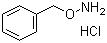 |
| Molecular Formula | C7H9NO.HCl |
| Molecular Weight | 159.61 |
| CAS Registry Number | 2687-43-6 |
| EC Number | 220-249-0 |
| SMILES | C1=CC=C(C=C1)CON.Cl |
| Melting point | 238 °C (Sublimes) (Expl.) |
|---|---|
| Hazard Symbols |  GHS07 Warning Details GHS07 Warning Details | ||||||||||||||||||||
|---|---|---|---|---|---|---|---|---|---|---|---|---|---|---|---|---|---|---|---|---|---|
| Risk Statements | H315-H319-H335 Details | ||||||||||||||||||||
| Safety Statements | P261-P264-P264+P265-P271-P280-P302+P352-P304+P340-P305+P351+P338-P319-P321-P332+P317-P337+P317-P362+P364-P403+P233-P405-P501 Details | ||||||||||||||||||||
| Hazard Classification | |||||||||||||||||||||
| |||||||||||||||||||||
| SDS | Available | ||||||||||||||||||||
 chemBlink Chemical Story
|
Benzylhydroxylamine hydrochloride is an organic hydroxylamine derivative isolated as a hydrochloride salt. It consists of a benzyl-substituted hydroxylamine structure in which a benzyl group is attached to the nitrogen atom of hydroxylamine, together with hydrochloric acid providing a protonated salt form. The compound combines an aromatic hydrophobic region with a nitrogen–oxygen functional system that contributes distinctive chemical reactivity. The fundamental structural framework contains a benzyl group linked to a hydroxylamine moiety. The benzyl group consists of a phenyl ring attached through a methylene bridge (–CH2–). The aromatic ring possesses a delocalized π-electron system characteristic of benzene and contributes rigidity and hydrophobic character to the molecule. The methylene carbon introduces flexibility between the aromatic ring and the nitrogen-containing functional group, allowing rotational freedom around single bonds. The hydroxylamine portion contains adjacent nitrogen and oxygen atoms connected through a single bond. In benzylhydroxylamine, the nitrogen atom is bonded to the benzyl substituent and retains hydrogen substitution, while the oxygen atom carries a hydroxyl group. The nitrogen–oxygen bond gives hydroxylamines chemical properties distinct from ordinary amines or alcohols. Hydroxylamine derivatives possess both nucleophilic and reducing characteristics because of the electronic properties of the nitrogen–oxygen system. The oxygen atom is more electronegative than nitrogen, producing a polarized N–O bond. The nitrogen atom contains a lone pair that can participate in chemical reactions, while the hydroxyl group can engage in hydrogen bonding. In the hydrochloride form, the compound exists primarily as a protonated ammonium species associated with chloride ions as counterions. Protonation generally occurs at the nitrogen atom, resulting in a positively charged nitrogen center balanced by chloride. Formation of the hydrochloride salt increases stability and improves handling and aqueous solubility compared with the corresponding free base. The chloride ion functions primarily as a counterion and typically does not form covalent interactions with the organic portion of the molecule. In aqueous media, ionic dissociation commonly occurs, producing solvated benzylhydroxylammonium and chloride ions. From a structural perspective, the molecule combines a hydrophobic aromatic region with a strongly polar functional region. The aromatic ring contributes nonpolar character, while the hydroxylamine functionality and ionic hydrochloride form contribute substantial polarity. This creates an amphiphilic molecular profile. Hydrogen bonding is an important feature of benzylhydroxylamine hydrochloride. The hydroxyl group can serve as both hydrogen-bond donor and acceptor, while the protonated nitrogen can act as a hydrogen-bond donor. These interactions influence crystal packing, solubility behavior, and intermolecular association. Chemically, the hydroxylamine functional group represents the most reactive region of the molecule. Hydroxylamines can participate in condensation reactions with carbonyl compounds to form oxime derivatives or related products. The nitrogen–oxygen bond also contributes reducing properties under certain conditions. The benzyl group itself is relatively stable under ordinary conditions, although benzylic positions may undergo oxidation under sufficiently strong oxidizing conditions. The aromatic ring generally remains chemically stable under standard conditions and may participate in electrophilic substitution reactions under appropriate circumstances. However, the dominant chemical behavior of the compound is determined primarily by the hydroxylamine functionality rather than the aromatic portion. Overall, benzylhydroxylamine hydrochloride is a protonated aromatic hydroxylamine derivative consisting of a benzyl-substituted nitrogen–oxygen functional system paired with chloride as a counterion. Its structure combines hydrophobic aromatic character with a reactive and highly polar hydroxylamine region, resulting in distinctive chemical and intermolecular properties. References 2025. N-Benzyloxycarboxamides and Their Zirconium Complexes: Synthesis, Structures, and Thermal Properties. Russian Journal of Coordination Chemistry. DOI: 10.1134/s1070328425601049 2024. Kinetic characterization of two neuraminic acid synthases and evaluation of their application potential. Applied Microbiology and Biotechnology. DOI: 10.1007/s00253-024-13277-1 2023. Influence of alkyl linkers on the anti-breast cancer activity of dihydroartemisinin-isatin hybrids. Medicinal Chemistry Research. DOI: 10.1007/s00044-023-03120-z |
| Market Analysis Reports |