
Online Database of Chemicals from Around the World
| Changzhou Ditong Chemical Co., Ltd. | China | |||
|---|---|---|---|---|
 | www.edengenechem.com | |||
 | +86 (519) 8829-8848 +86 18118010980 | |||
 | info@edengenechem.com sale@edengenechem.com | |||
 | QQ Chat | |||
 | WeChat: 18118010980 | |||
| Chemical manufacturer since 2006 | ||||
| chemBlink Premium supplier since 2026 | ||||
| Classification | Chemical reagent >> Organic reagent >> Tricyclic compound |
|---|---|
| Name | 1-Pyrenecarboxaldehyde |
| Synonyms | Pyrene-1-carbaldehyde |
| Molecular Structure | 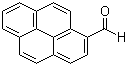 |
| Molecular Formula | C17H10O |
| Molecular Weight | 230.26 |
| CAS Registry Number | 3029-19-4 |
| EC Number | 221-196-6 |
| SMILES | C1=CC2=C3C(=C1)C=CC4=C(C=CC(=C43)C=C2)C=O |
| Density | 1.3±0.1 g/cm3 Calc.* |
|---|---|
| Melting point | 123 - 126 °C (Expl.) |
| Boiling point | 438.2±14.0 °C 760 mmHg (Calc.)* |
| Flash point | 294.6±6.3 °C (Calc.)* |
| Index of refraction | 1.875 (Calc.)* |
| * | Calculated using Advanced Chemistry Development (ACD/Labs) Software. |
| Hazard Symbols |  GHS07 Warning Details GHS07 Warning Details | ||||||||||||||||||||
|---|---|---|---|---|---|---|---|---|---|---|---|---|---|---|---|---|---|---|---|---|---|
| Risk Statements | H315-H319-H335 Details | ||||||||||||||||||||
| Safety Statements | P261-P264-P264+P265-P271-P280-P302+P352-P304+P340-P305+P351+P338-P319-P321-P332+P317-P337+P317-P362+P364-P403+P233-P405-P501 Details | ||||||||||||||||||||
| Hazard Classification | |||||||||||||||||||||
| |||||||||||||||||||||
| SDS | Available | ||||||||||||||||||||
 chemBlink Chemical Story
|
1-Pyrenecarboxaldehyde is an aromatic aldehyde derived from pyrene, a polycyclic aromatic hydrocarbon consisting of four fused benzene rings arranged in a compact planar structure. In this compound, a formyl group (–CHO) is attached to the 1-position of the pyrene framework. The molecule combines the extended aromatic system of pyrene with the reactive aldehyde functional group, giving it important applications in organic synthesis, materials science, and chemical research. Pyrene and its derivatives have been studied extensively since the development of coal tar chemistry and the identification of polycyclic aromatic hydrocarbons. The discovery and characterization of pyrene contributed to the understanding of fused aromatic ring systems and their electronic properties. As synthetic methods for aromatic functionalization advanced, substituted pyrene derivatives such as 1-pyrenecarboxaldehyde became accessible and were investigated as useful intermediates for introducing reactive functional groups into the pyrene structure. The molecular structure of 1-pyrenecarboxaldehyde consists of a rigid pyrene core connected to an aldehyde group. The pyrene portion contains a large conjugated pi-electron system formed by fused aromatic rings. The extended conjugation allows delocalization of electrons throughout the aromatic framework and gives the compound characteristic optical and electronic properties associated with polycyclic aromatic hydrocarbons. The aldehyde group provides a chemically active site for further transformation. The carbonyl carbon of the aldehyde is electrophilic and can participate in reactions with nucleophiles. The aldehyde functionality can undergo oxidation to form carboxylic acids, reduction to produce alcohol derivatives, and condensation reactions with amines or other reactive compounds to generate more complex molecules. A major application of 1-pyrenecarboxaldehyde is as a synthetic intermediate in the preparation of functionalized pyrene derivatives. Chemists use this compound as a starting material for attaching additional chemical groups to the pyrene framework. Such modifications allow researchers to design molecules with specific optical, electronic, or biological properties. The compound has been particularly important in the development of fluorescent materials and molecular probes. Pyrene derivatives are widely studied because their extended aromatic systems exhibit characteristic fluorescence behavior. By introducing functional groups such as aldehydes, researchers can modify the pyrene structure and connect it with other molecular components used in sensors, imaging agents, and supramolecular systems. In materials chemistry, pyrene-based compounds have been investigated for applications involving organic electronic materials, molecular recognition systems, and nanostructured materials. The rigid aromatic framework of pyrene provides a stable platform for constructing molecules that rely on pi-stacking interactions and electronic communication between aromatic units. 1-Pyrenecarboxaldehyde serves as a useful precursor for preparing such advanced derivatives. The aldehyde functionality also enables the formation of Schiff bases and other condensation products. These derivatives have been studied in coordination chemistry and materials research because they can provide additional binding sites or modify the electronic properties of the pyrene framework. The physical properties of 1-pyrenecarboxaldehyde are strongly influenced by its fused aromatic structure. The pyrene core contributes rigidity, planarity, and hydrophobic character, while the aldehyde group introduces polarity and chemical reactivity. The molecule does not contain hydrogen bond donor groups but can participate in hydrogen bonding as an acceptor through the carbonyl oxygen. The compound has also been studied as part of broader research on polycyclic aromatic hydrocarbon derivatives. Functionalized pyrenes are useful models for investigating aromatic electronic structures, fluorescence mechanisms, and molecular interactions. Overall, 1-pyrenecarboxaldehyde is an important functionalized pyrene derivative whose significance arises from the combination of a highly conjugated aromatic framework and a versatile aldehyde group. Its main applications are as an intermediate for synthesizing fluorescent molecules, advanced aromatic materials, and other functional organic compounds used in chemical research and materials development. References 2026. Interface Engineered Spinning of Carbon Nanotube Fiber for Fabrication of Unprecedentedly High-Performance Cu/Carbon Nanotube Fibers. Advanced Fiber Materials. DOI: 10.1007/s42765-025-00666-y 2026. Polymeric micellar sensor for nitroaromatic pesticide detection. MRS Communications. DOI: 10.1557/s43579-025-00918-3 2025. Ratiometric Pyrene-Based Fluorescent Probe for Rapid Visualization of Hypochlorous Acid in Cells. Journal of Fluorescence. DOI: 10.1007/s10895-025-04430-8 |
| Market Analysis Reports |